
Civilian casualties mount amid Indo-Pak conflict
Diplomatic Correspondent :
Tensions between nuclear-armed neighbours India and Pakistan have sharply escalated over the past 48 hours, plunging South Asia into one of the most dangerous confrontations in recent years.
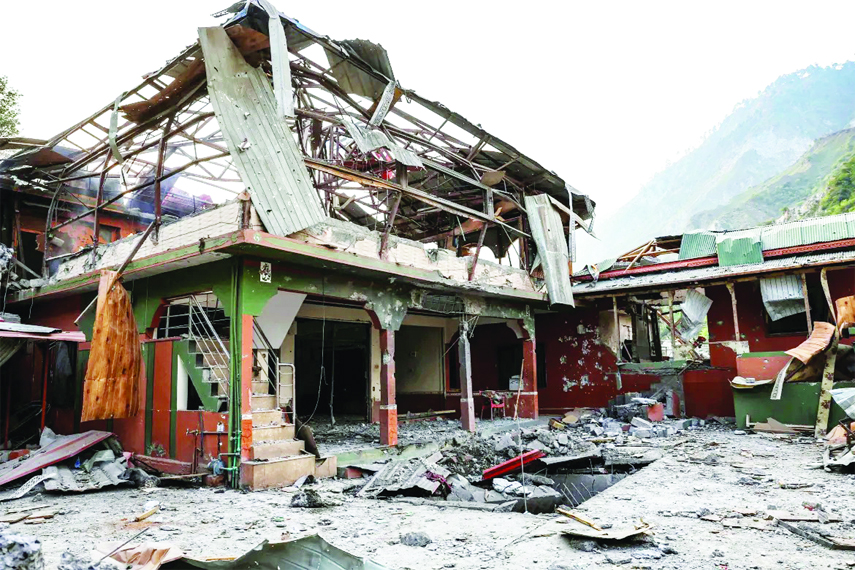
The latest wave of cross-border violence has led to dozens of civilian casualties, downed fighter jets, canceled flights, and growing calls for restraint from the international community.
According to Pakistani authorities, 31 civilians have been killed and dozens injured following Indian airstrikes in Pakistan and Pakistan-administered Kashmir.
India, meanwhile, reports that 16 people, including a soldier, three women and five children have died in cross-border attacks it attributes to Pakistan.
Pakistani Prime Minister Shehbaz Sharif, addressing a tense parliament, claimed that Pakistani forces had downed five Indian fighter jets in response to India’s air assault.
India maintains that its strikes targeted “terror training camps,” while Pakistan accuses New Delhi of bombing civilian areas and mosques – branding the attacks an “act of war.”
In an emergency meeting, Pakistan’s National Security Committee gave the green light for military retaliation “at a time, place, and manner of its choosing.”
Defence Minister Khawaja Asif reiterated Islamabad’s desire to avoid full-scale war but underscored the country’s readiness for one.
The volatile situation has already affected civilian life. Ninety flights were canceled at Delhi airport, and 27 airports across India were closed as a precaution.
A major IPL cricket match scheduled in Dharamsala has been relocated to Ahmedabad due to security concerns.
Amid the military escalation, diplomatic efforts are being cautiously revived. Pakistan’s Foreign Minister Ishaq Dar confirmed that the national security advisers of both countries – Lt Gen Asim Malik (also DG ISI) and India’s Ajit Doval – have re-established communication. Additionally, the hotline between their respective director generals of military operations has been activated.
Iranian Foreign Minister Abbas Araghchi has emerged as a key diplomatic player, visiting both Islamabad and New Delhi in an apparent bid to mediate.
Iranian officials are reportedly offering to facilitate peace talks, with backing from Turkiye, Qatar, and the UAE. Araghchi’s arrival in New Delhi on Thursday follows meetings in Pakistan with its top civilian and military leadership.
Pakistan’s Inter-Services Public Relations (ISPR) claims to have shot down 25 Israeli-made Harop drones launched by India, using both soft-kill and hard-kill tactics.
“The Pakistan armed forces, using their soft-kill (technical) and hard-kill (weaponised) skills fully, have shot down 25 Israeli-made Harop drones sent by India,” ISPR said.
Indian forces, in turn, report intercepting multiple Pakistani aerial threats overnight and striking radar installations inside Pakistan. Pakistan’s military also stated it downed 12 more Indian drones, including one that struck near Lahore, and reported injuries among its troops.
On the diplomatic front, India’s External Affairs Minister S. Jaishankar at the 20th India-Iran Joint Commission meeting on Thursday told Iranian Foreign Minister Abbas Araghchi, “Our response was targeted and measured. It is not our intension to escalate this situation.”
“However, if there are military attacks on us, there should be no doubt that it will be met with a very very firm response. As a neighbour and close partner, it is important that you have a good understanding of this situation,” he continued.
Meanwhile, Wing Commander Vyomika Singh of the Indian Air Force said the Indian Armed Forces remain committed to non-escalation, provided this stance is reciprocated by the Pakistani military.
“Indian Armed Forces reiterate their commitment to non-escalation, provided it is respected by the Pakistani military,” she said in the special Ministry of External Affairs briefing.
“Pakistan has increased the intensity of its unprovoked firing across the Line of Control using Mortars and heavy calibre Artillery in areas in Kupwara, Baramulla, Uri, Poonch, Mendhar and Rajouri sectors in Jammu and Kashmir,” she said.
Meanwhile, Pakistan’s parliament convened to discuss the crisis, condemning what it called India’s “baseless” allegations linking Pakistan to the recent Pahalgam attack, and criticizing India’s suspension of the Indus Water Treaty as a “blatant violation.”
With mounting casualties and increasing international anxiety, all eyes are on New Delhi and Islamabad as the region stands on the brink. While both sides claim military preparedness, diplomatic channels are cautiously being reactivated, offering a narrow window for de-escalation before the conflict spirals further.
Meanwhile, Nobel Peace Prize laureate Malala Yousafzai appealed to India and Pakistan to de-escalate rising tensions between the two countries.
In a post on X, Yousafzai said, “Hatred and violence are our common enemies, not each other.”
“I strongly urge leaders in India and Pakistan to take steps to de-escalate tensions, protect civilians – especially children – and unite against the forces of division,” she said.
Urging the global community to step in and encourage diplomatic efforts, she said, “The international community must act now to promote dialogue and diplomacy. Peace is the only way forward for our collective security and prosperity.”
Meanwhile, Deputy Prime Minister and also Foreign Minister of Pakistan briefed to the Islamabad-based Ambassadors on India aggression against Pakistan, stating that India violated Pakistan’s sovereignty, and endangered regional peace and stability.
“These unprovoked and unjustified attacks deliberately targeted the civilian areas – on the false pretext of presence of terrorist infrastructure – resulting in the martyrdom of innocent men, women, and children,” he said.
“The international community should hold India accountable for its irresponsible, unlawful and belligerent conduct,” he concluded.
The US Consulate General in Lahore, Pakistan, has directed its staff to shelter in place amid reports of drone explosions, downed drones and possible airspace incursions, the State Department said.
The consulate said it has also received initial reports that authorities may be evacuating some areas adjacent to Lahore’s main airport, according to a statement.
Meanwhile, World powers – including the UK, France, Germany, Iran, Turkiye, Qatar and the UAE – have urged both nuclear-armed nations to show restraint and return to diplomacy.