
China-BD symposium to facilitate healthcare and education
Staff Reporter :
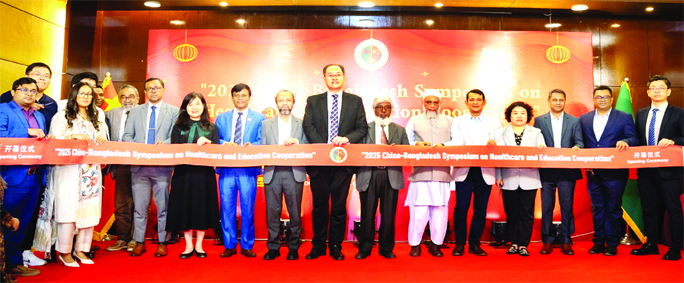
Bangladesh and China, policymakers, scholars and medical professionals from both nations convened for the 2025 China-Bangladesh Symposium on Health and Education Cooperation, held in the capital, on Thursday.
The day-long gathering brought renewed focus to joint efforts in strengthening healthcare services, promoting medical education and enhancing academic exchange.
With new projects underway – from advanced medical equipment support to expanding Confucius Institutes and collaborative university programmes – the symposium highlighted how bilateral cooperation is increasingly touching the lives, careers and wellbeing of people across both countries.
The symposium was inaugurated by Li Shaopeng, Cultural Counsellor of the Chinese Embassy, who served as the Chief Guest. Welcoming experts and scholars from the health and education sectors, colleagues working in these fields, leaders of relevant institutions who had specially come from China, representatives of Chinese organisations in Bangladesh, and friends supporting China-Bangladesh friendship, Cultural Counsellor Li Shaopeng said health and education are two enduring themes in the development of human society. They are the foundation for a country’s prosperity and national rejuvenation – one focusing on physical well-being and the other on spiritual enrichment and wisdom.
“These two areas are also indispensable parts of the exchanges and cooperation between China and Bangladesh. They not only bring the benefits of our friendship to every citizen but also reflect the importance of the strong relationship between our two countries for social progress and prosperity,” he said. Calling China and Bangladesh good neighbours who support each other and good partners who move forward together, Li said the friendly exchanges between the two countries have lasted for thousands of years.
This year marks the 50th anniversary of diplomatic relations between China and Bangladesh and the China-Bangladesh People-to-People Exchange Year.
Under the strategic guidance of their leaders, the relationship has deepened in all fields, with particularly fruitful results in health and education, he added.
“In the field of health, this year we opened up medical treatment in China for Bangladeshi citizens. China donated the world’s most advanced robotic rehabilitation physiotherapy equipment to Bangladesh and, responding to Bangladesh’s urgent needs, sent a medical team of burn experts,” he said.
Sharing details of support for dengue fever and COVID-19 test kits, Li said the burn unit at Chittagong Medical College Hospital – a China-aided project – has already begun construction, and China plans to build a modern general hospital with 1,000 beds in Rangpur.
“Two days ago, we witnessed the unveiling of the China-Bangladesh Joint Cardiovascular Disease Clinic between Fuwai Yunnan Hospital, Chinese Academy of Medical Sciences, and the Bangladesh National Institute of Cardiovascular Disease and Hospital. The mobile medical surgical vehicle donated by China to Bangladesh is also on its way,” he added.
He said these initiatives demonstrate the deep affection of the Chinese government and people toward Bangladesh, showing that the friendship between the two countries is rooted in the people, for the people, and supported by all.
In the field of education, he said more and more Bangladeshi citizens are eager to learn Chinese. “We already have three Confucius Institutes and one Confucius Classroom in Bangladesh, with two more added this year – the highest number of new Confucius Institutes established this year. Next month, the Chinese government will send three volunteers to teach Chinese in more schools. Nearly 100 Chinese and Bangladeshi universities have signed cooperation agreements,” he said.
Li Shaopeng said thousands of Bangladeshi students study in China every year, and more experts from both countries exchange visits and conduct joint research. Some universities have even begun pilot projects on joint curriculum development and mutual credit recognition.
“We also plan to set up ‘Chinese Language Workshops’ and ‘Luban Workshops’ in Bangladeshi universities to provide ‘Chinese + Vocational Skills’ education. The educational cooperation between China and Bangladesh not only builds bridges for academic exchanges but also expands academic and career opportunities for young students, significantly enhancing their professional skills and technical abilities,” he added.
He expressed hope that these engagements would further enhance healthcare and education in both countries, improve the well-being of the peoples, and contribute to building a China-Bangladesh community with a shared future.
Nahar Khan, Founder and CEO of Cosmos Health, noted that China remains “consistently among the top sources of foreign medical graduates practicing in Bangladesh,” and has long supported the country with medical supplies, equipment, and the deployment of doctors during critical moments.
She underscored that this cooperation comes at a decisive moment for Bangladesh’s healthcare system. Workforce models based on WHO-recommended staffing ratios indicate that the country could require up to 400,000 additional healthcare professionals by 2032 to meet the needs of a growing population. Against this backdrop, she stressed that Bangladesh and China have enormous potential to deepen their collaboration – from capacity-building exchanges and advanced medical education partnerships to joint research and innovation centers, technology transfer, and expanded cross-border health initiatives that can accelerate system-wide transformation.
“Cosmos Health aims to support Bangladesh’s evolution toward a more modern, efficient, and accessible healthcare system,” she added.
Dr Md Zainal Abedin Tito, Line Director of Hospital Services Management (DGHS); Brig Gen Md Munirul Islam, Director General of BKSP; Dr Fakrul Islam, Secretary of UGC; and Professor Dr Md Abu Hashan Bhuiyan, Vice Chancellor of UITS; along with Nahar Khan, Founder and CEO of Cosmos Health, attended the event alongside representatives from BRAC University, Dhaka University, NSU, SUST, DMCH and various Chinese healthcare groups.
Following the inauguration, guests visited 11 exhibition booths showcasing services and opportunities from Chinese government scholarship programmes, Guangzhou Fosun Chancheng Hospital, Modern Cancer Hospital Guangzhou, Evercare Hospital, BRAC University, Daffodil University, Belt & Road Healthcare Center, Hope Education, MalishaEdu and others.
Four thematic forums highlighting challenges and scope of Education and health held.
The day-long symposium featured four forums focusing on healthcare collaboration, medical education and people-to-people exchanges.
Speakers noted a rising number of Bangladeshis travelling to Chinese medical hubs such as Kunming and Guangzhou for advanced but affordable treatment. Experts from Fosun Chancheng Hospital, Fuxing Health, the Chinese Medical Alumni Association and the Belt and Road Healthcare Center highlighted developments in medical tourism, telemedicine and robotic-assisted care.
Moderator Dr Abu Kausar of Long Life Hospital said streamlined visa processing and direct hospital coordination have already benefited hundreds of Bangladeshi patients this year.
Wu Yaobo (Bob Wu), Director of Hospital Operations, Guangzhou Fosun Chancheng Hospital; Pan Wei, Vice General Manager, International Cooperation Department, Fuxing Health; Dr Ahmed Sharif, President, Chinese Medical Alumni Association of Bangladesh; Dr Sumon Rahman Chowdhury, Bangladesh China Postgraduate Doctors Alumni Association; and Dr Maruf Mollah, Co-founder and CEO, Belt & Road Healthcare Center, joined the discussion.
Participants underscored expanding institutional partnerships and highlighted the recent establishment of the China-Bangladesh Joint Cardiovascular Disease Clinic at NICVD in collaboration with Fuwai Yunnan Hospital.
Panelists from DMCH, Cosmos Health and Chinese medical technology companies called for greater joint research, technology transfer and specialised training for Bangladeshi doctors.
Prof Bulbul Ashraf Siddiqi, Local Director, Confucius Institute at North South University, hosted the session. Brig Gen Md Munirul Islam, Director General, Bangladesh Krira Shikkha Protishthan (BKSP); Dr Md Ashraful Alam, Deputy Director, Dhaka Medical College Hospital (DMCH); Prof Dr Abdullah Shahriar, Child Specialist & Paediatric Cardiologist, National Institute of Cardiovascular Diseases & Hospital; Prof Dr M.A. Shakoor, Physical Medicine & Rehabilitation Specialist, Bangladesh Medical University Hospital; Chinese doctor Dr Guo Yulong; Jack Zhang, Co-founder and General Manager, Damiang Medical Technology (Suzhou) Co., Ltd; and Ms Nahar Khan, Founder and CEO, Cosmos Health, participated.
Education experts discussed scholarship schemes, university admission routes and growing academic ties. China remains one of the top destinations for Bangladeshi students, and speakers said graduates from Chinese universities are increasingly finding employment in engineering, IT, medical and business sectors in Bangladesh.
Dr Maruf Mollah, Managing Director of MalishaEdu, hosted this session while Prof Dr Md Zulfeqar Haider, Director General, National Academy for Education Management (NAEM); Dr Fakrul Islam, Secretary, University Grants Commission Bangladesh (UGC); Prof Dr Shahab Ul Haque, Department of Political Science, Shahjalal University of Science and Technology and Secretary, Association of Bangladesh-China Alumni (ABCA); Mohiuddin Taher, Adviser to Chairman, Shanto-Mariam University of Creative Technology and Bangladeshi Director, Shanto-Mariam Honghe Confucius Classroom; Li Wenhao, South Asia General Manager, Hope Education Group; Syed Raihan-Ul-Islam, Deputy Director, International Department, Daffodil International University; and Prof Dr Mohammad Absar Kamal, Director, Institute of Modern Languages and Local Director, Confucius Institute, University of Dhaka, took part in the discussions.
Academics from Dhaka University, UITS, BRAC University, the International Mother Language Institute and Confucius Institutes highlighted areas of long-term collaboration including language programmes, cultural exchanges and joint degree initiatives. They stressed that stronger educational linkages will help develop skilled professionals for both countries.
Prof Yang Hui, Dean, Confucius Institute, Dhaka University, hosted the forum. Prof Dr Md Abu Hashan Bhuiyan, Vice-Chancellor, UITS; Ariful Islam, Treasurer, BRAC University; Dr Shamsad Mortuza, Professor of English, Dhaka University; Prof Dr Mohammad Ashaduzzaman, Director, International Mother Language Institute; and Ma Xiaoyan, Chinese Director, Confucius Institute at North South University, joined the session.
The symposium concluded with a networking dinner. Organisers said the platform will continue to promote cooperation in medical services, healthcare investment, academic partnerships and educational exchange between Bangladesh and China.