
Child labour persists despite laws and policies: Study warns
Staff Reporter
Child labour remains a serious and persistent challenge in the country, with millions of children continuing to work despite existing laws, policies and international commitments, a new study said.
The findings raise concerns about the country’s ability to achieve its goal of eliminating child labour by 2030.
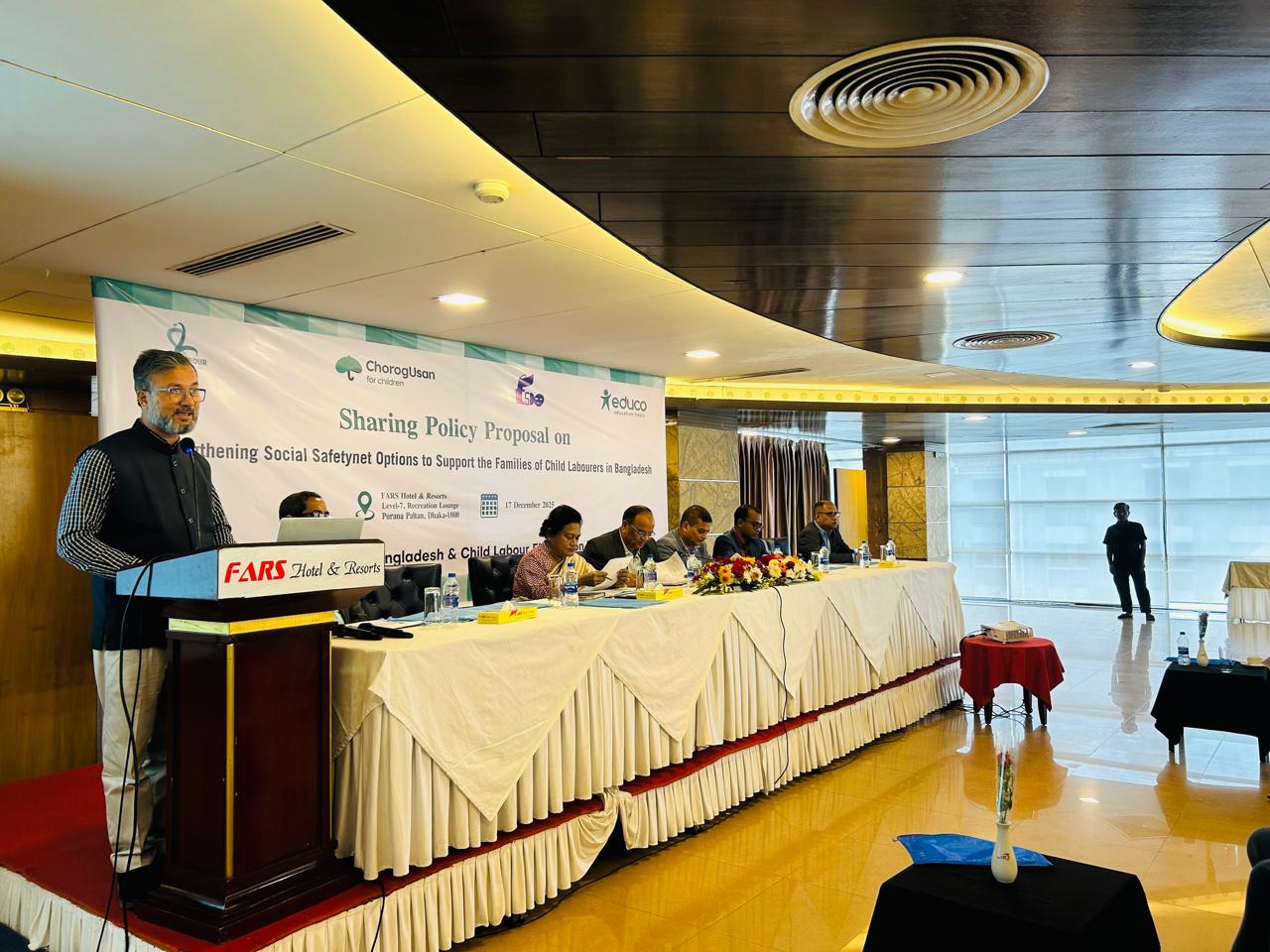
The study, Strengthening SSNP Options to Support the Families of Child Labourers in Bangladesh, was presented by Dr Khondaker Golam Moazzem, Research Director of the Centre for Policy Dialogue, at a city hotel on Wednesday.
The event was organised by the Educo Bangladesh and the Child Labour Elimination Platform (CLAP), with Afzal Kabir Khan, Manager of Educo Bangladesh, presided.
Among others present at the event were Additional Secretary of the Ministry of Social Welfare Md Kamal Uddin Biswas, Mohammad Mozammel Haque, Joint Secretary of the Ministry of Labour and Employment, Advocate Salma Ali, Co-Chair of the Child Labour Monitoring Council, Md Shahidul Islam of Educo Bangladesh, and representatives from academia, civil society and child rights organisations.
Using data from the Bangladesh Bureau of Statistics 2022, the study reports that about 3.54 million children are engaged in work, of whom 1.77 million are classified as child labourers. More than one million children are involved in hazardous occupations that threaten their health, safety and development.
Although Bangladesh has ratified the UN Convention on the Rights of the Child and key International Labour Organization conventions, and has laws such as the Children Act 2013 and the National Child Labour Elimination Policy 2010, the study finds that child labour has not declined as expected.
Weak enforcement, poor coordination among agencies and limited coverage of social safety net programmes have reduced the effectiveness of these commitments.
The study shows that child labour is no longer confined to rural areas. While rural participation remains high due to agriculture and seasonal work, urban child labour has increased, driven largely by informal service-sector activities such as domestic work, street vending, scrap collection and employment in small workshops. Industry and service sectors account for the highest share of hazardous child labour.
Gender and social norms also distort the real picture. Boys make up a larger share of recorded child labourers, while girls are often excluded from statistics due to early marriage and underreporting.
The study notes that falsified age documents frequently lead to misclassification during labour inspections, weakening protection and enforcement.
District-level analysis reveals wide regional disparities, with Mymensingh (8.19%), Dhaka (5.74%) and Chattogram (4.85%) showing higher proportions of child workers.
Districts reporting low prevalence may still have hidden child labour, particularly in domestic and informal work, while data gaps in some regions suggest limitations in monitoring.
According to the study, poverty remains the main driver of child labour, worsened by economic shocks following the Covid-19 pandemic, rising unemployment and political instability.
Many families with working children are trapped in regular debt, while street children and those living away from parents remain largely outside existing social protection systems.
To address the problem, the study calls for stronger enforcement of labour laws alongside improved social protection.
Speaking as chief guest, Kamal Uddin Biswas said the UN Sustainable Development Goals clearly call for ending “the recruitment and use of child labour, exploitation, trafficking, all forms of violence and abuse, and all forms of child labour”.
He added that the government remained committed to achieving the SDG targets and had taken a number of initiatives, projects and programmes across different ministries to eliminate child labour.
He noted that in the current fiscal year, nine programmes for school-going children had been allocated Tk 9,790 crore, which accounts for 8.37 per cent of the total social protection budget.
However, he acknowledged that there was no allocation for out-of-school children and pledged to take steps to implement recommendations to increase support for them.
Associate Professor Md Aurongajeb Akond of Mawlana Bhashani Science and Technology University stressed the need for universal child benefits and adequate social protection.
He said investment in quality education must increase and all children, including those currently out of school, should be brought back into the education system.
He also called for decent employment opportunities for adults so that families are not forced to rely on children to boost household income, alongside increased investment in child protection, agricultural development, rural services, infrastructure and livelihoods.
Afzal Kabir Khan said a strong social protection system was essential to eliminate child labour. He noted that social security programmes reduce household poverty risks and help families cope with economic or health shocks, thereby lowering reliance on child labour.
Such programmes also support school enrolment and continued education, he said, adding that both the coverage of social safety nets and support for families of child labourers must be expanded.
Educo Bangladesh Director Abdur Rahim highlighted that social protection for children safeguards both human rights and the economy. He observed that Bangladesh’s social protection system is highly fragmented, with programmes often poorly linked to one another. Many initiatives have overlapping objectives but limited budgets and coverage, underscoring the urgent need for a more coordinated and integrated approach.