
Iran-Israel Conflict: Ceasefire announced amid hostilities
Abu Jakir :
After nearly two weeks of fierce hostilities between Israel and Iran, US President Donald Trump on Tuesday announced a ceasefire agreement between the two regional arch-rivals, raising hopes for an end to the bloodshed that has shaken the Middle East and alarmed the international community.
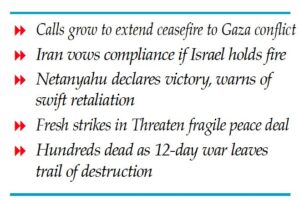
However, despite diplomatic breakthroughs, incidents of violence and mutual accusations continue to test the fragile peace.
Speaking to reporters aboard Air Force One, President Trump confirmed that both Israel and Iran had agreed to the ceasefire deal brokered by the United States in collaboration with Qatar.
Trump urged both sides to “respect the truce fully” and declared that now was the time for diplomacy, not war.
“I’m really unhappy with Israel,” Trump said, expressing frustration over reports of Israeli airstrikes even after the ceasefire took effect. “Bring your pilots home, now,” he added bluntly, signaling a rare rebuke of a close US ally.
The ceasefire agreement was reportedly finalized after intensive back-channel negotiations led by Qatari officials with Tehran, followed by direct communications between Trump and Israeli Prime Minister Benjamin Netanyahu.
Prime Minister Netanyahu confirmed Israel’s acceptance of the ceasefire but maintained a defiant tone.
“Israel has achieved its military objectives in this campaign,” he said, citing the destruction of key Iranian nuclear facilities and missile sites. However, he issued a stern warning: “Any violation of this ceasefire by Iran will be met with overwhelming force.”
Netanyahu’s office stated that following a personal call from President Trump, Israel had refrained from further planned strikes on Iranian targets, including sites in and around Tehran.
On the Iranian side, President Masoud Pezeshkian welcomed the ceasefire but made it clear that Iran’s commitment was conditional on Israel’s adherence to the deal. “Iran will not violate the ceasefire unless Israel does,” Pezeshkian stated via Iran’s state-run Nournews agency.
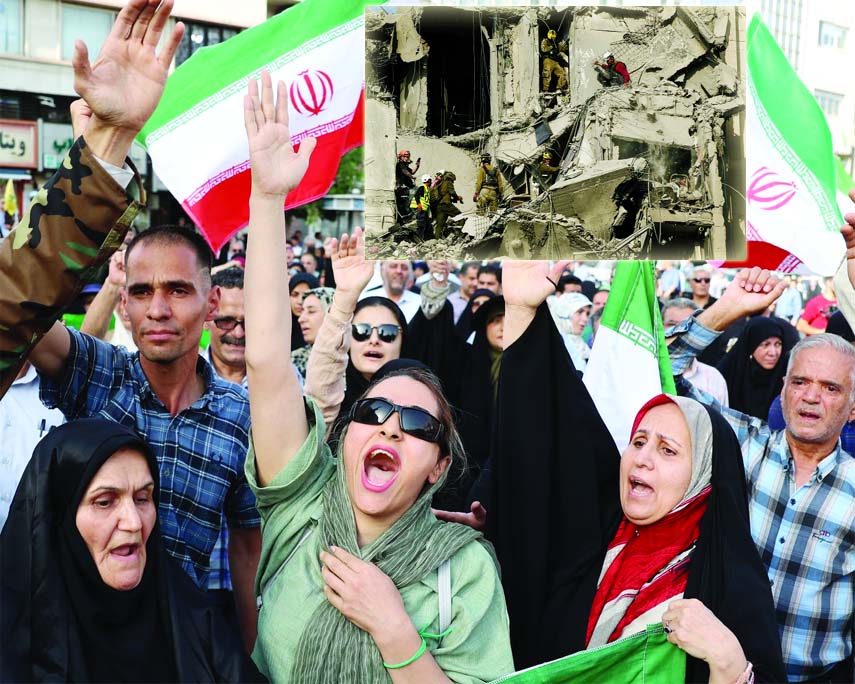
Meanwhile, Iranian officials celebrated what they called a strategic victory. Vice President Mohammad Reza Aref declared that the agreement marked “the breaking of the horn of the US and Israel in the region,” while Mahdi Mohammadi, senior aide to Iran’s parliamentary leadership, described the outcome as “history-making.”
Spokesman for Iran’s Atomic Energy Organization, Behrouz Kamalvandi, emphasized that despite the strikes, Iran’s nuclear program would not be dismantled. “We cannot be uprooted. Our nuclear capacities will continue to develop,” he said on Iranian state television.
Even as the ceasefire was being announced, both nations accused each other of fresh violations. Israeli Defence Minister Israel Katz said Israeli jets had carried out intense strikes on Iranian military installations following what he described as “fresh Iranian provocations.”
Iran, on the other hand, denied violating the truce and instead accused Israel of attempting to sabotage the diplomatic breakthrough. Tehran warned that its armed forces remained on “full alert” and ready to retaliate.
In a further escalation, Iran fired a salvo of missiles at a US military base in Qatar on Monday, reportedly in retaliation for earlier US and Israeli strikes on Iranian nuclear facilities, including the highly sensitive Fordo and Natanz sites.
The 12-day conflict has resulted in significant human and infrastructural losses. Iranian authorities report that over 400 people, including at least 13 children, have been killed, with more than 3,000 wounded. Israeli officials said at least 24 people have died in Iranian missile strikes across various cities.
Tehran has vowed to repair its damaged nuclear infrastructure quickly. “Plans for restarting our facilities have already been prepared,” said Mohammad Eslami, head of Iran’s Atomic Energy Organization.
The conflict between Israel and Iran has reignited calls for broader regional peace. The Palestinian Authority in Ramallah welcomed the ceasefire but urged that it be extended to include the besieged Gaza Strip, where Israeli operations against Hamas continue unabated.
German Chancellor Friedrich Merz also called for a halt to the war in Gaza, stating in his national parliament: “The moment has come for a comprehensive ceasefire in the region. Israel’s right to self-defense must not compromise humanitarian obligations.”
Iraq’s Ministry of Foreign Affairs publicly praised Qatar’s diplomatic efforts, underscoring Doha’s growing influence as a regional power broker. “Qatar’s commitment to regional stability has yielded results,” Iraq’s Foreign Ministry said in a statement.
Major world powers, including the European Union, China, and Russia, have welcomed the ceasefire announcement but remain cautious about its durability given the volatile rhetoric on both sides.
As of now, the ceasefire between Israel and Iran stands on shaky ground. With unresolved grievances, damaged infrastructure, and continued military posturing, the potential for renewed conflict remains high. The coming days will be crucial in determining whether this agreement marks the beginning of a new diplomatic chapter or just another temporary pause in a long-running regional rivalry.