
Case filed against Hasina, Quader, Shamim in N’ganj
Staff Correspondent :
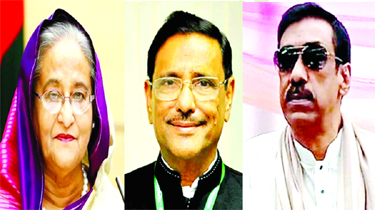
A murder case has been filed in Narayanganj over the death of Mohammad Sajib, who was shot dead during the anti-discrimination movement. Former Prime Minister Sheikh Hasina, former Bridges Minister Obaidul Quader, and former MP A.K.M. Shamim Osman are among 45 people named as accused. In addition, between 100 to 150 unidentified individuals have also been made accused in the case.
Along with Hasina, Quader, and Shamim Osman, the list of accused includes former administrator of Siddhirganj municipality and former treasurer of Krishak League Abdul Matin Pradhan; convener of Siddhirganj thana Jubo League and former councilor of Narayanganj City Corporation Ward-6, Matiur Rahman Mati; and president of Thana Chhatra League and former councilor of Ward-3, Shahjalal Badol.
On Sunday (September 7), Siddhirganj Police Station Officer-in-Charge Mohammad Shaheenur Alam confirmed the matter to the media. Earlier, the case had been officially recorded at the station on the night of September 4. The case was filed by Sajib’s father, Md. Salauddin. In the government gazette of martyrs, Sajib’s name is listed as serial number 536. After about one year and one and a half months, Salauddin filed the case in Narayanganj Court, and following the court’s directive, Siddhirganj police registered it.
The case statement also notes that leaders and activists of different levels of the Awami League participated in the attack.
According to the plaintiff, Sajib worked at “Bikrampur Hardware,” a shop inside Ahsan Ullah Super Market in Shimrail, Siddhirganj, Narayanganj. On the day of the incident, thousands of students and ordinary people were marching as part of the anti-discrimination student movement. Shops and traffic in the area were shut down. Around 11 a.m., when his shop closed, Sajib did not go home but joined the protest.
At that time, following the orders of former Prime Minister Sheikh Hasina, under the planning of former Minister Obaidul Quader, and under the leadership of Shamim Osman, the accused held several secret meetings in Narayanganj.
In those meetings, they decided to attack in order to suppress the movement. Later, they split into groups and launched assaults on protesters with modern firearms and sharp weapons.
Sajib was struck by gunfire and collapsed on the spot. He was taken to Narayanganj 300-Bed Hospital, where doctors declared him dead at 1:20 p.m.
Family members said Sajib was buried on July 22, 2024, in the family graveyard of his village. After recovering from grief, his father Salauddin collected the necessary documents and spoke to eyewitnesses. When he tried to file the case with police, they refused to accept it. He then turned to the court for justice.
The plaintiff alleged that negligence by the authorities and political pressure caused the delay in filing the case.