
Caretaker govt system returns
Staff Reporter :
In a historic decision that reshapes Bangladesh’s electoral future, the Supreme Court on Thursday restored the nonpartisan caretaker government system for overseeing smooth transfers of power — reviving a constitutional mechanism long demanded by opposition parties and civil society groups seeking credible elections.
Attorney General Md Asaduzzaman told reporters that the verdict “reinstates the previous caretaker government system,” adding that it will formally take effect within 15 days of the dissolution of the next parliament.
While the upcoming national election will be held under the current interim government led by Nobel laureate Muhammad Yunus, subsequent polls must be conducted under a caretaker administration, according to the Appellate Division’s order.
Chief Justice Syed Refaat Ahmed delivered
the unanimous verdict, overturning the court’s own 2011 ruling from the era of Sheikh Hasina, who was ousted last year after mass student-led protests.
The judgment followed a series of appeals and review petitions filed by the Bangladesh Nationalist Party (BNP), Bangladesh Jamaat-e-Islami, and several independent petitioners.
A Constitutional Turnaround
The restored system — introduced in 1996 but abolished by Hasina’s parliament in 2011 — had served as a buffer in Bangladesh’s turbulent political climate, ensuring neutral election-time governance.
Its removal triggered widespread opposition boycotts and cast long shadows over the 2014 and 2024 national polls, both of which were marred by allegations of partisan control and widespread irregularities.
A ruling last December declared that scrapping the caretaker mechanism had violated the basic structure of the Constitution, setting the stage for Thursday’s reversal.
The 2011 judgment had been issued by a Supreme Court bench led by then–Chief Justice ABM Khairul Haque, who is now in jail facing allegations that he played a pivotal role in prolonging Hasina’s authoritarian 15-year rule.
Praise from Petitioners and Opposition Figures
BNP Senior Advocate Zainul Abedin, who argued the party’s case, hailed the verdict as a “historic correction” of past judicial missteps. “It feels like Eid,” he told reporters. “Not only BNP, but the whole nation is elated. Through this ruling, the caretaker system has returned to the Constitution.”
He noted that the 13th Amendment, which introduced the caretaker model, had once been annulled under questionable circumstances — with the enabling amendment passed immediately after the retirement of the judge who delivered the verdict. “Today the Supreme Court has righted that wrong,” he said.
Ruhul Quddus Kazal, another senior BNP lawyer, said the verdict restores public faith in constitutionalism. “This is a victory for democracy, not for any single party,” he said.
Jamaat-e-Islami’s counsel, Shishir Monir, echoed the sentiment, emphasizing that their petition was not driven by partisan motives. “We want the state to stand on a strong democratic foundation, with constitutionalism taking firm root,” he said. “This is about Bangladesh, not BNP or Jamaat.”
Civil society figures also welcomed the ruling. Senior lawyer Sharif Bhuiyan of Sujan said the Appellate Division had finally repaired the damage caused by the 2011 decision. “Today is a truly historic day for Bangladesh — and for our beloved Supreme Court,” he said.
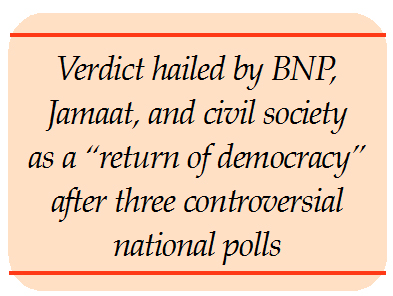
Badiul Alam, another prominent governance advocate, warned that abolishing the caretaker system had “exiled the election process,” producing three consecutive disputed elections. “With this verdict, a path toward free and fair elections has reopened,” he said.
A Blow to the Previous Regime
The decision also revives scrutiny of Hasina’s long tenure. After fleeing to India in August last year, following the fall of her government, she left behind a constitutional landscape shaped by years of executive dominance.
Her party had justified the abolition of the caretaker system by arguing that it prevented “unconstitutional forces” from taking power. Opposition parties countered that the move was designed solely to cement political control.
BNP Senior Joint Secretary General Ruhul Kabir Rizvi said the reinstatement of the caretaker system would help block “the path to fascism” and prevent the re-emergence of authoritarian rule. “Sheikh Hasina abolished it only to cling to power,” he said.
Islami Andolan Bangladesh’s senior leader Mufti Syed Muhammad Faizul Karim declared that the restored caretaker system is essential for ensuring “free, fair, and credible elections,” calling its previous abolition “forcible” and detrimental to public interest.
A Turning Point for Democratic Transition
The verdict comes at a sensitive moment. Bangladesh is governed by an interim administration led by Muhammad Yunus, which came to power following mass unrest and the collapse of the Awami League’s long rule.
Although the next general election will be held under this interim authority, the restoration of the caretaker system signals a deeper structural shift in Bangladesh’s political order.
For many, the decision rekindles hopes of a more stable electoral future. For others, it reopens old debates over the balance between elected governments and technocratic oversight.
But on one point, Thursday’s judgment was clear: the nonpartisan caretaker government — once the backbone of Bangladesh’s most credible elections — is back in the Constitution. And with it, the promise of a more neutral, accountable political transition has returned to the center of the country’s democratic aspirations.