
Begum Rokeya Day 2025: CA urges women-led ‘new BD’
Staff Reporter :
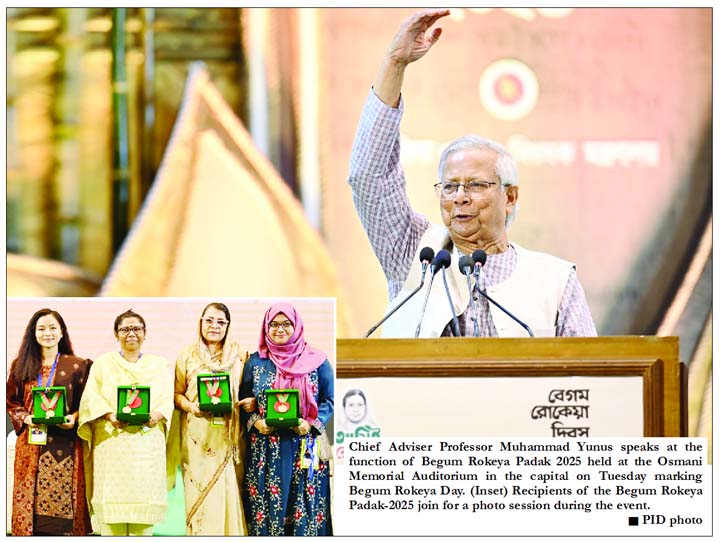
Chief Adviser Professor Muhammad Yunus yesterday called for placing women at the heart of rebuilding the “new Bangladesh” in the post-uprising era, urging the nation to draw strength from the legacy of Begum Rokeya and the struggles she championed more than a century ago.
Speaking at the Begum Rokeya Padak 2025 ceremony at the Osmani Memorial Auditorium, Prof Yunus said women had played a defining role in the July 2024 uprising that toppled the previous regime, and that their leadership must now guide the country’s reconstruction.
He described today’s women as fundamentally transformed, shaped by their participation in the events of last year.
“The post-uprising women’s society is the one to build the new Bangladesh,” he said. “They are inspiring not only for women but for all. We need to uphold them.”
The Chief Adviser presented this year’s Begum Rokeya Padak awards and said the recipients had elevated Bangladesh’s standing on the global stage.
Calling the award “epoch-making,” he said the laureates were not only capable of leading the country but also of providing leadership to the world.
He urged citizens and institutions to revive the true spirit of Rokeya’s activism, saying that over time society had narrowed her legacy to literature alone, overlooking the radical urgency of her ideas.
“Even after 100 years, we have not been able to create another Rokeya. This is our misfortune,” he said. “We have talked but have not been able to move forward. We must find out why.”
Reflecting on the need for bold vision, Prof Yunus said Bangladesh must embrace modern technology and foster a culture where women and girls are encouraged to lead without hesitation.
He noted that the country has made significant progress in girls’ education and women’s participation in various sectors, but added that equal opportunities across all spheres remain essential if Bangladesh is to fulfil Rokeya’s aspirations.
The Chief Adviser also recalled his early work during the 1974 famine, when he was a professor at Chattogram University and began engaging with impoverished women in Jobra village. He described finding women without personal identity, known only as someone’s wife, daughter or mother.
He spoke about how the initiative that later evolved into Grameen Bank began by giving these women their own names, literacy training and financial access.
“This was the scenario a hundred years after Begum Rokeya began her struggle for women’s rights,” he said, adding that the fight for identity, autonomy and dignity remains unfinished.
In a symbolic announcement, Prof Yunus declared that the Ministry of Women and Children Affairs will now be known in Bangla as Nari O Shishu Mantranalay, replacing the previous Mohila O Shishu Mantranalay — a change he said better reflects the country’s shifting social consciousness.
This year’s Begum Rokeya Padak was awarded to Dr Rubhana Rakib for contributions to women’s education and research, labour rights leader Kalpana Akter for her work on women workers’ rights, human rights activist Dr Nabila Idris, and national footballer Ritu Porna Chakma for her role in advancing women’s awakening in sports.
Women and Children Affairs Adviser Sharmeen S Murshid chaired the ceremony, which was attended by members of the interim government, prominent rights advocates and the families of the awardees. Senior Secretary Mamtaz Ahmed delivered the welcome address.
The event featured a cultural programme and a screening of Ami-e Rokeya, a documentary highlighting Rokeya’s pioneering work in promoting women’s education and combating child marriage.
Throughout the ceremony, speakers emphasised that Rokeya’s revolutionary ideas remain central to the ongoing struggle for gender equality, and that the momentum generated by the post-uprising generation of women could shape Bangladesh’s future for decades to come.