
Rohingya Repatriation: CA urges global action
Staff Reporter :
Nobel Laureate and Chief Adviser to the Interim Government, Professor Muhammad Yunus, has urged urgent and coordinated international action
to secure the safe, voluntary, and dignified repatriation of Rohingyas to Rakhine State in Myanmar.
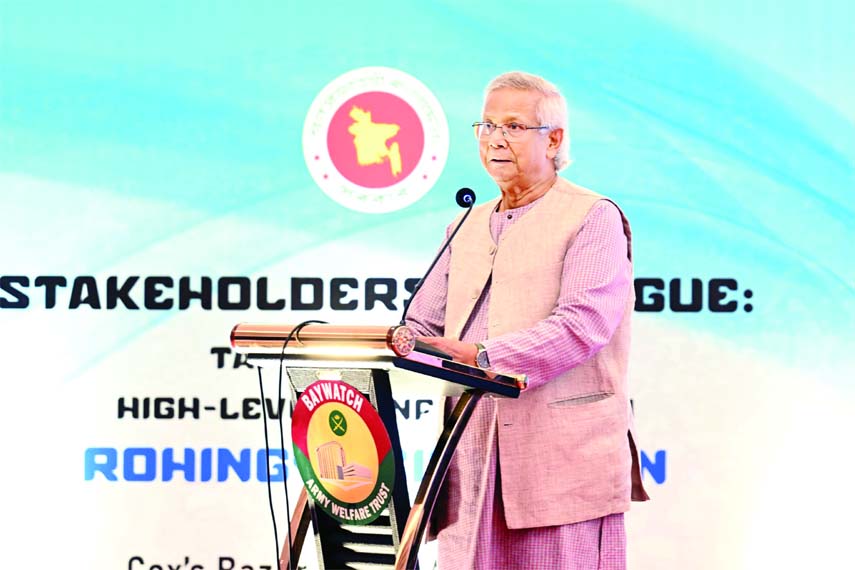
Speaking at a special session of the three-day international conference titled ‘Stakeholders’ Dialogue: Takeaways to the High-Level Conference on Rohingya Situation’ on Monday in Cox’s Bazar, Prof Yunus presented a seven-point proposal and called for global solidarity to end the prolonged humanitarian crisis.
“We must not be held hostage to mere rhetoric. The time for action is now,” he said, addressing policymakers, diplomats, UN officials, and humanitarian workers in the world’s largest refugee settlement.
Prof Yunus emphasised that the crisis, originating in Myanmar, can only be resolved within the country through international pressure and cooperative engagement.
His seven-point plan focuses on the right of return, sustained humanitarian aid, cessation of violence, inclusive dialogue, international accountability, and a strong regional role in promoting peace and security.
Highlighting the urgent need for action, he stressed that repatriation of over one million Rohingyas in Bangladesh must be carried out promptly and in a manner that preserves their dignity and rights.
“The burden of this crisis should not fall solely on Bangladesh. It is also the responsibility of the international community to share the load, consider solutions, and take active steps to implement them,” Prof Yunus said, noting that Bangladesh cannot mobilise additional resources for the 1.3 million Rohingya refugees residing in the country.
The session also marked the observance of the 8th Rohingya Genocide Remembrance Day, commemorating the mass exodus of more than 800,000 Rohingyas into Bangladesh on 25 August 2017 following military crackdowns in Rakhine State. A minute of silence was observed, and a documentary was screened, illustrating the horrors endured by the displaced community.
Prof Yunus recalled the ongoing plight of Rohingyas arriving at the border with harrowing accounts of persecution, denial of citizenship, mass killings, sexual violence, torture, and destruction of property. He warned that complacency could allow a “historic blunder” resulting in the complete ethnic cleansing of Rohingyas from Myanmar.
Key figures addressing the event included Dr Khalilur Rahman, High Representative for the Rohingya Issue and National Security Adviser of Bangladesh; Foreign Secretary Asad Alam Siam; Adviser for the Ministry of Disaster Management and Relief Faruk E Azam; Bir Protik; and UNHCR Assistant Secretary-General Raouf Mazou. They echoed the call for stronger international action to ensure accountability, humanitarian support, and eventual repatriation.
Dr Rahman urged more concrete political and operational steps from global actors, particularly Myanmar’s neighbours and ASEAN, to secure long-term peace in the region.
Prof Yunus also expressed gratitude to Bangladesh’s host communities in Cox’s Bazar for their sacrifices over the past eight years, acknowledging the immense impact on the country’s economy, resources, environment, and society. He noted that 1.3 million Rohingyas currently reside in the camps, with over 32,000 babies born annually.
Describing the ongoing dialogue in Cox’s Bazar as a stepping stone towards decisive action at the upcoming UN General Assembly session in New York, he concluded: “We cannot afford to remain silent. It is our moral responsibility to take the right side of history and prevent the armed actors from executing their horrific plan of ethnic cleansing. Let us join hands and commit to ensuring the dignified return of the Rohingya, with justice and accountability.”