
BU, Cambridge discuss impact-driven collaboration
City Desk :
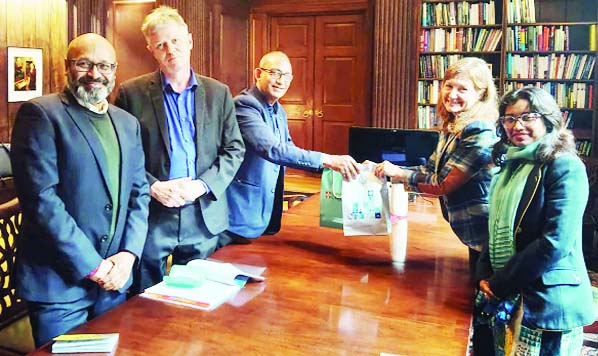
BRAC University (BU) and the University of Cambridge have recently engaged in discussions focused on collaborations to accelerate research-to-impact across health, education, wellbeing, social inclusion, industrial development and the responsible use of technology.
The partnership discussions, held at the University of Cambridge on 20 October 2025, align BRAC University’s community reach and capacity for innovation with the Cambridge’s research excellence.
In other words, it creates a disciplined pathway from discovery to deployment-testing quickly, learning transparently and implementing effectively-to deliver solutions that can be scaled and which endure.
Bangladesh has long served as a launchpad for scalable social innovation.
The collaboration will enable co-designing studies and solutions in real-world settings through a co-creation lab. Cambridge partners have shared a program to align with BRAC University’s strengths and to accelerate the first wave of projects.
Near-term priorities include formalizing joint governance, confirming the first tranche of pilots with clear success metrics for learning, health, safety, and inclusion.
Representatives from BRAC University and partners included Vice-Chancellor Prof Ferhat Anwar, Dr Imran Matin, Executive Director of the Institute of Governance and Development; Registrar Dr David Dowland, and Gemma May, Government Relations & Policy Lead, BRAC Europe.
Cambridge attendees included Vice-Chancellor Professor Deborah Prentice, Prof John Danesh, Head of the Department of Public Health and Primary Care; and Dr Nazia Habib, Director of the Centre for Resilience and Sustainable Development.
The Rt Hon Sir Andrew Mitchell MP, a former UK government minister, joined the meeting live from the House of Commons and recognized the valuable work of the BRAC movement, underscoring the global relevance of the initiative.
The BRAC University-University of Cambridge partnership directly advances several of the United Nations Sustainable Development Goals (SDGs), including 3 (Good Health and Well-being), 4 (Quality Education), 9 (Industry, Innovation and Infrastructure), and 17 (Partnerships for the Goals).
By co-creating scalable research and innovation initiatives across health, education, social inclusion, and responsible technology, the collaboration builds on Bangladesh’s legacy of social innovation to promote equitable growth and sustainable impact.