
BNP, Jamaat rift deepens as poll nears
Abu Jakir :
The long-standing alliance between the BNP and Jamaat-e-Islami, once pillars of opposition politics in Bangladesh, is now facing serious fractures as the country edges closer to its next general elections.
With the elections expected to take place by the end of this year or mid-next year, tensions between the two former allies have become increasingly visible.
For over two decades, BNP and Jamaat shared a political and electoral partnership, unified in their opposition to the Awami League. However, this relationship began to erode in 2022, when the 20-party alliance officially dissolved.
Following the student uprising on August 5, 2024, which led to the ousting of the Awami League government, BNP and Jamaat found themselves in direct contention over reforms, election schedules, and control over key government positions.
Political analysts suggest that the absence of a common adversary — the Awami League — has exposed deep-seated differences between the two parties. This was evident in recent public exchanges between their leaders, signaling a new polarization in the political landscape.
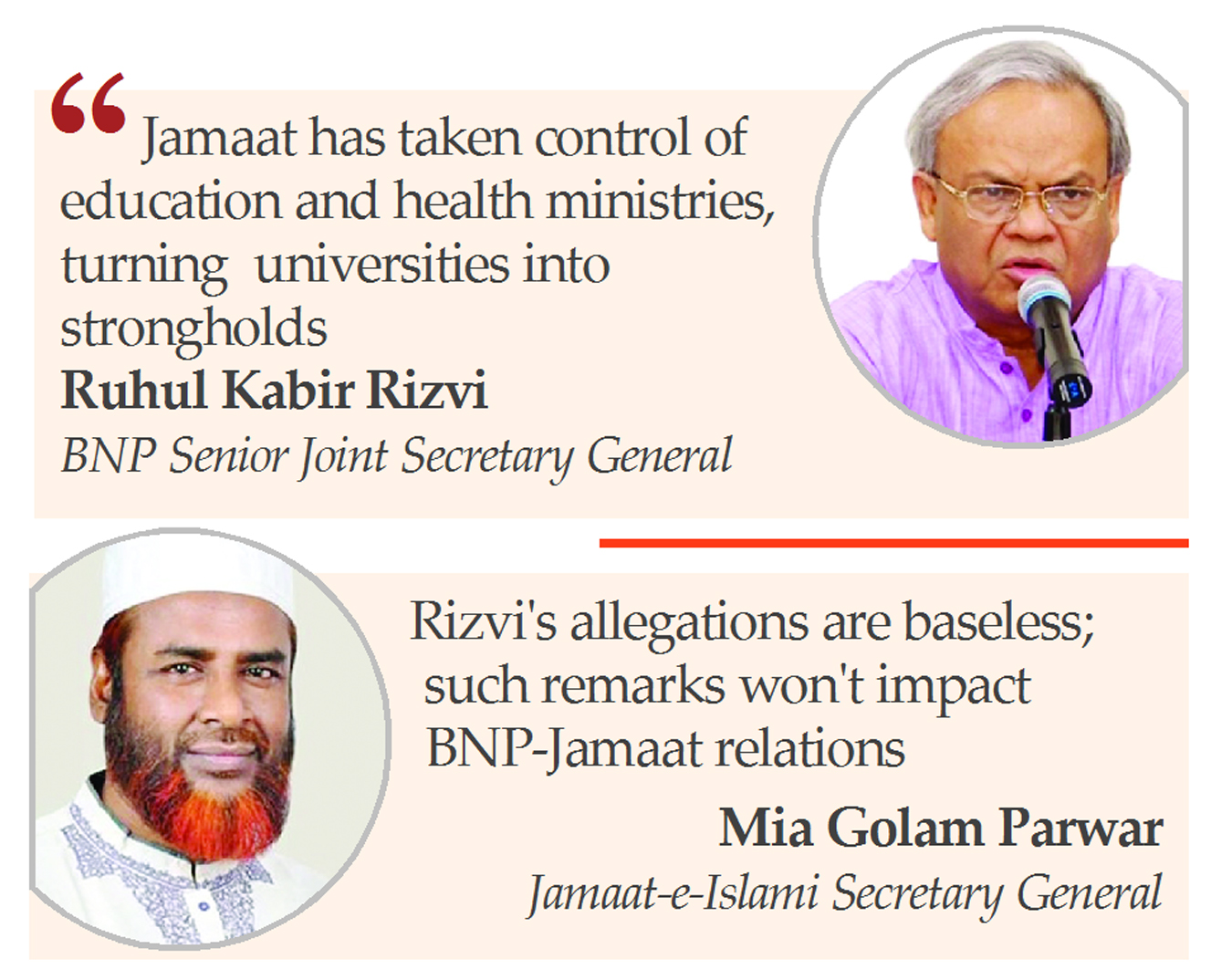
The latest example came on Tuesday, January 28, when BNP Senior Joint Secretary General Ruhul Kabir Rizvi openly questioned whether the interim government was influenced by Jamaat-e-Islami. Speaking at a discussion at the National Press Club, Rizvi alleged that Jamaat had gained control over the Ministry of Education and the Ministry of Health.
“Today, the Ministry of Health and particularly the Ministry of Education have been taken over by a specific group. Major universities have been ‘Jamaat-ized,’ as reported in the media. The entire education sector is being turned into a Jamaat stronghold,” Rizvi said. He further claimed that Jamaat-affiliated individuals had been placed in key positions within prominent universities, marginalizing BNP-backed professionals.
Jamaat Responds
Jamaat-e-Islami Secretary General Mia Golam Parwar dismissed Rizvi’s allegations as “baseless and imaginary,” suggesting they stemmed from personal animosity. Speaking to The New Nation, Parwar said, “On the contrary, I would say that many of our qualified leaders and activists have been deprived over the past 16 years.” He added, “We are not paying any heed to his [Rizvi’s] remarks, and such ridiculous statements will not affect the long-standing relationship between BNP and Jamaat.”
Clashing Priorities
The differences between BNP and Jamaat extend beyond public statements. BNP has insisted on elections following significant reforms, while Jamaat has expressed willingness to give the Prof. Muhammad Yunus-led interim government more time. Tensions further escalated when Jamaat Chief Shafiqur Rahman, in an August 26 statement, accused BNP of monopolizing power, claiming, “BNP has already grabbed 80 percent of the power.”
Rahman’s comments sparked outrage among BNP leaders, with Rizvi labeling them “ridiculous” and BNP senior leader Hafiz Uddin Ahmed questioning Jamaat’s stance on their controversial role during the 1971 Liberation War. Hafiz urged Jamaat to apologize to the public rather than justify their actions.
A Historical Shift The public disagreements mark a stark contrast to the parties’ past collaboration. BNP and Jamaat previously formed electoral alliances and worked together to challenge the Awami League’s rule.
However, as Prof. Bashir Ahmed of Jahangirnagar University’s Department of Government and Politics observes, the dynamics have changed. “The two parties no longer need each other after the political changeover on August 5, as their common political rival, the Awami League, is no longer in the scene,” he said.
This new phase of political realignment highlights a significant shift in Bangladesh’s political landscape. As BNP and Jamaat continue to clash, the prospect of reconciliation appears uncertain, further complicating the road to the upcoming elections.
The once-united opposition now faces the challenge of navigating this newfound division while contending with the nation’s evolving political realities.