
BNP aligns with reform commission on major proposals

Staff Reporter :
In a notable turn in ongoing political reform dialogue, the Bangladesh Nationalist Party (BNP) on Tuesday proposed institutionalising the appointment process for the Chief Justice.
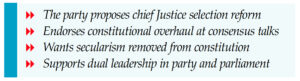
The party called for selecting the Chief Justice from among the three most senior judges of the Appellate Division, aiming to enhance transparency and predictability in judicial appointments.
The proposal was presented during the third day of BNP’s formal discussions with the National Consensus Commission, held at LD Hall in the National Parliament.
Briefing the media during a recess, BNP Standing Committee member Salahuddin Ahmed elaborated on the party’s stance on a wide range of constitutional and political reforms under review.
Ahmed noted that the BNP had endorsed several key proposals put forth by the reform commission. Among these is a substantial constitutional amendment requiring a two-thirds majority in both houses of parliament to impeach the president.
The BNP also expressed support for the long-overdue appointment of an ombudsman, a constitutional position that has remained vacant since its inception.
“We are in agreement with most of the commission’s proposals,” said Ahmed. He particularly highlighted BNP’s backing for the revocation of five constitutional amendments-the eighth, ninth, tenth, twelfth, and fifteenth-which, according to the party, have distorted the foundational principles of the nation.
One of the more contentious stances adopted by the BNP was its support for a proposal to remove secularism from the constitution. Instead, the party advocates for enshrining “equality, human dignity, and social justice” as fundamental human rights.
This proposal is expected to reignite debate about the role of religion in state affairs, especially given the historical sensitivity of secularism in Bangladesh’s political discourse.
On the structure of governance, Salahuddin Ahmed reiterated BNP’s support for rebalancing executive powers between the president and the prime minister – an issue that has repeatedly emerged in reform discussions over the years.
The BNP proposed allowing an individual to return as prime minister for a third term, provided there is an interval after two consecutive terms. However, the party opposed recommendations barring the same person from holding the roles of both party leader and parliamentary leader concurrently.
“The position of parliamentary leader should be held by the prime minister, and it should be left to the majority party to decide whether the party chief and prime minister are the same person,” Ahmed added.
The BNP voiced its support for several electoral and governance reforms. These include a ban on party symbols in local government elections and the introduction of a four-tier local administrative structure to foster decentralisation.
Furthermore, the party endorsed the creation of a bicameral legislature, comprising a 400-member lower house with 100 seats reserved for women, and a 100-member upper house.Representing the BNP at the meeting were Salahuddin Ahmed, Ismail Jabiullah, Advocate Ruhul Kuddus Kajal, and former secretary Abu Mohammad Moniruzzaman.
The session was chaired by the commission’s vice-president, Professor Ali Riaz. Other commission members in attendance included Justice Emdadul Haque, Badiul Alam Majumdar, Iftekharuzzaman, Safar Raj Hossain, and Monir Haider, special assistant to the chief adviser.
The National Consensus Commission is currently engaging political parties in a series of meetings to deliberate on major recommendations from five separate reform panels. The talks with the BNP represent a vital part of this national effort to establish cross-party consensus on Bangladesh’s political and constitutional trajectory.