
Bloc Politics of Superpowers: China In, America Out!
Sultan Mahmud Sarker :
21st-century world politics is moving towards a time where the dominance of a single power is gradually collapsing, and a multidimensional balance of power is emerging anew.
After the end of the Cold War and the collapse of the Soviet Union in 1989, the United States became the world’s sole superpower—the centre of a unipolar world.
At that time, the influence of the United States in the world’s economy, security, and international policymaking was omnipresent. From Europe to Asia, from Africa to Latin America, the influence of the United States was the main driving force in politics and economics. But history never stands still.
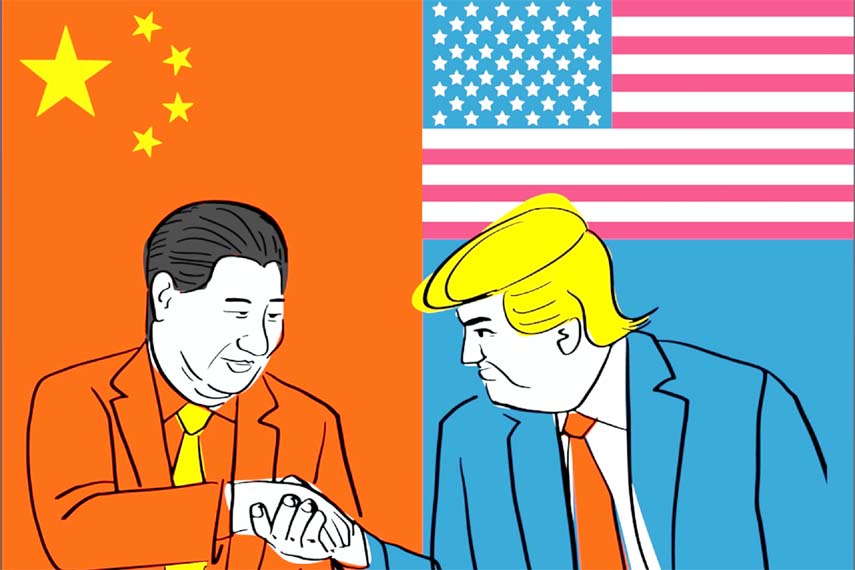
Over time, that unipolar world is gradually breaking down and is developing into a new multipolar world. Today, a new reality is being seen on the stage of world politics, much like “China In, America Out.”
China’s rise is not only economic, it is strategic, political, and even cultural. In the last two decades, China has risen to the centre of the world economy, establishing itself as the driving force of the global supply system.
Behind this lies a long-term plan, a diplomacy based on national interests, and a unique example of state unity. Through the “Belt and Road Initiative (BRI)” project, China has established commercial and strategic connections with Asia, Africa, and Europe.
By investing in infrastructure, ports, railways, and energy projects in more than 60 countries, China has expanded its influence, which has effectively formed a new economic bloc.
A Chinese bloc, developing countries are gradually coming out of their financial dependence on the United States. On the other hand, the sole dominance of the United States is clearly facing challenges today.
With the failed withdrawal from Afghanistan, the instability in Iraq and Syria in the Middle East, and the attack on Russia in the context of the war in Ukraine, America is not able to exert its influence as before. Its foreign policy is a victim of double standards in many areas.
The United States’ unconditional support for Israel on the Palestinian issue has called into question the global humanitarian conscience.
Instead, China and Russia are now presenting themselves as the voices of “peace and balance.” This reality is taking today’s geopolitics in a new direction.
Just as the rise of China is a planned process, the decline of America is the result of multiple internal and external reactions.
The economic inequality, political division, economy dependent on the arms trade, and the policy of artificially created wars of the United States has all eroded its influence.
The one-time “global leader” is now proving time and again that he is no longer capable of leading the world alone. Its interference in the internal affairs of other countries in the name of promoting democracy has created anger in the world.
Libya, Iraq, Afghanistan, and Syria are all examples of the tragic results of US intervention. From this reality, many countries are now seeking refuge in alternative powers, and that alternative is China.
Along with China, Russia has also become quite active. Through the Ukraine war, Russia has shown that Western hegemony is no longer unconditional. Moscow and Beijing are now strategic partners where their common interest is to resist the US-led world order.
Turkey has also taken an important position in this new geopolitics; Despite being a member of NATO, it has developed close relations with Russia and China.
The diplomatic positions of Saudi Arabia, Iran, Qatar and the United Arab Emirates in the Middle East are also changing; they are no longer at the mercy of the US as before. These countries are restructuring their sovereign policies in light of economic and geopolitical realities.
Twenty-first-century politics no longer rely solely on military power; rather, economics, technology, and information flow are the real weapons. China has made the most of this reality. Huawei, TikTok, ZTE, or Alibaba are not just companies, but symbols of China’s “soft power.”
Although the United States has blocked the expansion of these technology companies, in reality, they have already created a new digital world outside Western influence.
Where the “American Dream” was once a symbol of world culture, the “Chinese model” is now becoming one of the possibilities for the developing world.
The geography of world politics is also being redefined. Africa, South Asia, and Latin America have long been the victims of economic exploitation by the United States and Europe.
Now China and Russia are filling that void. Chinese investments in Africa, the Padma Bridge project in Bangladesh, the CPEC in Pakistan, and the gas pipeline in Central Asia are all indications of new alliances in the world
At the centre of this change is China’s “Belt and Road Initiative”, which has practically given birth to an alternative global economic system.
By participating in this Chinese project, countries are developing their infrastructure, increasing their economic capacity, and freeing themselves from Western economic pressure.
This is not only an economic, but also a strategic move in which China is presenting itself as a kind of peaceful development power. In contrast, the United States still relies on military bases, sanctions, and war policies that are increasingly ineffective.
This change means a new geopolitical reality for the next generation. On the one hand, the American hegemony is collapsing, while on the other hand, China and its allies are creating a new balance where global power will be shared and leadership will be based on cooperation.
Russia, China, Turkey, India, and Brazil are now coming together for each other’s interests, which can be called a new “multipolar world order.”
Therefore, in this era of “bloc politics” of the 21st century, we are witnessing a new reality: “China in, America out.” China, Russia, Turkey, and other emerging powers are now consolidating their geopolitical positions, and the United States is gradually losing its sole influence. The world is no longer a single power; it is a stage for the combined balance of many powers.
And it is towards this balance that the future world is moving, where peace, not power, will be the main principle; cooperation, not competition, will be the main goal; mutual interest and respect, not dominance, will shape the geopolitics of the future world.
(The author is a Columnist & MPhil Researcher, Rajshahi University
and Teacher of Gazipur Cantonment Public School and College.
E-mail: [email protected])