
‘BD must reorient toward emerging Asian power centre’
Staff Reporter :
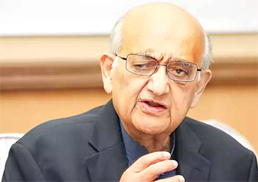
Economist Rehman Sobhan has called on Bangladesh to fundamentally reassess its global economic strategy as the centre of global power rapidly shifts toward Asia. He cautioned that continued reliance on Western markets and legacy assumptions could leave the country exposed to new risks.
Speaking at the ‘Bay of Bengal Conversation’ organised by the Centre for Governance Studies (CGS) on Saturday in Dhaka, Sobhan said the world of 2025 represents “a profoundly altered global landscape,” where economic weight is increasingly concentrated in the Global South-particularly South, Southeast, and East Asia.
He observed that China is already the world’s largest economy in purchasing-power-parity terms, India is climbing swiftly, and by 2050 China, India, and Indonesia are projected to rank among the top four global economies.
Sobhan identified three major forces behind this transition: the restructuring of global trade, shifts in capital flows, and rapid technological advancement.
China, he noted, has emerged as the world’s biggest exporter and the principal trading partner for nations across Asia, Africa, and Latin America, effectively ending the decades-long commercial dominance of the United States. It has also become the largest global provider of development finance, extending about $2.1 trillion in aid and loans between 2000 and 2024 – surpassing the US. “China, Japan, and other Asian economies now command global reserves and sovereign wealth funds, and Bangladesh can no longer afford to overlook this reality,” he added.
Bangladesh must reposition itself now
Sobhan stressed that Bangladesh’s traditional tilt toward Western economies no longer reflects current global dynamics. At independence, Western partners supported nearly 12% of Bangladesh’s GDP. Today, external aid accounts for only around 2%, and nearly $50 billion in committed assistance remains undisbursed.
He emphasized that the primary sources of investment and financing now lie within Asia. China alone has roughly $40 billion invested in Bangladesh through loans and various financial mechanisms. Yet, Bangladesh remains fixated on protecting access to US and Western markets-especially for garments-and overly dependent on LDC-era trade benefits.
Such dependence, he warned, is increasingly precarious, particularly in light of the US’s unpredictable and highly transactional trade policies. Sobhan added that Bangladesh has failed to benefit from India’s duty-free market access offered since 2010 and has not embedded itself into the massive supply chains of China and India, despite their enormous potential.