
BD lost $240b during Hasina regime TI chief
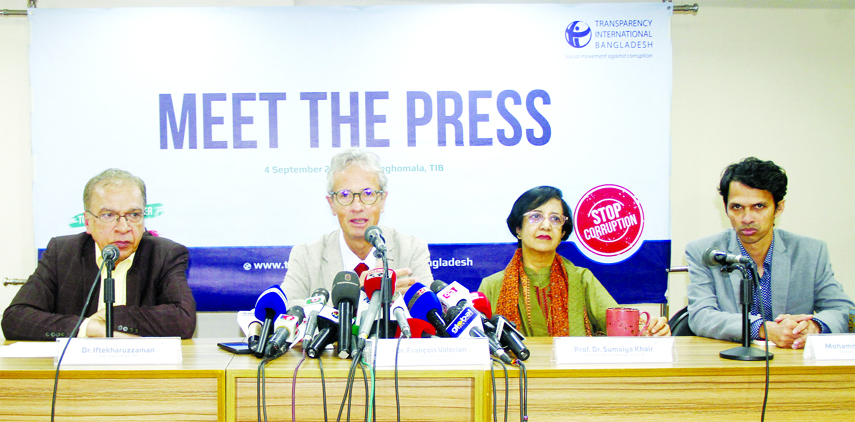
Staff reporter :
Transparency International (TI) Chair François Valérian has alleged that Bangladesh lost nearly $16 billion every year during the 15-year rule of former Prime Minister Sheikh Hasina, citing corruption and large-scale money laundering by political elites and their associates.
Speaking at a press briefing at the Transparency International Bangladesh (TIB) office in Dhaka, Valérian described the former government as “authoritarian and massively corrupt,” claiming that power was used for profit rather than public service.
He said the billions that left Bangladesh annually “became part of the global economy of corruption.”
According to TI’s estimates, illicit funds were channeled through offshore accounts, cryptocurrency platforms, and tax havens before being parked in major financial hubs such as Dubai, Singapore, Hong Kong, London, Paris, Frankfurt, Zurich, and New York.
Much of the money was invested in real estate and luxury assets, rather than in sectors like education, healthcare, or climate resilience.
Valérian pointed to a recent case in the UK, where £185 million worth of property in London was confiscated following a joint appeal by TIB, TI UK, and other anti-corruption groups.
“This demonstrates that international cooperation can deliver results. But the challenge lies in restitution – ensuring the money returns to the Bangladeshi people instead of enriching foreign treasuries,” he said.
He also urged Bangladesh to pass the long-pending draft law on beneficial ownership transparency, which would reveal the individuals behind shell companies used to launder illicit wealth.
“Without knowing who owns these assets, civil society cannot push for recovery,” he warned.
On questions about corruption allegations against Sheikh Hasina’s family, Valérian refrained from commenting on specific cases.
However, he stressed the need for an independent judiciary capable of investigating and prosecuting corruption without political influence.
“Bangladesh is at a historic turning point. Recovering stolen assets is not just about justice, but also about laying the foundation for democratic accountability,” Valérian added, warning that without restitution, citizen sacrifices may go in vain.
Meanwhile, TIB Executive Director Dr Iftekharuzzaman highlighted both progress and persistent challenges in fighting money laundering.
At the press conference, he acknowledged that reforms in the banking sector have reduced large-scale fraud, while many individuals previously involved in laundering have faced legal action or fled abroad.
He added that the flow of remittances through informal channels like hundi has also been curtailed.
However, Dr Iftekharuzzaman identified trade-based money laundering, particularly mis-invoicing in imports and exports, as the largest ongoing risk.
“This is where the bulk of laundering happens. Preventing this must be treated as a top priority,” he said.
He cautioned that once money is laundered abroad, recovery becomes extremely difficult, if not impossible.
“The smarter strategy is to strengthen prevention through structural reforms and enforcement,” he concluded.
Valérian reiterated that asset recovery requires global collaboration but insisted that restitution must benefit Bangladeshis directly. “Worldwide, $1 trillion is stolen annually.
Bangladesh’s case is one of the most alarming, and its resolution is not just a national duty, but also a global responsibility.”