
‘BD can’t sustain growth without decentralisation’
City Desk:
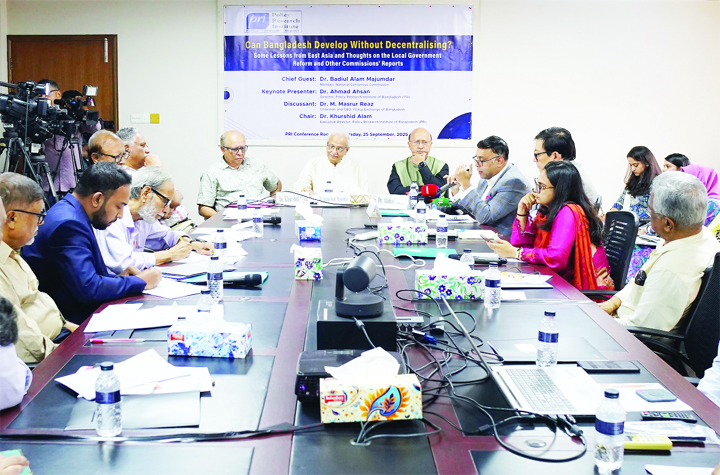
Experts at a seminar on Thursday said Bangladesh cannot sustain its development journey without meaningful decentralisation and stronger local government institutions.
The Policy Research Institute of Bangladesh (PRI) hosted the event, the second in its two-part series titled “Can Bangladesh Develop Without Decentralising? – Some Lessons from East Asia and Thoughts on the Local Government Reform and Other Commissions’ Reports”.
PRI Executive Director Dr Khurshid Alam called for inclusive dialogue on strengthening local governance as a cornerstone of broader reforms, reports UNB.
Dr Badiul Alam Majumdar, member of the National Consensus Commission, warned that decentralisation must go hand in hand with political reform.
“If politics continues to operate as a business rather than a public service, honest people will remain reluctant to join it,” he said.
He said principle of subsidiarity—resolving issues at the level closest to citizens—as the guiding motto for reform.
Delivering the keynote, PRI Director Ahsan presented evidence that Bangladesh is among the most centralised countries of its size globally.
He said this structure undermines service delivery in education, health, sanitation, and infrastructure.
Citing East Asian experiences, he argued that well-designed decentralisation—anchored in accountability, transparency, and performance monitoring—is essential for sustained growth.
Ahsan endorsed many recommendations of the Local Government Reform Commission but criticised proposals for indirect elections of local government representatives and overlapping jurisdictions, warning these could weaken accountability.