
Bangladesh’s economy accelerates as PMI jumps to 61.8 in October
Business Report:
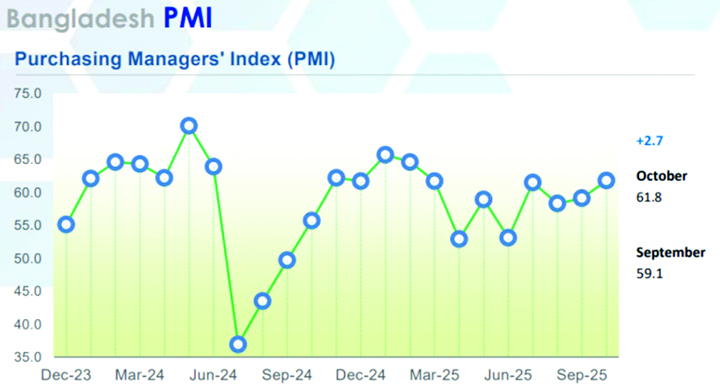
Bangladesh’s economy expanded at a faster pace in October, with the country’s Purchasing Managers’ Index (PMI) climbing by 2.7 points from the previous month to reach 61.8, signaling broad-based growth across agriculture, manufacturing, construction, and services.
The PMI, compiled jointly by the Metropolitan Chamber of Commerce and Industry, Dhaka (MCCI), and Policy Exchange Bangladesh (PEB), serves as a forward-looking indicator of economic health. A reading above 50 signifies expansion, while one below 50 indicates contraction.
Broad-based expansion across sectors
According to the October report published on Sunday, the agriculture sector posted its second consecutive month of growth, buoyed by favorable weather conditions, strong crop yields, and an increase in new business and employment.
Input costs rose slightly due to higher fertilizer and transport prices, but improved harvest prospects helped maintain optimism. Order backlogs, however, continued to contract, suggesting that production was able to keep pace with demand.
The manufacturing sector extended its expansion streak to an impressive 14 consecutive months, reflecting sustained growth in new orders, exports, and production volumes. Factory output increased as firms ramped up purchases of raw materials and intermediate goods, though rising input prices indicated some lingering cost pressures.
Employment also rose steadily, and supplier delivery times improved, pointing to better supply chain efficiency.
In the services sector, which accounts for a large share of the country’s GDP, October marked the 13th consecutive month of expansion. Growth in new business, business activity, and employment strengthened, reflecting improving consumer sentiment and increased activity in trade, transport, and finance. Order backlogs in services, which had been contracting for the past two months, reverted to expansion an encouraging sign for continued growth.
Positive outlook for the final quarter
“The latest PMI readings indicate that the overall Bangladesh economy continued to expand, primarily driven by favourable crop conditions and expectations of a good harvest in the agricultural sector,” said M Masrur Reaz, Chairman and CEO of Policy Exchange Bangladesh.
He added that the broader economic outlook remains positive heading into the final quarter of 2025, as external demand for manufactured goods improves, inflationary pressures ease, and exports regain momentum
Tracking economic momentum
The MCCI and PEB launched the Bangladesh PMI in January 2024 with support from the UK government. The survey currently covers over 500 private-sector firms across the four major sectors agriculture, manufacturing, construction, and services and provides an early indication of economic trends before official data are released.
Economists say the October PMI underscores Bangladesh’s gradual recovery path, driven by domestic demand, stable remittance inflows, and steady export performance, though continued vigilance is needed to contain inflation and maintain currency stability.