
Bangladesh seeks FDI in renewable energy, carbon markets
Staff Reporter :
A group of international energy experts has highlighted Bangladesh’s strong potential for attracting significant investments in renewable energy and carbon trading.
The experts conveyed their views to the Chief Adviser, Professor Dr Muhammad Yunus, during a meeting on Sunday.
The delegation, comprising specialists in development and renewable energy, was led by former Norwegian Minister for Development and Environment Erik Solheim.
They met with Professor Yunus at the State Guest House, where they expressed keen interest in investing in small-scale solar power plants, carbon markets, and agroforestry in Bangladesh.
Additionally, they proposed a collaborative exploration of hydroelectric investment opportunities in Nepal, aligning with Bangladesh’s long-term strategy to reduce its dependence on fossil fuels.
Welcoming the initiative, Professor Yunus stated that the interim government was actively seeking foreign direct investment (FDI) in these emerging sectors.
“These are critical issues for us. Bangladesh is eager to attract substantial investments in renewable energy and the carbon market,” he said.
Professor Yunus further emphasised that discussions were already
underway regarding the import of hydroelectric power from Nepal and Bhutan.
His government is particularly focused on establishing a South Asian power grid to facilitate energy transmission to Bangladesh through a narrow corridor in India.
“The hydroelectric potential in Nepal is a hidden treasure, but the real challenge lies in its delivery,” he remarked.
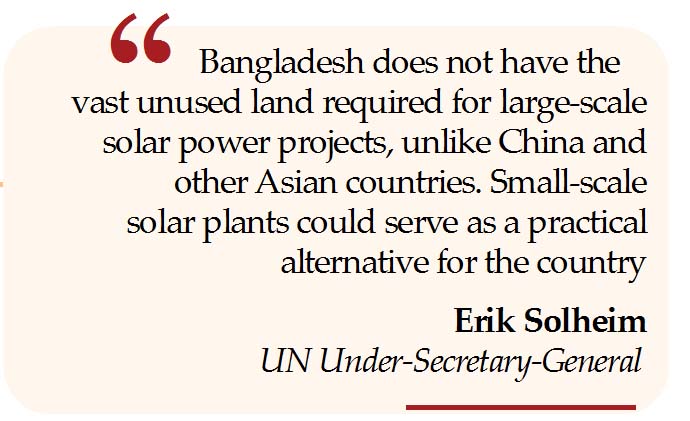
Erik Solheim, who has also served as a UN Under-Secretary-General, pointed out that Bangladesh does not have the vast unused land required for large-scale solar power projects, unlike China and other Asian countries.
However, he suggested that small-scale solar plants could serve as a practical alternative for the country.
Reaffirming his government’s commitment to solar energy, Dr Yunus revealed that he had already invited Chinese investors to relocate their solar panel manufacturing plants to Bangladesh.
In response, several Chinese solar manufacturers have visited the country to evaluate the feasibility of establishing production facilities, with the aim of exporting their products to high-income Western markets.
Kavin Kumar Kandasamy, CEO of ProClime – a company specialising in carbon trading and climate investment – stated that Bangladesh could generate tens of millions of dollars through carbon trading, following the example of other South Asian nations such as Sri Lanka.
The Chief Adviser acknowledged Bangladesh’s strong interest in the carbon market, viewing it as both a financial opportunity and a means to support conservation efforts in the Sundarbans, the world’s largest mangrove forest.
During the hour-long discussion, the delegation and the chief adviser also addressed the Rohingya crisis and recent developments in Myanmar’s Rakhine state, where a rebel group has reportedly taken control of most of the region.