
Bangladesh on the Geopolitical Chessboard
Engineer Fakhr Uddin Manik :
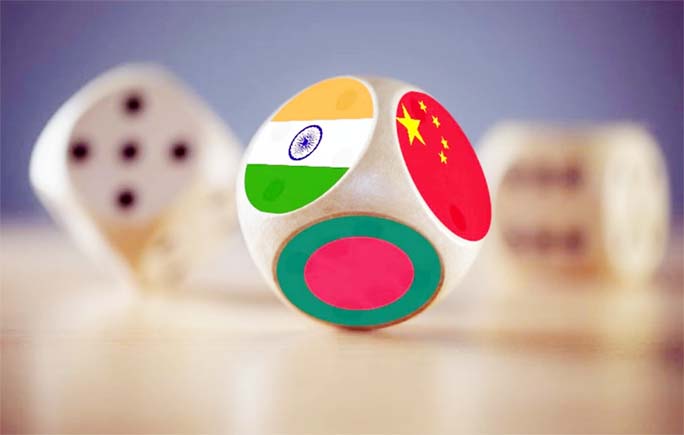
The chessboard is set—not of wood, but stretched across the map of continents, with pieces taking human form. At the corners sit four powerful players, while Bangladesh stands in the middle—a curious character, sometimes called the queen, sometimes a mere pawn, or sometimes just a square that everyone wants to occupy.
In the northeast sits China—eyes on trade telescopes, hands tracing maritime routes. With a smile, it declares, “We’ll build ports, roads, and bridges—but the key remains with us.” To the south, the United States—suit and tie, a shiny democracy badge in hand, but behind the politeness, a market ledger.
It whispers, “You may be independent, but under our umbrella.” To the east, India—a neighbor, yet always peeking through the window, observing which lamp we light or extinguish. It murmurs, “I’ll traverse your northeastern corridor and keep tabs on your affairs.”
To the west, Russia—stern-faced, dragging lines of nuclear electricity across the board as if planning to electrify the very chess squares. It’s cold voice warns, “If you want the lights on, you’ll have to turn our switch.”
Bangladesh stands in the center, holding a diplomatic notebook, ears tuned to whispers from all directions.
It’s like a young bride surrounded by suitors—one offers a ring, another a bank balance, another a land deed, yet another electricity connection. She wonders, “Which promise will please everyone without angering any?” But in the marriage market of geopolitics, pleasing all at once is nearly impossible.
Our location dictates our fate—nestled at the intersection of South Asia, Southeast Asia, and the Indian Ocean. History itself refuses to let this geography remain neutral.
In ancient times, Arab traders, Portuguese corsairs, and British colonizers all reached out to control the trade routes. During Pakistan’s era, Chittagong port was part of international calculations. After independence, new players arrived—bringing not just weapons or ships, but investments, loans, technology, and policy advice.
Chittagong, Mongla, Payra—these ports are more than cargo hubs; they are the dreams of major powers. The U.S.’s Indo-Pacific strategy, China’s Belt and Road Initiative, India’s regional security concerns, Russia’s energy links—all feature Bangladesh in bold letters. It is as if the central square on the chessboard is ours—and controlling it means controlling the game.
Yet this game is far from simple. Smiles do not always mean friendship; beneath them often lie traps. Chinese investments come with debt conditions, American aid with political strings, Indian proximity with security pressures, Russian technology with long-term dependencies. Twenty-first-century diplomacy is like a chess gambit—first tempt with gifts, then capture the real prize.
Bangladesh’s strategy resembles a tightrope walker—one hand holding China’s projects, the other balancing access to the U.S. market, with India’s neighborhood watch at the back and Russian energy collaboration on the side. Lose balance, and the geopolitical abyss awaits. One wrong move, and we become a sacrificed pawn—discarded by the players who only seek to save their major moves.
Recent examples abound. During the Rohingya crisis, Western nations delivered human rights speeches but failed to provide solutions; Asian powers, meanwhile, leveraged the crisis for their own strategic interests. Likewise, the Bay of Bengal’s gas reserves and maritime economy attract diplomatic offers, under the cover of commercial and military interests. Even the garment export sector is under pressure—some advocate raising worker wages, others push for cost reduction.
Yet it is not all darkness. Bangladesh has moves of its own. Regional trade, the blue economy, transit commerce, industrialization—these can form the basis of an endgame strategy. With the right moves at the right time, Bangladesh can not only be a chess piece but a board setter. This requires coherent foreign policy, economic diversification, and courageous leadership.
Winning in geopolitical chess means reading your opponent’s moves while keeping some in reserve. The smiles, promises, and gifts of great powers hide calculations—understanding them allows us to turn the rules in our favor.
But caution: in this game, a mistake is not just defeat; it is surrendering the entire board. History may then record: “Bangladesh? once the central queen, now a forgotten pawn in the corner.”
Until we hold our own board in our hands, every move on the geopolitical chessboard will be a fight for survival—not only against external forces but also against our own shortsightedness.
(The author is a Political Analyst & Social Commentator Address- 96A Mile End Road, London, E1 4UN Contact: +44 7405 332548, Email: [email protected])