
Bangladesh clinches trade win as US lowers tariffs to 20pc
Reza Mahmud :
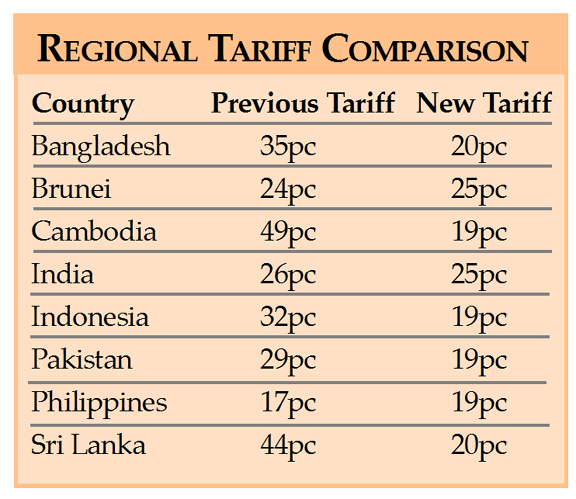
The United States has officially reduced its tariff rate on imports from Bangladesh to 20pc, down from a previously imposed 35pc, following a series of high-level negotiations held in Washington.
The decision has been welcomed by economists and business leaders, though some exporters have expressed mixed views on the deal’s long-term implications.
Leading economist Professor Muinul Islam described the reduction as “undoubtedly positive” for Bangladesh’s export competitiveness. “A 15-point drop in tariffs is a notable achievement.
It enhances the appeal of Bangladeshi goods in the US market,” he told The New Nation on Friday. He credited the negotiating team for securing what he termed a “commendable diplomatic outcome.”
Mir Nasir Hossain, former President of the Federation of Bangladesh Chambers of Commerce and Industry (FBCCI), echoed similar sentiments. “This outcome is advantageous for Bangladeshi exporters, especially when compared to regional competitors such as India and Vietnam, who have not secured similar benefits,” he said.
Hossain pointed out that while India’s goods face a 25pc tariff, Bangladesh’s rate is now lower despite the latter enjoying a low-cost production advantage.
However, former BGMEA Director Mohiuddin Rubel urged the government to focus on diversifying export products to sustain competitiveness over the long term. “We must broaden our export basket to ensure durability in global markets,” he said.
The White House made the tariff reduction official following the conclusion of bilateral negotiations between Bangladeshi officials and the Office of the United States Trade Representative (USTR).
According to the Chief Adviser’s Office, Bangladesh’s revised tariff rate now aligns with those of comparable economies including Sri Lanka, Vietnam, Pakistan, and Indonesia, which also secured tariffs in the 19-20pc range.
By contrast, India’s tariff rate remains at 25pc, following the country’s inability to reach a comprehensive agreement with the US.
Dr Khalilur Rahman, National Security Adviser and the lead negotiator, said the deal was carefully crafted to maintain the competitiveness of Bangladesh’s key sectors while safeguarding national interests.
“We preserved our advantage in apparel exports, avoided a steep 35pc tariff, and agreed to reasonable import commitments on select US agricultural goods,” he stated.
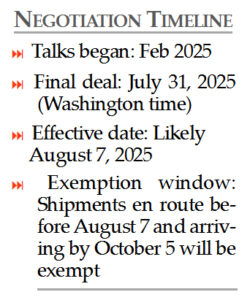
The revised tariff rate is set to take effect at 12:01 a.m. EDT (10:01 a.m. Bangladesh time) seven days after the signing of the executive order by President Donald Trump. Shipments already en route before the August 7 effective date and arriving before October 5 will be exempt from the new rate.
This development comes amid a wider US tariff review initiative led by President Trump, who earlier this year imposed new duties of up to 41pc on exports from 70 countries.
Nations that negotiated trade agreements by the July 31 deadline were offered lower tariffs in exchange for addressing US concerns on trade imbalances, import commitments, and non-tariff barriers.
The Bangladesh Garment Manufacturers and Exporters Association (BGMEA) expressed cautious optimism following the announcement. President Mahmud Hasan Khan Babu welcomed the reduction, noting that it levels the playing field for Bangladesh’s apparel sector.
“While short-term challenges such as pricing pressures may arise, the long-term impact is expected to be stabilising,” he said.
The US remains Bangladesh’s largest export market for ready-made garments (RMG), accounting for approximately $8 billion in annual trade. In contrast, Bangladesh imports roughly $2 billion worth of goods from the United States.
Tariff tensions began in April when the Trump administration announced a 37pc duty on Bangladeshi goods, citing trade imbalance concerns. Following diplomatic engagement and temporary suspensions, Bangladesh’s rate was revised to 35pc in early July, with final negotiations concluding on July 31.
Following the announcement, Chief Adviser Professor Dr Muhammad Yunus commended the negotiating team for their strategic efforts.
“This is a landmark achievement-17 percentage points lower than initially projected. The team has demonstrated exemplary skill in navigating a complex international environment,” he said.
Professor Yunus added that the agreement secures continued access to the US market, ensures competitiveness, and sets the stage for new opportunities and long-term economic growth. “This is a proud moment for Bangladesh and a strong signal of our growing stature in global trade,” he concluded.
The agreement is the result of joint efforts by both the public and private sectors. While the government delegation held formal talks in Washington, private sector representatives also played a key role by engaging with US exporters to help reduce the trade imbalance. Their collective efforts contributed significantly to the eventual reduction in countervailing tariffs on Bangladeshi goods.