
Bangladesh-China Health Diplomacy: A Model of South-South Cooperation
Mohammad Maruf Hasan, PhD :
The Bangladesh-China model underscores that South-South cooperation is not charity; it is a strategic alignment where mutual investment yields shared health security In the context of global health challenges, China’s health diplomacy with Bangladesh has developed into a strong framework for South-South cooperation, integrating medical expertise, technological advancement, and humanitarian aid to establish a comprehensive partnership.
This cooperation is the part of China’s Belt and Road Initiative (BRI) that emphasizes international health collaboration is the Health Silk Road (HSR). It is a framework via which China uses health-related engagement to improve relations with partner nations, not a stand-alone endeavour.
This collaboration, encompassing treatment services, capacity building, and emergency response, signifies a crucial aspect of the bilateral relations between the two nations, which commemorated 50 years of diplomatic ties in 2025.
China has established itself medical tourism and cross-border treatment program for Bangladeshi patients. Hospitals in Kunming, like Kunming First People’s Hospital, Kunming Medical University, and Kunming Eye Hospital, provide contemporary facilities and superior services that attract people in search of advanced care not easily accessible domestically.
Patients can also choose other provincial hospitals Capital Hospital (Beijing), West China Hospital (Sichuan) and many more.
Mr. Islam from Chittagong shared his experience of his successful heart ring surgery in West-China medical hospital and said he already had open heart surgery before and now heart block again this kind of treatment in Bangladesh is not possible.
Another patient who completed his treatment from Kunming said, here (China) treatment is not only low cost but also the best quality treatment than other countries, and the hospital environment is entirely excellent.
Nonetheless, he mentioned that obstacles such as linguistic difficulties and cultural disparities, especially dietary choices, persist as substantial impediments.
Interpreters may charge 600 yuan for a day and 100-150 yuan per hour subsequently, a cost that patients are required to cover personally. Hospitals are enhancing interpreter services and restaurants that cater to Bangladeshi patients.
According to China Daily, China has instituted emergency medical responses for critical instances. After a July 2025 aviation accident in Dhaka that resulted in injuries to more than 100 students, a specialized burn treatment team from Wuhan Third Hospital was dispatched to Bangladesh.
A validated “Chinese protocol” was implemented, encompassing surgical debridement, a homemade burn powder, and prone positioning nursing, which effectively treated critically burned patients, including a 12-year-old boy with 45% body surface area burns. Bangladeshi physicians adopted these techniques following their demonstrated efficacy.
China’s health diplomacy in Bangladesh encompasses not just immediate assistance but also long-term structural initiatives.
In April 2025, China committed a grant of 1 billion RMB to facilitate economic and technical cooperation initiatives, which encompass the establishment of a 100-bed rehabilitation hospital in Dhamrai, Dhaka, for individuals with disabilities; a robotic physiotherapy centre at Bangladesh Medical University, with equipment already supplied; the expansion of medical surgical units in peripheral regions; scholarships, human resource training, and a Memorandum of Understanding for the collaborative execution of Bangladesh’s 2025 Human Resource Development Plan focused on health sector personnel development.
Furthermore, academic engagement has expanded, with ties formed between the University of Dhaka’s Department of Biochemistry & Molecular Biology and Chinese institutions such as Yunnan Peking Cancer Hospital and Kunming Medical University, as reported by a national daily in Bangladesh.
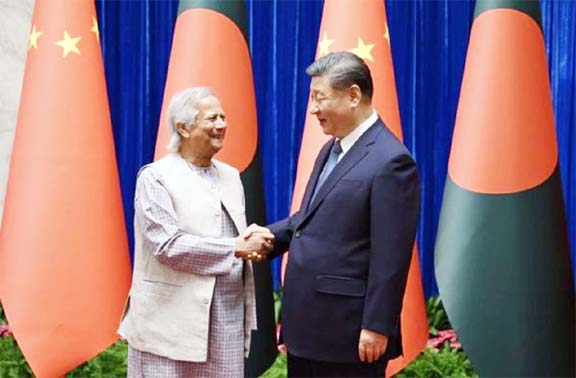
Along with the Chinese foreign ministry, these health activities are components of a broader bilateral framework initiated during a governmental visit to China in July 2024, when Bangladesh’s connection with China was raised to a “comprehensive strategic partnership.”
Within this framework, both nations officially consented to enhance health collaboration, encompassing: Research and development of drugs, vaccines, and medical equipment; Preventive care and chronic illness management; Digitization of health services and infectious disease control.
China’s health initiatives in Bangladesh are not solely humanitarian; they are also strategic. Analysts indicate that these initiatives allow China to augment its influence in South Asia amidst evolving geopolitical dynamics, especially as regional historical dominance encounters obstacles.
Advanced policy frameworks enable this collaboration.
In May 2025, the Chinese Embassy in Bangladesh established a “green channel” for medical visas, streamlining the application procedure by permitting local travel agents to furnish financial and familial paperwork guarantees.
This effort, featuring specialized consultation hotlines and expedited processing, assists Bangladeshi citizens in obtaining medical care, check-ups, or wellness treatments in China.
China is advocating for the integration of traditional medicine with contemporary healthcare.
According to JAAS in August 2025, China’s Ministry of Science and Technology released rules for the “Strategic Science and Technology Innovation Cooperation” key special project, which encompasses assistance for international standard demonstration research and promotional uses of traditional medicine.
This strategy includes collaboration with nations such as Thailand and Indonesia, with possible ramifications for Bangladesh.
Humanitarian initiatives constitute another essential component. In December 2023, China allocated $1.5 million via the China International Development Cooperation Agency (CIDCA) to assist Rohingya refugee women and girls in Bangladesh.
This donation financed the annual distribution of approximately 250,000 hygiene kits, providing necessary supplies such as soap and buckets. Furthermore, it generated economic prospects for refugee and local women involved in kit production, enhancing community resilience and self-sufficiency.
Notwithstanding achievements, numerous difficulties endure. Language limitations and cultural disparities can impede the medical care experience for Bangladeshi patients in China. The elevated expense and shortage of interpreters, along with unfamiliar cuisine, continue to pose considerable challenges. Furthermore, guaranteeing the durability and local integration of Chinese medical protocols and technology necessitates continuous training and capacity development.
China’s health diplomacy with Bangladesh demonstrates a contemporary style of statecraft that integrates humanitarian aid, medical outreach, infrastructural investment, and interpersonal connections. It embodies a definitive, multifarious strategy tackling urgent requirements, promoting enduring institutional collaboration, and subtly readjusting regional connections.
Bangladeshis experience concrete advantages: expedited access to specialized medical care, enhanced rehabilitation services, and cutting-edge technology. It strategically enhances Dhaka’s leverage in bilateral interactions, creating a realistic yet tilted equilibrium in its external partnerships.
As this health diplomacy progresses, medical professionals, policymakers, and ordinary citizens will closely observe its impact on the healthcare environment and the geopolitical dynamics of South Asia.
(The author is an Associate Professor, School of International Studies, Sichuan University,
Sichuan, China).