
Bangladesh-China-America relations
Professor Dr. M A Rashid :
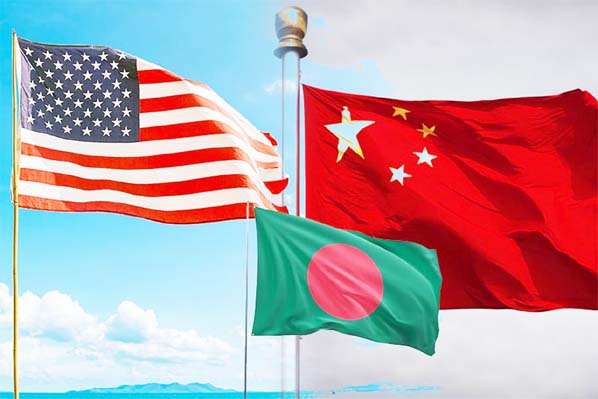
When outsiders think about global rivalries, Bangladesh is rarely the first country that comes to mind. Yet today, this South Asian nation finds itself at the crossroads of the world’s two great powers.
On the one side is China, pouring billions into roads, bridges, and power plants through the Belt and Road Initiative.
On the other is the United States, Bangladesh’s largest export market and a partner in trade, education, and governance.
Dhaka has no illusions about being a great power itself. But geography, economic momentum, and diplomatic autonomy have quietly made it too important to ignore.
Perched on the Bay of Bengal, sharing borders with both India and Myanmar, and hosting one of Asia’s fastest-growing economies, Bangladesh is emerging as a stage where Washington and Beijing test their competing visions.
Its leaders, meanwhile, are determined to avoid being reduced to a pawn—insisting instead on a policy of “friendship to all, malice toward none.”
Bangladesh–China–USA Relations: A Strategic Balancing Act
Bangladesh follows a policy of “Friendship to all, malice towards none”, aiming to maintain balanced and cordial relations with both China and the USA without aligning too closely with any global power bloc.
Bangladesh–China Relations
Under the Belt and Road Initiative (BRI), launched by China in 2013, Bangladesh has become a key South Asian partner.
The initiative aims to improve regional connectivity through infrastructure, trade, and investment.
For Bangladesh, BRI has opened access to large-scale funding, technical expertise, and project implementation support—particularly in transport and energy.
Key BRI-Funded or BRI-Linked Projects in Bangladesh
Bangladesh has become a key recipient of Chinese investment through the Belt and Road Initiative, with several landmark infrastructure projects reshaping its economic landscape.
The $3.1 billion Padma Bridge Rail Link is enhancing transport and connectivity by linking Dhaka to the southwestern region, while the 1,320 MW Payra Power Plant, a joint venture with Chinese companies NWPGCL and CMC, is strengthening the national grid.
The Karnaphuli (Bangabandhu) Tunnel, South Asia’s first underwater tunnel, aims to ease traffic congestion in Chattogram and improve port access, complementing the Dhaka Elevated Expressway, which is reducing congestion in the capital through partial Chinese investment.
Additionally, China is supporting the development of export-oriented Special Economic Zones, such as those in Anwara, fostering industrial growth with capital and technology transfer.
Challenges and Risks
Despite the tangible infrastructure gains from China’s Belt and Road Initiative, Bangladesh faces several significant challenges and risks.
A major concern is debt dependency, as most BRI projects are financed through concessional loans rather than grants—raising questions about the country’s long-term repayment capacity.
Additionally, the lack of transparency in some agreements, including limited competitive bidding and insufficient environmental or social impact assessments, has sparked criticism.
Geopolitically, the growing Chinese footprint in Bangladesh is viewed with increasing suspicion by Western powers and regional actors like India, potentially straining Dhaka’s broader diplomatic relations.
Bangladesh–USA Relations
Bangladesh–U.S. relations are anchored in robust economic, educational, and developmental cooperation, with trade forming a cornerstone of the partnership.
The United States is Bangladesh’s largest export destination, particularly for ready-made garments (RMG), a critical driver of the country’s economy.
In addition to trade, the U.S. provides significant development assistance through USAID, while thousands of Bangladeshi students pursue higher education in American universities—strengthening long-term people-to-people ties.
Expanding American investment is vital for Bangladesh not only to boost economic growth but also to enhance governance standards, regulatory reforms, and institutional stability. U.S.
investments typically carry expectations of transparency and rule of law, fostering a more predictable business climate.
Furthermore, American involvement signals confidence to other global investors. For instance, Japan, known for its cautious approach, is more likely to invest in politically stable environments bolstered by U.S. partnerships.
Even China, despite its strategic rivalry with the U.S., tends to invest more confidently in countries with sound go vernance and regulatory frameworks. Strong U.S.–Bangladesh ties thus serve as a multiplier—attracting not only Japanese and Chinese capital, but also fostering broader multilateral investor confidence from Europe, South Korea, and beyond.
Core Features of Bangladesh’s Strategic Balancing Policy
At the heart of Bangladesh’s foreign policy lies a strategic balancing act, guided by pragmatism and non-alignment.
Dhaka steers clear of formal military alliances such as QUAD, AUKUS, NATO, or the SCO, preferring issue-based diplomacy and adhering to the principle of “Friendship to all, malice toward none.”
Economically, Bangladesh engages robustly with both China and the United States, leveraging China’s infrastructure-driven investments—primarily through BRI loans—for development, while benefiting from the U.S. as its top export destination and a major source of grants, aid, and support for innovation, education, and institutional governance.
This dual-track strategy enables Bangladesh to secure infrastructure financing from Beijing while expanding global market access through Washington.
In the defense arena, Bangladesh adopts a similar approach: it procures submarines, tanks, and aircraft from China, while receiving training, counterterrorism assistance, and joint military engagement from the U.S. via the Indo-Pacific Command.
Notably, Bangladesh avoids aligning with any military bloc, instead participating actively in UN peacekeeping missions, often with backing from both powers.
Navigating political pressure is another critical element. The U.S. frequently raises concerns over democratic governance and human rights—as evidenced by visa sanctions in 2023—while China adopts a non-interference stance, focusing purely on economic and military ties.
Bangladesh seeks to diplomatically manage Western concerns without provoking Chinese anxieties about Western alignment, particularly regarding the Indo-Pacific Strategy.
Regionally, Dhaka also balances ties with India, a close U.S. partner wary of Beijing, ensuring it does not become entangled in major power rivalries.
This carefully calibrated foreign policy helps Bangladesh protect its sovereignty while maximizing the benefits of multipolar engagement.
Risks and Challenges
While Bangladesh has so far managed to navigate its relationships with both China and the United States through strategic balancing, several risks and challenges loom on the horizon. The intensifying rivalry between Washington and Beijing could eventually compel Dhaka to take sides, undermining its long-standing policy of non-alignment.
Additionally, persistent political pressure from the West—particularly regarding democratic governance, human rights, and electoral integrity—poses reputational and diplomatic challenges. On the economic front, overdependence on Chinese loans raises concerns about debt sustainability, especially if project returns fail to match repayment obligations.
Moreover, regional actors such as India and Japan may grow increasingly wary if Bangladesh appears to tilt too closely toward China, potentially complicating broader diplomatic and investment partnerships. These risks underscore the need for Bangladesh to maintain a careful equilibrium and reinforce its commitment to transparency, multilateralism, and sovereign decision-making.
Bangladesh’s geopolitical location makes it a focal point of US-China strategic competition. While the US pushes Dhaka toward counterbalancing China, Bangladesh remains committed to strategic neutrality and pragmatic engagement—carefully balancing relationships to maximize benefits and safeguard national interests.
(The author is a Senior Fellow, SIPG, North South University
Email: [email protected])