
Army’s image must not be harmed thru social media: Experts
Reza Mahmud :
Several online activists mostly are exiled used to spike the image of personnel of Army provoking tensions in Bangladesh politics, experts said.
Experts, especially politicians, said such activities of criticizing Army harm the national dignity and unity. They said such activities are clearly igniting national politics.
They called for staying restrain from such activities which ultimately harm not only the certain force but also the national harmony.
Sources said, several exiled Bangladeshi activists are trying to influence in the country have targeted even Army to criticize over several issues ignited politics.
According to the sources, over the past months, these social platform activists including exiled Bangladeshi activists — Zulkarnain Saer Khan (Sami) (U.K.), Pinaki Bhattacharya (Paris), Elias Hossain, Dr. Kanak Sarwar and Sumi Khan (U.S.) and Tasneem Khalil (Sweden) — have repeatedly posted several issues to persuade Bangladeshi politics.
In recent times, some of those online activists are trying to ignite political field about the unfolding “army issue” in Bangladesh — allegations around the role of senior officers, house-arrests of some personnel, and questions about whether the army should play any part in politics.
Their posts mix investigative claims, warnings and blunt political commentary and those messages have been picked up by rival political camps and sympathetic media, amplifying tensions on the ground.
In such, politicians expressed their anxiety saying it is not acceptable to target the image of Bangladesh Army by focusing a few personnel’s pro-fascist regime activities.
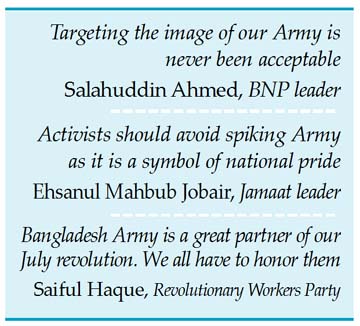
When contacted, BNP Standing Committee Member Salahuddin Ahmed told The New Nation, “As an institution, Bangladesh Army is icon of national dignity. Targeting the image of our Army is never been acceptable. It will be defamatory for the whole institution of the national Army.”
The eminent politician said, everyone should restrain from such heinous activities.
Contacted, Advocate Ehsanul Mahbub Jobair, spokesperson of Bangladesh Jamaat-e-Islami told The New Nation on Monday, “Though the social media is a open platform, the activists should avoid spiking Army as it is a symbol of national pride.”
He said everyone should act to protect our national symbols of unity.
Comrade Saiful Haque, General Secretary of Revolutionary Workers Party also echoed the similar opinion saying, “Bangladesh Army is a great partner of our July revolution. We all have to honor them.”
He asked the activists to focus the real culprits shunning the path of getting cheap popularity.
Sources said, Zulkarnain Saer Khan has used long Facebook threads and X posts to publish alleged inside information about senior army officers, their movements, and the involvement of certain units in political operations — sometimes framed as leakable facts and sometimes as commentary about the army’s proper role.
Those posts have been widely shared and also vigorously challenged as inaccurate by pro-government pages.
Pinaki Bhattacharya tweets and YouTube videos have warned that “top leadership of the armed forces is behaving alarmingly” and flagged what he describes as worrying links between military personalities and interim or shadow political actors.
Pinaki’s tone is often urgent and he sometimes calls for political mobilisation or vigilance in response to perceived military overreach. Pro-state outlets have accused him of spreading alarmist, destabilising narratives.
Kanak Sarwar, through his YouTube channel and social posts, has aired interviews, made allegations about security-force abuses, and posted commentary about specific incidents (including family members and detentions tied to his reporting).
State-aligned outlets and some politicians have labelled his coverage “anti-state” or misleading; human-rights and press-freedom groups, however, cite his family’s harassment as evidence of pushback against dissident journalists.
Elias Hossain, in some videos makes claims about how law enforcement / security forces are acting.
The other activists also in several times use the similar tools on provoking politics pointing the national defense forces.