
Alternative alliance takes shape ahead of nat’l polls
Abu Jakir :
With the 13th parliamentary election on the horizon, behind-the-scenes negotiations are quietly taking shape among several political forces-including Jamaat-e-Islami, the National Citizen Party (NCP), and a coalition of Islamist parties-who are exploring the possibility of coordinated electoral strategies as a potential alternative to the Bangladesh Nationalist Party (BNP).
While ideologically diverse, these groups are reportedly considering joint candidacies in key constituencies and coordinated campaign efforts aimed at challenging the BNP’s longstanding dominance in the opposition landscape. Party sources have been quick to clarify that the current discussions represent a “political understanding” rather than a formal alliance-at least for now.
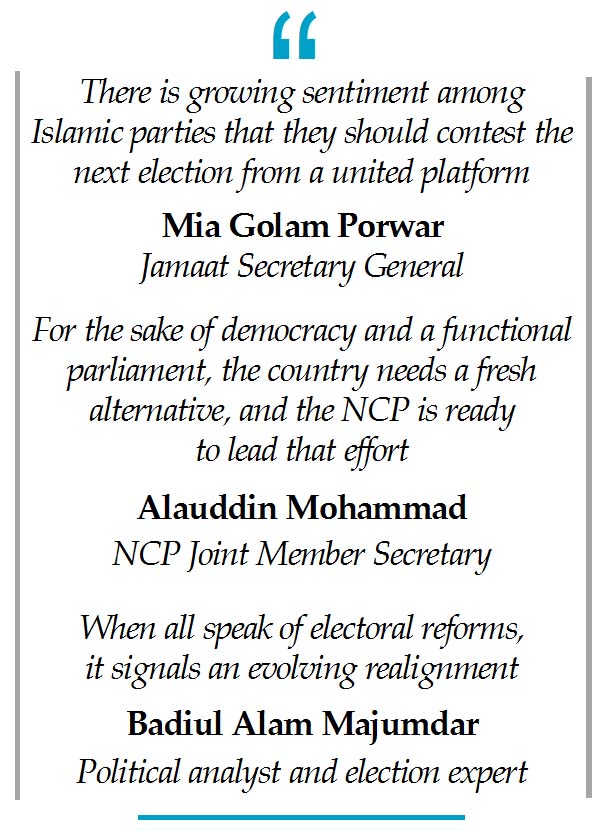
“There is growing sentiment among Islamic parties to contest the next election under a united platform,” said Jamaat Secretary General Mia Golam Porwar. “We are engaged in discussions and there is shared thinking across parties. However, this is not yet a formal alliance.”
Of particular note is the involvement of the National Citizen Party
(NCP)-a secular reformist party that emerged in the aftermath of the July 2024 Uprising. Although not an Islamist organisation, the NCP shares common ground with other parties on key reform issues such as proportional representation, constitutional restructuring, and decentralisation of executive power.
“NCP also envisions a new Bangladesh,” said Gazi Ataur Rahman, leader of Islami Andolan. “We have good mutual understanding. We do not want a return to authoritarianism, and the NCP aligns with us on that.”
In an interview, NCP Joint Member Secretary Alauddin Mohammad confirmed the party’s openness to forging a broader alliance with like-minded, smaller parties-while firmly ruling out cooperation with the BNP.
“We are committed to leading a political realignment ahead of the national election,” he said. “To ensure democracy and a functional parliament, the country needs a credible alternative-and the NCP is prepared to lead that effort.”
Though all involved parties appear to be positioning themselves as a distinct “third force” apart from both the BNP and the Awami League, sources suggest that any formal coalition is unlikely to be declared until the Election Commission announces the national election schedule. A liaison committee comprising several Islamist-leaning parties has already been formed to facilitate ongoing coordination.
Earlier this year, Char Monai Pir and Islami Andolan initiated efforts to consolidate Islamic political forces, bringing together five registered parties, including Bangladesh Khilafat Majlis, Jamiat Ulema-e-Islam, Nizam-e-Islam Party, and two factions of Khilafat Majlis.
In a notable demonstration of unity, leaders from Jamaat, NCP, Ganaodhikar Parishad, and other parties appeared together at a Dhaka rally last Saturday calling for electoral reforms and justice for those killed during the July uprising. Significantly, the BNP was neither present nor invited.
Addressing the rally, NCP’s northern organiser Sarjis Alam stated: “There will be no compromise on justice or structural reforms before the next election. A system of proportional representation is essential to ensure true representation in parliament.”
Both Jamaat and the NCP have also called for local government elections to be held prior to national polls-another departure from the BNP’s current position. In addition, they advocate for curbing the prime minister’s authority in appointing key constitutional officers and amending Article 70 to allow for greater legislative independence.
During a recent address in Nilphamari, NCP Convener Nahid Islam reiterated the party’s commitment to implementing the July Charter-a comprehensive reform proposal drafted following last year’s uprising.
“Bangladesh needs structural reform, not recycled elections,” Nahid declared. “We require a new constitution that reflects the aspirations of the people. The current political framework, rooted in the Mujibist legacy, has failed to uphold democracy or human dignity.”
Political analysts observe that the growing alignment between the NCP and Islamist parties, despite ideological divergences, reflects a strategic recalibration. With the BNP facing internal disarray and struggling to unify the opposition, the prospect of a third electoral bloc is becoming increasingly viable.
“When Jamaat, Islami Andolan, and NCP all speak of electoral reform and proportional representation – sometimes from the same platform-it indicates a shifting political landscape,” said election analyst Badiul Alam Majumdar.
Nonetheless, the situation remains fluid. The parties continue to engage – some openly, others behind closed doors-as they await the Election Commission’s announcement, and as public frustration deepens over the lack of a credible political alternative.