
AL-JaPa one and same Akhtar Hossain
Staff Reporter:
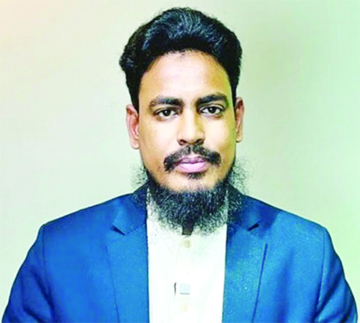
At a gathering that echoed the shifting undercurrents of Bangladesh’s post-Awami League politics, Akhtar Hossain, the member secretary of the National Citizen Party (NCP), delivered a fiery and introspective speech on Sunday afternoon.
Addressing the fourth founding anniversary of the Gono Odhikar Parishad at the Diploma Engineers Institute in Kakrail, Dhaka, he declared that the Jatiya Party had played the most decisive role in shaping what the Awami League had become over the decades.
“The Jatiya Party is not a separate entity—it is, in truth, the Awami League in disguise,” Akhtar said, his voice steady but cutting through the murmurs of the audience. “If Jatiya Party is allowed to participate in the next election while Awami League remains barred, then make no mistake—Awami League is still participating.”
His words drew nods and whispers across the crowded hall, where leaders from a spectrum of opposition parties—old and new—had gathered under a single banner to reflect on the nation’s fragile political transition.
Akhtar Hossain went on to assert that the caretaker government had given assurances that the Awami League would not contest the upcoming parliamentary election. “Those who are now advocating for Awami League’s return to electoral politics are, in effect, voicing anti-state sentiments,” he warned. “They must be held accountable under the law.”
Beyond his criticism of the past establishment, Akhtar spoke of consensus and unfinished promises. He reminded the audience that all major political forces had already agreed on fundamental reforms to the state structure, as well as on providing a legal foundation for the July Charter—a document now seen as the blueprint for a reformed democratic order.
“Despite this agreement,” he lamented, “we have achieved very little. To steer the country out of its crisis, we must ensure the full implementation of the July Charter. Every political party wants it to have a legal basis. The question is—where does the obstacle lie?”
He urged political leaders to confront those who might be placing their narrow partisan interests above national priorities. “If a party’s internal agenda stands in the way of the Charter’s realization, we must persuade them to abandon that self-interest,” he said. “Bangladesh demands unity—on that, there should be no disagreement.”
The event, presided over by Gono Odhikar Parishad president Nurul Haque Nur and moderated by spokesperson Faruk Hasan, turned into a tableau of political solidarity and reflection. BNP standing committee members Salahuddin Ahmed and Amir Khasru Mahmud Chowdhury, Jamaat-e-Islami secretary general Mia Golam Porwar, Ganasanghati Andolon coordinator Zonayed Saki, AB Party chairman Mojibur Rahman Monju, and several other leaders from Islamist, leftist, and nationalist fronts shared the stage—an uncommon sight in Bangladesh’s fractured opposition politics.
There were also emotional moments. Labour leader Rubel Hossain, who lost an eye during the July uprising, and family members of those killed in the protests—such as Miraj Hossain’s father Abdur Rob and Golam Nafiz’s mother Nazma Akhter—spoke briefly, reminding everyone of the human cost of the country’s ongoing struggle for justice and reform.
As the audience rose to its feet at the end of the program, the sense of a fragile but growing alliance hung in the air. Akhtar Hossain’s remarks had done more than criticize old political structures—they had reignited the conversation about what kind of democracy Bangladesh must now build, and who among its leaders is truly willing to leave the past behind.