
U.S.–Bangladesh Ties: AL, Indian media spin false propaganda
Special Report :
In recent weeks, certain Awami League–backed Indian media outlets have attempted to manufacture a sensational narrative: that the United States is planning a “takeover” of Bangladesh.
This claim, wrapped in alarmist headlines and mischaracterizations, is nothing more than a continuation of the fabricated storylines these same media actors have been pushing since the July 5th people’s movement.
The narrative is as predictable as it is false. Unable to come to terms with Bangladesh’s changing political realities, these outlets have sought to blame external powers, particularly the United States, for every shift in Dhaka’s political landscape.
Their latest attempt is to miscast routine U.S.–Bangladesh joint military exercises—longstanding, structured, and recurring—as evidence of an American plot.
The facts are clear. According to the U.S. Embassy in Dhaka, Bangladesh and the United States will hold three joint military exercises in 2025: Tiger Lightning, Tiger Shark, and Pacific Angel.
• Tiger Lightning – Conducted for the fourth consecutive year, this exercise focuses on counterterrorism, jungle operations, peacekeeping, and disaster response readiness.
• Tiger Shark 2025 – Part of the Flash Bengal series, running since 2009, this drill strengthens Bangladesh’s
Special Forces with training in patrol boat handling, small arms proficiency, and special operations.
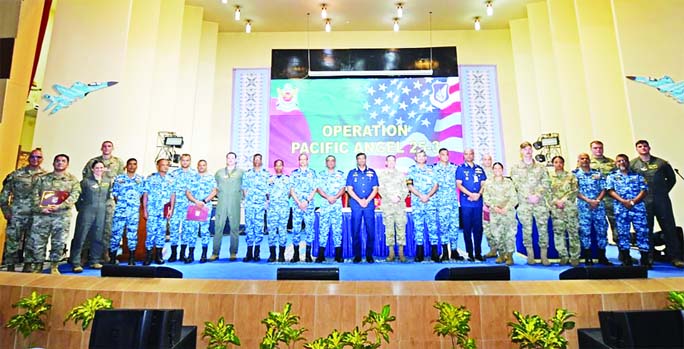
• Pacific Angel – Also in its fourth iteration, this joint program emphasizes humanitarian assistance, search and rescue, and aeromedical operations, including disaster response airdrops using C-130 aircraft.
Additionally, the United States is working with Bangladesh to introduce the RQ-21 Blackjack unmanned aerial system, which will boost maritime surveillance, border security, and peacekeeping capabilities.
None of these initiatives are new. They represent the deepening of a professional military-to-military partnership that has been ongoing for decades, consistent with Bangladesh’s sovereign interests.
Adding to the discomfort of Awami League–aligned Indian commentators is Bangladesh’s recent success on the economic front.
Dhaka concluded tariff negotiations with the Trump administration at a low rate of only 20%, while India was left grappling with a crippling 50% tariff.
This outcome highlights Bangladesh’s diplomatic agility and strategic engagement with Washington—further undermining the claim that Dhaka is being “taken over.”
Instead, it shows a government pursuing national interests effectively, securing better market access than its larger neighbor.
Another dimension conveniently ignored by these propaganda outlets is the current BJP regime under Narendra Modi actively hosting thousands of Awami League leaders and activists on Indian soil.
Reports allege that the Awami League has siphoned off over USD 200 billion to various countries, including India, through illicit operations.
While these funds represent the looting of Bangladesh’s resources, the narrative spun by Awami League–backed Indian media attempts to paint Bangladesh as a victim of U.S. domination, rather than acknowledging the cross-border networks that enabled this massive capital flight.
The irony is striking: even as Awami League leaders find refuge and financial channels in India, Indian media tries to vilify U.S.–Bangladesh cooperation.
The propaganda also attempts to bury the findings of the United Nations Office of the High Commissioner for Human Rights (OHCHR).
In February 2025, OHCHR released its Fact-Finding Report on Human Rights Violations and Abuses Related to the Protests of July–August 2024 in Bangladesh.
The report, based on an independent investigation, concluded that there are reasonable grounds to believe the former Awami League government, together with its security and intelligence apparatus, systematically engaged in extrajudicial killings, torture, arbitrary detention, and violent suppression of protesters.
Most strikingly, the report documented that over 1,400 people were killed during the July movement and its aftermath, with thousands more injured and detained.
The OHCHR further stated that these violations were carried out with the knowledge, coordination, and direction of political leadership and senior security officials, raising concerns that crimes against humanity may have been committed.
Rather than confronting this damning record, Awami League–backed Indian media have chosen to manufacture distractions, inventing stories about U.S. “takeovers” while ignoring international recognition of the atrocities committed against the Bangladeshi people.
Despite these clear facts, partisan voices in sections of the Indian press aligned with the Awami League have sought to sensationalize the issue. They frame continuity as conspiracy, cooperation as colonization. This is no accident—it is part of a broader disinformation strategy.
Since July 5, when citizens mobilized in unprecedented numbers to demand accountability, these outlets have struggled to explain away the popular uprising.
Instead, they choreographed a story of “foreign interference,” portraying the movement as Washington-orchestrated rather than people-driven. The new propaganda about “U.S. takeover” is an extension of this fiction.
False propaganda of this nature is dangerous for three reasons:
1. It distracts from genuine domestic issues. By scapegoating Washington, these outlets deflect attention from Bangladesh’s internal democratic demands and governance failures.
2. It undermines legitimate security cooperation. Joint exercises strengthen Bangladesh’s own military readiness, from peacekeeping to disaster response—areas where Bangladesh has an international reputation.
3. It attempts to polarize regional opinion. By fueling paranoia of U.S. intentions, these outlets play into a zero-sum narrative that Bangladesh must choose between Washington and Delhi, when in fact Dhaka’s foreign policy has always been multidirectional.