
ADP execution falls to 36.65pc in FY25
Staff Reporter :
Implementation of Bangladesh’s Annual Development Programme (ADP) for the 2024-25 fiscal year has fallen to its lowest level in at least 15 years, as political transition, fiscal austerity, and stalled projects weigh on development expenditure.
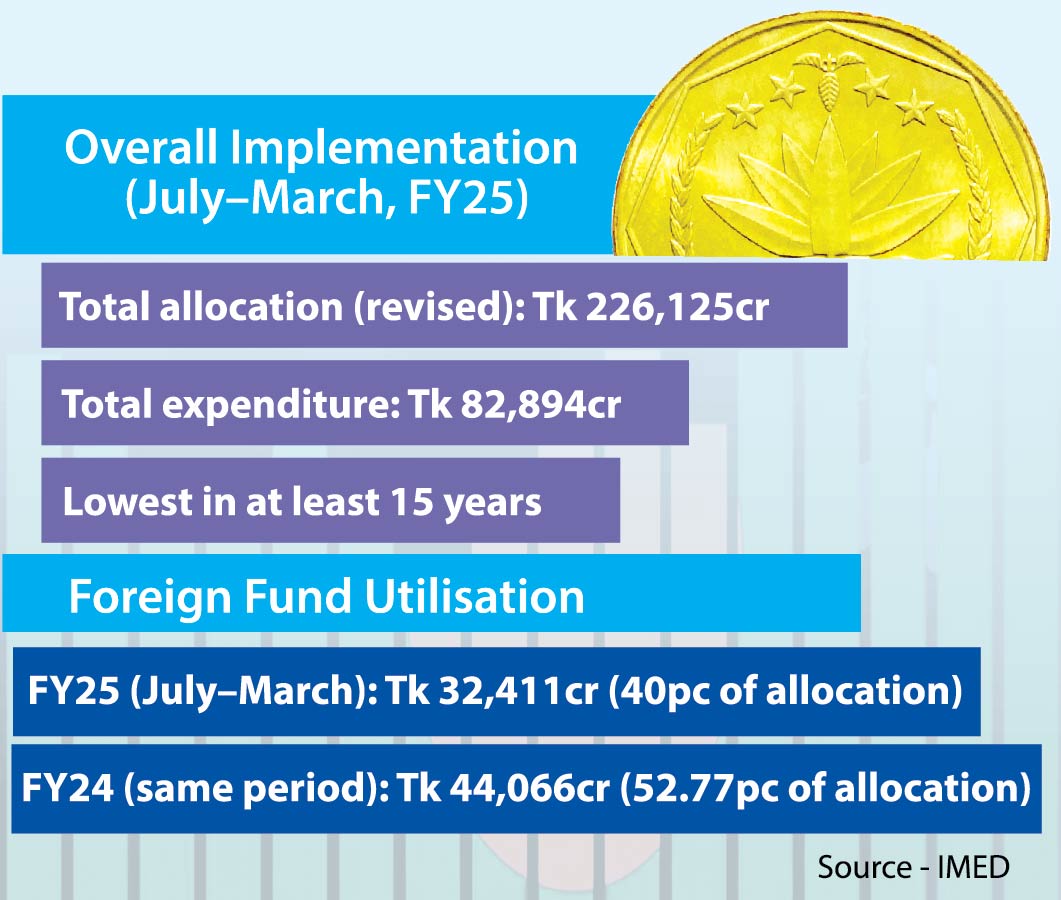
According to data released on Thursday by the Implementation Monitoring and Evaluation Division (IMED), the government utilised Tk 82,894 crore in the first nine months of FY25, representing only 36.65 percent of the revised ADP outlay.
The figure marks a significant decline compared to the same period in FY21-at the height of the Covid-19 pandemic-when the implementation rate stood at 42 percent.
Planning ministry officials attribute the underperformance to political unrest at the beginning of the fiscal year, which commenced on 1 July, and a cautious policy stance adopted by the interim government.
The current administration has initiated budgetary tightening, including the deferment or slowdown of several projects launched by the previous regime, in response to fiscal pressures.
Additionally, the situation has been exacerbated by the departure of several contractors who abandoned projects mid-execution following the political shift, further delaying implementation timelines and impeding progress.
In light of these challenges, authorities have revised down the total ADP allocation for FY25 by approximately Tk 53,000 crore, reducing it to Tk 226,125 crore to align with the prevailing fiscal and operational constraints.
Both domestic funding and foreign loan disbursements have experienced a downturn during the July-March period. Foreign fund utilisation dropped to Tk 32,411 crore-equivalent to just 40 percent of the revised allocation.
This contrasts sharply with the same period in FY24, when Tk 44,066 crore, or 52.77 percent, of the ADP was financed through external sources.
The performance of individual ministries and divisions varied considerably.
The Energy and Mineral Resources Division led in implementation, utilising 79.71 percent of its allocated budget, followed by the Power Division at 56.27 percent. In contrast, health-related sectors significantly underperformed.
The Health Services Division reported an implementation rate of only 14.41 percent, underlining ongoing challenges in delivering critical public health infrastructure and services.
The subdued pace of ADP execution highlights broader concerns over development capacity and policy continuity during political transitions.
Economists suggest that without restoring contractor confidence and ensuring consistent project management, the country may continue to struggle in meeting its development targets.