
Admin finally woke up to save ragged ‘White Stone’
Reza Mahmud, Dhaka, with :
Shofique Ahmed Shofiee, Sylhet :
At the source of the Dhalai River, along the Companyganj border, lies the ‘Sada Pathor’ tourist spot-an enchanting natural wonder formed over time by the accumulation of water, pebbles, and stones.
But now, it seems to have been all but destroyed by the greed of looters. Hundreds of crores of taka worth of mineral resources have been plundered day and night, right under the administration’s nose.
‘Shada Pathor’ in Bholaganj, Sylhet, is a haven of natural beauty and a popular tourist destination. Today, that mesmerizing area has grown almost colorless-more like a barren wasteland.
In the face of this unprecedented stone looting, the Anti-Corruption Commission (ACC) is pointing to the responsibility of the administration. ACC officials say the local administration should have been far more vigilant in protecting this natural resource.
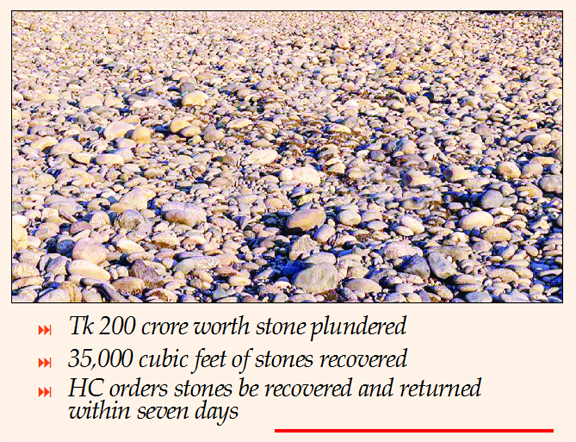
According to environmental activists and local traders, in just one year, around 15 million cubic feet of stones have been looted from Sada Pathor, with an estimated market value of over Tk 200 crore.
Only after the plunder of hundreds of crores worth of stones did it seem the Anti-Corruption Commission (ACC) and the Sylhet District Administration finally woke up.
When contacted, Dr. Ahmad Kamruzzaman Majumder is the Professor of the Department of Environmental Science at Stamford University Bangladesh told The New Nation on Thursday, “Preventive measures had to take before such huge plundering taking place.”
He urged the authorities to take stern actions against the stone plunders so that no one could brave to involve such heinous activities any more.
Bholaganj’s once-lush white-stone (Sada Pathor) landscape has been stripped bare after months of large-scale plunder, allegedly under the protection of local political leaders and influential people.
Sources said, extraction took place openly in the past 10 months. Following viral images and videos, criticism erupted at home and abroad, prompting the authorities to take several emergency measures including recovering and restoring those plundered stones.
Recent meetings by the Sylhet administration took such decisions.
Besides, the High Court has ordered that stones taken from Bholaganj in Companyganj, Sylhet, be recovered and returned within seven days.
The directive came Thursday after a hearing on a writ petition filed by Human Rights and Peace for Bangladesh, represented by lawyer Manzil Morshed.
The bench of Justice Kazi Zinat Hoque and Justice Ainun Nahar Siddiqa also ordered a list of looters, with names and addresses, and questioned why local administration inaction should not be declared illegal, why the area should not be protected and declared an Ecologically Critical Area (ECA), and why compensation should not be collected from those responsible. Four weeks were given for replies.
Although a High Court ban exists, extraction continued in Jaflong’s ECA-listed areas. Since August 5, 2024, political groups demanded reopening of quarries, claiming legality. Criminals exploited this to loot day and night. A three-member probe committee was formed, and environmental groups began protests.
ACC Investigation: On August 13, an Anti-Corruption Commission team visited Sada Pathar, confirming large-scale theft possibly involving influential businessmen, local leaders, and even administration officials. Locals alleged 50,000 labourers were engaged daily. The ACC will submit a report, estimating losses at several crores of taka.
After political changes on August 5, looting began in previously banned zones like Arefin Tila and Ropeway Bunker.
35,000 Cubic Feet of Stones Recovered: In a joint forces operation on Wednesday and Thursday about 35,000 cubic feet of stolen stones were seized from Kalairag and returned to the river.
Power to multiple crushing machines in Kolabari was cut. The army assisted within border limits, and checkpoints were set up on the Sylhet-Bholaganj road. Similar drives destroyed 100 boats and seized 130 cubic feet of sand in Jaflong.
Years of Unchecked Plunder: For years, Sylhet’s “stone empire” has been eroded by illegal extraction, reportedly protected by political leaders. Environmentalists warn Sylhet’s natural reserves may vanish if unchecked. Estimated losses: Tk 20 billion.
BNP Links and Protests: Over 50 BNP leaders and activists from Gowainghat, Jaintiapur, and Companyganj are allegedly involved. Some have been expelled for looting or leading protests demanding quarry re-openings. On August 10, leaders from BNP, Jubo Dal, Chhatra Dal, and Sramik Dal blocked advisers’ convoy in Jaflong.
Legal Cases, Limited Arrests: Since August 5, nine cases involving 226 accused have been filed over illegal extraction in Jaflong and Gowainghat, but arrests are rare. Raids temporarily halt theft, but activity resumes once officials leave. Residents say manpower shortages hinder enforcement.
Sylhet’s DC claims looting has dropped due to raids and power cuts, but locals insist these are temporary measures. Without stronger, sustained action, they fear the region’s natural beauty will be lost forever.
Different political parties backed stone lifting: On 24 June, during a human chain, Rezaul Hasan Kayes Lodi, acting Sylhet BNP chief, declared, “The stone quarries… have been shut down, kicking 1 million people in the stomach.”
Barrister Asaduzzaman Fuad, AB Party General Secretary, said, “We held a press conference last November… Later, we raised the demand… As a result, the stone quarries were opened.”
Jamaat’s Sylhet chief, Fakhrul Islam, questioned the closures’ motives: “It is time to investigate whether those… protecting the environment have any other agenda.”
By mid-September, Islami Andolan’s Syed Muhammad Faizul Karim Charmonai warned, “The river will silt up and cause floods… If necessary, stones will be extracted even by creating mobs.”
On 2 July, BNP leader Ariful Haque Chowdhury backed a sit-in by workers, accusing the administration of sabotaging local businesses.