
AC efficiency set at 25°C this summer
Reza Mahmud :
Energy Adviser Fouzul Kabir Khan announced on Monday that no organisations, institutions, or individuals will be allowed to set air conditioners below 25°C during the upcoming summer. He warned that violations of this regulation could result in electricity disconnection and legal action.
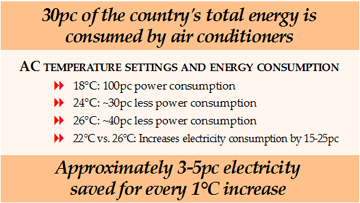
The government views this measure as a scientific and effective approach to addressing electricity shortages and load shedding, although energy experts have raised concerns about the challenges of monitoring compliance. Power sector officials stated that energy wastage due to excessive air conditioning is a significant issue, with air conditioners consuming around 30 per cent of energy.
They emphasised that even small changes in AC temperature settings can lead to substantial reductions in electricity consumption. For instance, a 1°C increase in the temperature setting can save around 3-5 per cent of electricity.
This measure mirrors similar actions taken in Malaysia, where air conditioners in government offices are now set at 24°C-25°C to reduce electricity consumption and contribute to the country’s goal of achieving net-zero greenhouse gas emissions by 2050. According to Nik Nazmi Nik Ahmad, the Malaysian Minister of Natural Resources, Environment, and Climate Change, air conditioners in government offices of Malaysia will now be set at 24°C- 25°C.
However, as per data, setting an air conditioner to 18°C results in 100 per cent power consumption, while setting it to 24°C can reduce consumption by approximately 30 per cent, and 26°C can reduce it by about 40 per cent. Setting the AC to 22°C instead of 26°C can increase electricity consumption by 15-25 per cent.
However, energy experts have criticised the move, arguing that monitoring compliance would be difficult and that it may ultimately prove ineffective.
They suggested that the government should explore alternative energy sources to address power shortages. Eminent energy expert Badrul Imam expressed doubts, stating that monitoring every organisation and household would be unrealistic. He warned that people may temporarily adhere to the rule during inspections but would likely ignore it once the monitoring ends.
Professor Shamsul Alam, another energy expert, advised that the government ensure the new measure does not conflict with existing electricity laws. He suggested that while there is a power shortage, impractical measures like this should be avoided.
Instead, the government should focus on increasing gas supplies and boosting electricity production from gas-fired power plants.
Energy Adviser Khan explained that the AC restriction aims to conserve energy during the peak summer months when electricity demand rises. The demand is expected to increase from 9,000 megawatts in winter to between 17,000 and 18,000 megawatts in summer.
To enforce compliance, the Power Division will notify various sectors, and the Commerce Adviser will inform private businesses.
The Religious Adviser will ask mosque imams to adhere to the AC guidelines, while the Cabinet Division Secretary will ensure that government offices comply. Monitoring teams will be deployed to identify areas of excessive power consumption, and load shedding may be implemented if necessary.
The Energy Adviser also noted that air conditioners contribute to around 6,000 megawatts of electricity usage during the summer months. He pointed out that many people set their ACs to 19-22°C while wearing sweaters indoors, further highlighting the need for the new measures. The central bank will also issue directives to banks in line with this policy.