
Blaze rages over 5-hour in Korail slum: About 1500 homes destroyed, no casualties reported
Staff Reporter :
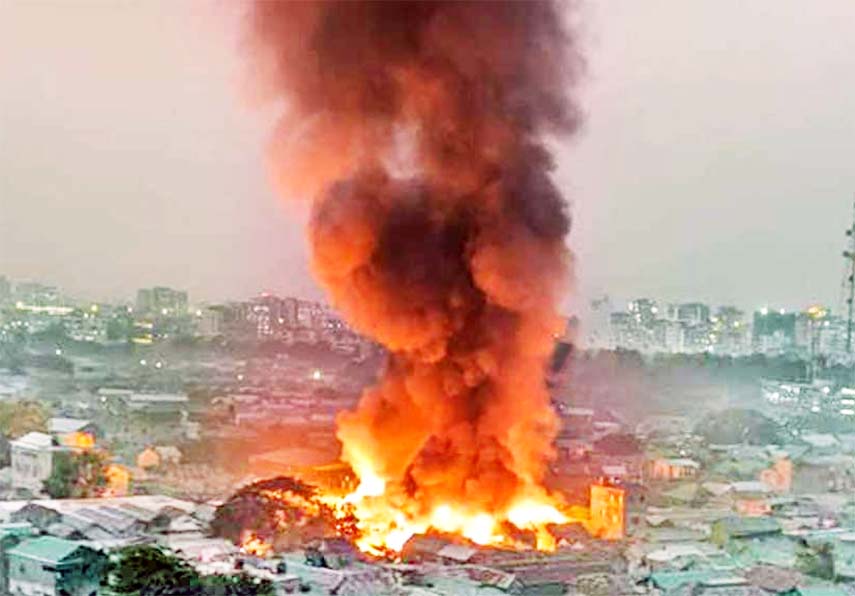
A devastating fire has been raging through the Korail slum near the capital’s Mohakhali–Gulshan area for over five hours, with the blaze growing increasingly uncontrollable, according to the Fire Service.
Nineteen firefighting units have been deployed in an effort to contain the flames, which have intensified particularly in the slum’s eastern zone.
The fire service brought the blaza under control at 10: 35 last night.
Families sat helplessly with the few belongings they managed to salvage as they waited for safety updates and emergency support.
Slum resident Marium, who has lived in Korail for 15 years, said she and her son could rescue only one item from their home — a freezer. “We couldn’t save anything else. Everything was swallowed by the fire,” she said.
Fire Service and Civil Defence Inspector Anwarul Islam said they received the alert around 5:19pm. By 9:05pm, he confirmed that 19 units had been dispatched,
with firefighters struggling to gain control of the situation.
Around 7:10pm, Anwarul told reporters that the fire was spreading rapidly, worsened by a severe water shortage and the slum’s narrow, congested lanes that hindered vehicle access.
“We had to draw water through a pipe from nearly a kilometre away, which is slowing down our response. Still, we’re doing everything we can,” he added.
At about 7:20pm, a power outage plunged the 90-acre slum into darkness as the fire tore through about 1500 homes, fire service officials said.
Eyewitnesses described scenes of panic — people running with whatever they could carry, residents trying to salvage valuables, and locals joining firefighters by using water from tube-wells to battle the flames.
The cause of the fire and the full scale of the destruction remain unknown.
Amid the chaos, two children reportedly went missing.
A distraught man was seen pleading with bystanders to help find them, saying their mother was in tears.
Md Monir, a physically challenged resident, escaped with the help of his son, Hridoy.
In his 25 years in Korail, Monir said he has witnessed at least 20 fires, underscoring the persistent vulnerability of the community.
Officials said the blaze, which began in the western part of the slum and crossed into the Boubazar area, has now engulfed nearly the entire settlement.
Residents described it as the most devastating fire in recent memory. Although no casualties had been reported, hundreds of homes have already been reduced to ashes.
Firefighters said water shortages are severely hampering efforts. To support the operation, three generators have been placed along Gulshan Lake and nearby canals, with multiple water pipes connected to them.
The Fire Service control room said the first call came in at 5:22pm. Eleven units are currently working on the ground, while eight more are on their way.
Korail has experienced multiple fires in recent months. On 22 February this year, a fire destroyed 61 homes before 10 fire units brought it under control. Another fire broke out on 18 December 2024, doused by seven units.
Research identifies Korail as one of Dhaka’s oldest and largest slums, covering around 90–99 acres and housing at least 80,000 people.
Its narrow alleys and tightly packed structures make firefighting extremely challenging.
The slum, located under Dhaka North City Corporation wards 19 and 20 and accessible by water across Gulshan Lake, hosts roughly 60,000 families, according to a recent Nagarabad survey.
Most live in single-room dwellings barely 14 square metres in size, often shared by up to eight people.
Homes are typically built from tin, bamboo, or whatever materials residents can gather. Many families migrated here after river erosion or in search of work.
Life in Korail is marked by constant uncertainty — fire, flooding, and eviction threats shape the community’s long struggle for survival.
A 2022 BUET policy brief estimated a staggering population density of 87,606 people per square kilometre.
The 2011 census recorded over 40,000 residents; with an increase of at least 10,000 in the years since, more than 50,000 people likely live there today.
In that case, dividing 90 acres among 50,000 residents amounts to roughly 78 square feet of space per person — below the minimum recommended benchmarks.
UN-Habitat advises at least 9 square metres (97 sq ft) per person to meet basic needs, while UNHCR emergency guidelines recommend 3.5 to 5.5 square metres (38 to 59 sq ft) per person in crisis situations such as refugee camps.