
Condominium Living: A growing trend among Dhaka’s middle class
News Desk :
Afzal Hossain, a resident of a condominium in Shantinagar, enjoys the convenience of daily amenities within his high-rise building and hopes to purchase another flat in a similar complex for his children – an aspiration common among Dhaka’s upper-middle-class families.
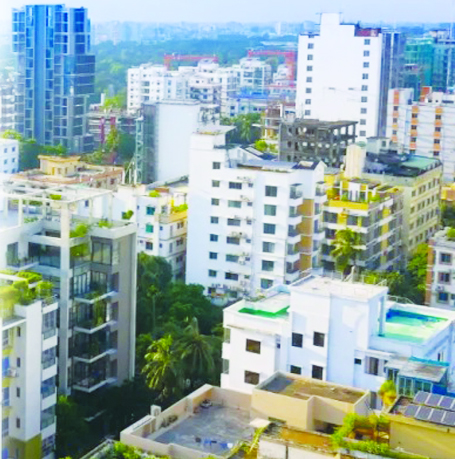
Since the 1990s, hundreds of housing companies have emerged across the capital, focusing on constructing tall buildings to meet growing demand while aiming to maximise profits. Landowners, unable to build themselves, often seek partial ownership by partnering with developers.
Dhaka Metropolitan Area covers 360 square kilometres, with its two city corporations accounting for 270 square kilometres following administrative changes in 2016. Though this represents less than 1 per cent of Bangladesh’s total land, it is home to nearly 20 million people, pushing population density beyond 50,000 per square kilometre. To accommodate this immense demand, high-rise buildings have proliferated over the past three decades, UNB reported.
While Rajuk estimates around 200,000 buildings within the city, urban planners believe the true figure exceeds 600,000 and continues to rise. In response, the Ministry of Housing and Public Works, through Rajuk, drafted a Detailed Area Plan (DAP) aimed at preventing Dhaka from becoming unlivable. However, the plan has stalled amid ongoing debates and revisions.
A key element of the DAP proposes regulating building height based on road width and plot size, limiting taller structures on narrow roads. Yet, developers resist Floor Area Ratio (FAR) restrictions, and protests in May pressured Rajuk to increase FAR allowances. Environmentalists and planners argue these concessions favour developers at the expense of the city’s future.
Land prices have soared dramatically. For instance, prices in upscale Gulshan have risen from Tk 5,000-8,000 per katha fifty years ago to Tk 50-80 million today. Similarly, Baridhara now ranks as the most expensive residential area, with official rates exceeding Tk 75 million per katha and market prices reaching Tk 100-150 million.
Commercial land prices in Motijheel, Banani, and Shantinagar have also surged. Vacant plots in prime locations are nearly nonexistent, pushing developers toward peripheral areas. Northern Badda, for example, has seen land prices rise from Tk 200,000-300,000 per katha a decade ago to Tk 5-6 million today, transforming from rural landscapes to clusters of 8-10 storey buildings.
Landowners often partner with developers, exchanging land use rights for partial ownership of multi-storey buildings, accelerating vertical growth in congested neighbourhoods like Beribadh, Badda, and Vatara. These areas lack adequate roads, parks, and open spaces, leading to increased traffic and deteriorating living conditions.
On August 10, the Ministry of Housing and Public Works is expected to finalise revised DAP regulations amid strong developer pressure. Sources indicate the plan will significantly increase FAR limits, enabling taller buildings, alongside easing construction approval processes.
While developers argue that height restrictions hinder meeting housing demand, urban planners warn that ignoring road widths and proper infrastructure risks making Dhaka unlivable. REHAB, representing developers, calls for uniform FAR policies across Dhaka, viewing current area-wise limits as unfair.
Conversely, the Bangladesh Institute of Planners emphasises the need for balanced urban planning, including schools, parks, and playgrounds, and stresses that narrow roads must restrict building heights. Its president, Adil Mohammed Khan, warns of potential legal action should the revised DAP undermine city planning goals, urging decentralisation to relieve Dhaka’s population pressure.
Without sustainable planning, experts caution, Dhaka’s rapid vertical expansion may compromise the city’s future livability and quality of life.