
Supply strong but prices higher

Despite a decline in international prices, edible oil costs in Bangladesh continue to rise, intensifying consumer hardship ahead of Eid-ul-Fitr. Traders in Chattogram’sKhatunganj wholesale hub cite supply shortages, although prices fluctuate even within a single day.
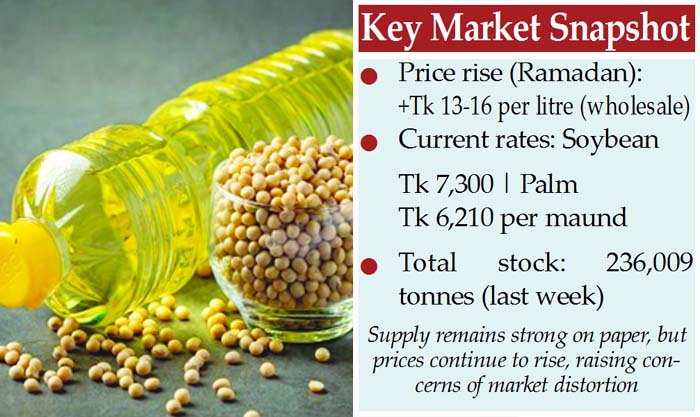
During Ramadan, wholesale prices of soybean and palm oil increased by Tk 13 to Tk 16 per litre, despite imports of 1.5 million tonnes over the past eight months.
As of last week, domestic stocks of refined and crude oil stood at 236,009 tonnes.
Supply at the port also appears strong.
Seven vessels carrying around 314,000 tonnes of edible oil are currently at Chattogram Port, with unloading expected soon. However, this has yet to ease market pressure.
After visiting Khatunganj, Commerce Adviser Khandaker Abdul Muqtadir described the gap between wholesale and retail prices as “unacceptable” and announced a fact-finding committee to investigate the causes.
According to the Ministry of Commerce, seven refining companies dominate the market. Their combined stock remained at 236,009 tonnes last week.
Letters of credit have been opened for 55,500 tonnes, while another 110,000 tonnes are in the import pipeline.
Refineries are releasing about 9,100 tonnes daily and supplied 85,000 tonnes over the past 21 days (until 15 March).
Meanwhile, global prices are falling.
The Bangladesh Trade and Tariff Commission (BTTC) reported a 6 per cent drop in the Free on Board (FOB) price of crude soybean oil over the past month, falling to $1,083 per tonne from $1,114.
Port data further contradicts supply shortage claims.
The seven docked vessels-Andrew Victory, Weco Holly, Ocean Diamond, Desert Virtue, Tomini Tenacity, Sarky, and Stena Conqueror-are carrying significant volumes of soybean oil.
Yet prices continue to climb in Khatunganj. Over the past week, wholesale prices rose by Tk 140-150 per maund. Before the Middle East conflict, soybean oil sold at Tk 6,700 per maund and palm oil at Tk 5,700.
Prices increased last week to Tk 7,100 and Tk6,060, and further to Tk 7,300 and Tk 6,210 this week. Traders blame reduced supply from mills.
Retail prices show sharper increases. In Chattogram city, loose soybean oil has risen by about Tk 9 per kg to Tk 202-204, while palm oil has increased by Tk 7 to Tk 173.
Abdus Salam, President of the Khatunganj Trade and Industries Association, said the market would stabilise if mills supplied oil as per demand, noting that control remains concentrated among a few players.
However, stakeholders offer conflicting accounts. Traders claim they cannot procure sufficient oil without paying higher prices, while ShafiulAtaharTaslim of T K Group insists supply is normal despite a 30 per cent rise in transport costs due to fuel shortages.
The Consumers Association of Bangladesh (CAB) suspects market manipulation. Vice-President S M NazerHossain alleged that artificial shortages are being created to push prices higher and pressure the government.
As Eid approaches, the gap between ample supply data and rising prices raises serious concerns over market governance and consumer protection.