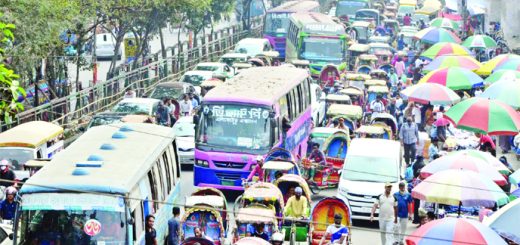
No bank counters, new notes sold costlier on footpaths

Fresh taka notes traditionally bring extra joy to Eid celebrations, particularly for children and younger family members.
Distributing crisp notes among relatives is a cherished custom that symbolises blessings and affection, making the festive occasion more memorable.
In previous years, people would visit commercial banks ahead of Eid to collect new notes.
This year, however, banks are no longer exchanging fresh notes directly with the public, and the central bank has also suspended several customer services, including cash exchange, savings certificate transactions and prize bond sales.
A spokesperson for Bangladesh Bank, Executive Director Arif Hossain Khan, said that new currency notes are still being supplied to banks according to demand and there is no shortage of notes in circulation.
However, he confirmed that, unlike previous years, special counters for exchanging new notes with the public are not being opened.
Many customers complain that the absence of dedicated exchange counters has limited public access to fresh notes. Some allege that, due to weak oversight, certain banks are prioritising corporate clients, associates and acquaintances, leaving ordinary customers unable to obtain new notes through formal channels.
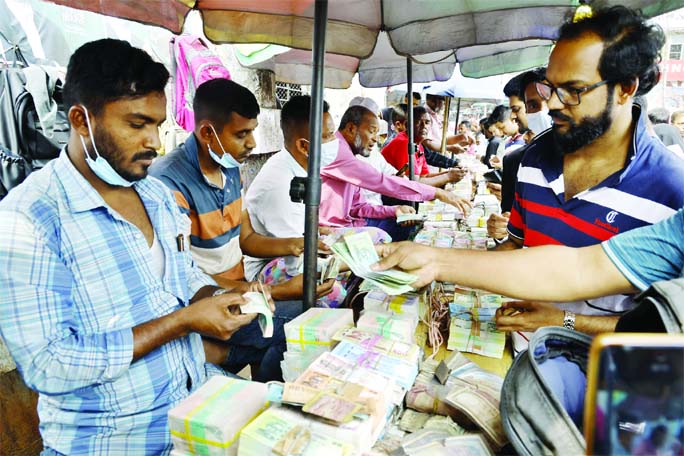
As a result, the price of fresh taka notes has risen sharply at informal footpath money changers in the capital.
Despite the higher cost, many people continue purchasing the notes in order to maintain the long-standing Eid tradition, while others find the additional expense difficult to manage.
With Eid approaching, these roadside exchangers have effectively become the main source of new notes for many residents. Buyers report paying between Tk 300 and Tk 500 above face value for a single bundle.
According to vendors and customers, a bundle of Tk 10 notes worth Tk 1,000 is currently being sold for about Tk 1,400—roughly 40 per cent above the original value, meaning each Tk 10 note effectively costs Tk 14. A bundle of Tk 20 notes (Tk 2,000) carries an additional Tk 500, while bundles of Tk 50 notes (Tk 5,000) and Tk 100 notes (Tk 10,000) are sold with an extra Tk 300.
At several footpath stalls in Motijheel, traders generally avoid breaking bundles of Tk 10 or Tk 20 notes and instead focus on higher denominations such as Tk 50 and Tk 100.
Although charging a premium for exchanging legal tender is illegal under Bangladesh law, the trade in fresh notes continues openly in parts of the capital, particularly along the sidewalks of Motijheel and Gulistan.
Alamin Hossain, who went to Motijheel after failing to obtain new notes from a bank, said the higher prices forced him to reconsider his purchase.
“If I buy Tk 1,000 worth of notes here, I have to pay Tk 1,400. That means Tk 400 extra,” he said, adding that he might buy only a few notes for children.
Abdul Alim, who was travelling home to Noakhali, said he buys new notes every year for his children.
“The price is higher this time, but they enjoy receiving fresh notes,” he said, noting that he may purchase a smaller amount this year due to lower income.