Drive to recover repatriate funds, assets

The government has initiated criminal and civil proceedings to recover assets allegedly siphoned out of the country, with investigations set to be carried out under both domestic and international legal frameworks.
Authorities said intelligence will first be gathered on assets that have been laundered abroad. Based on this information, investigations will be conducted through national and international agencies.
Alongside verifying the credibility of the information obtained, investigators will also collect documentary evidence.
Officials said criminal and civil cases will be filed against those involved in money laundering only after conclusive proof is established through analysis of the collected information.
Several cases have already been filed domestically based
on information obtained through multiple investigations within the country.
However, no cases have yet been filed in foreign jurisdictions.
Sources said intelligence gathering, investigations through domestic and international agencies and information exchange are under way to trace and seize the laundered assets.
According to officials, a large amount of money was allegedly siphoned out of banks through loan fraud during the tenure of the Awami League government that was ousted on 5 August 2024.
The total amount of funds laundered abroad could be as high as Tk 5 trillion. Efforts are now under way to recover the money.
Sources said the previous interim government had undertaken extensive initiatives to recover the laundered assets.
As part of those efforts, several assets in the United Kingdom belonging to former Awami League minister Saifuzzaman Chowdhury Javed and to Beximco Group—owned by Salman F Rahman, the then private sector adviser to the former prime minister—were seized.
Domestically, allegations have also surfaced that Saifuzzaman Chowdhury concealed information relating to bank loans. In some cases, assets allegedly laundered through the non-repatriation of export proceeds were brought back to the country through strict monitoring.
However, the effort to recover laundered funds slowed towards the end of the interim government’s tenure.
After assuming office, the current government identified asset recovery as a key priority.
Mastakur Rahman, the newly appointed Governor of Bangladesh Bank and chairman of the task force on asset recovery, has taken several measures in this regard.
These include initiating criminal and civil proceedings at both domestic and international levels, appointing international asset recovery firms to conduct investigations and pursue legal action abroad, and involving banks directly in the recovery process.
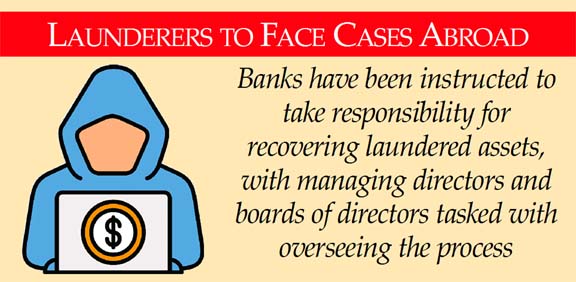
Banks have been instructed to take responsibility for recovering laundered assets, with managing directors and boards of directors tasked with overseeing the process.
Based on specific information about money laundering, six business groups have been identified and civil proceedings have already been initiated against them through the respective banks.
As a final step, cases are expected to be filed in the countries where the assets were allegedly laundered.
Once the first phase of the process is completed, Bangladesh Bank plans to launch a second phase focusing on more than 100 cases involving major loan defaulters and alleged money launderers.
Banks have also been instructed to sign agreements with international asset recovery firms to assist in gathering information, conducting investigations and pursuing legal action abroad.
The banks from which funds were allegedly siphoned have begun providing information on defaulted loans to these firms, which are analysing the data to trace the movement of laundered funds.
In addition, the Bangladesh Financial Intelligence Unit (BFIU) is collecting intelligence from various international sources on suspected money launderers.
When credible information is obtained, formal requests are made to the relevant authorities for further details.
The information gathered is being shared with the Anti-Corruption Commission (ACC) and the Criminal Investigation Department (CID), which are conducting further investigations and filing cases domestically.
Officials said that once the individuals involved are formally identified through these cases, it will become easier to pursue legal action in foreign jurisdictions.
The government is also communicating with authorities in countries where the funds are believed to have been laundered.
Through official information exchanges, if assets created abroad are identified as proceeds of money laundering or criminal activity, the respective countries may take action.
Under such arrangements, assets belonging to two groups have already been seized in the United Kingdom.
Banks have also been asked to initiate civil proceedings to establish their legal claims over the assets, which could facilitate their recovery.
These measures are being implemented in line with advice from international organisationsspecialising in asset recovery.
As part of the first phase of the initiative, six major groups have been identified over allegations of large-scale loan default and money laundering.
Civil proceedings are under way against them and, in the final stage; cases are expected to be filed in foreign jurisdictions.