Sylhet’s Basia River in peril

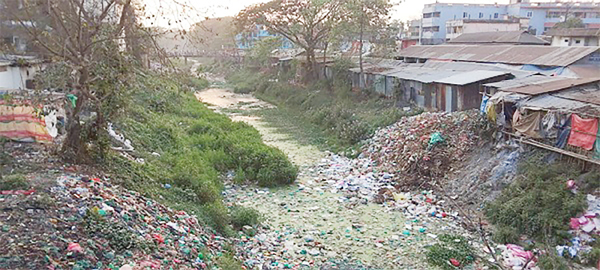
The once-flowing Basia River is gradually disappearing due to encroachment and pollution in Bishwanath, an expatriate-dominated area of Sylhet.
The foul stench from garbage dumped in the river is posing a serious risk to public health. What was once a fast-flowing river has now become a “thorn in the throat” for local residents.
Basia, one of the most important and traditional rivers of Sylhet, originates from the Surma River and flows through Dakshin Surma, Bishwanath, Osmaninagar, and Jagannathpur upazilas before merging with the Kushiyara River. Once about 44–56 km long and 200 feet wide, the river has now turned into a narrow, stagnant channel due to illegal encroachment, pollution, and dumping of garbage.
The river originates from the Surma River near Masukganj Bazar in Sylhet Sadar Upazila. It then flows through Kamal Bazar and Lalabazar in Bishwanath Upazila of South Surma, continues through Osmaninagar Upazila, and joins the Kushiyara River in the Khaika area of Jagannathpur Upazila in Sunamganj.
The Basia River was once a vibrant waterway where sailing boats used to ply. However, due to mismanagement, encroachment, and pollution over the years, its natural flow has been lost. Except during the monsoon season, the riverbed remains dry for most of the year—a reflection of a long lament.
Observations on the ground show that the river’s source is blocked, and illegal structures have been built in various markets and riverbank areas, including Bishwanath Bazar and Kaliganj Bazar. In some places, the banks have been filled with soil, while in others, the encroachment has been reinforced with structures and planted trees.
These activities obstruct the river’s natural flow and increase environmental risks.
To maintain control of both riverbanks, encroachers have halted river protection efforts under the cover of legal disputes. As a result, the river’s width continues to shrink. Concerned citizens are calling for the immediate removal of encroachments, cessation of pollution, and sustainable river management.
Locals say that dredging the river and evicting illegal structures are urgent measures. The dumping of garbage into the river is making daily life difficult due to the stench, while health risks are also rising.
According to residents, the plight of the Basia River poses a serious threat not only to the environment but also to livelihoods. They are demanding the removal of encroachments from both banks, cleaning of garbage, and immediate dredging of the river. For years, they have sought to restore the river with the cooperation of the authorities.
Bishwanath Upazila Nirbahi Officer Umme Kulsum Ruby said that the tender for river dredging has been completed, and excavation work can start soon. In addition, work is underway to create a designated site for dumping garbage.
Sylhet Water Development Board Executive Engineer Deepak Ranjan Das said that excavation work is in progress, and if illegal encroachments are removed with the help of the local administration, the dredging will be fully successful.
Sylhet-2 constituency MP Tahsina Rushdir Luna said that various initiatives have been taken to remove illegal encroachments on both riverbanks. Discussions are ongoing with encroachers and local businessmen to find solutions.
Measures are also being implemented to prevent garbage from being dumped into the river, and plans are in place to build another bridge at Bishwanath to improve mobility.