‘Fuel crisis’ excuse, bus fares soar before Eid

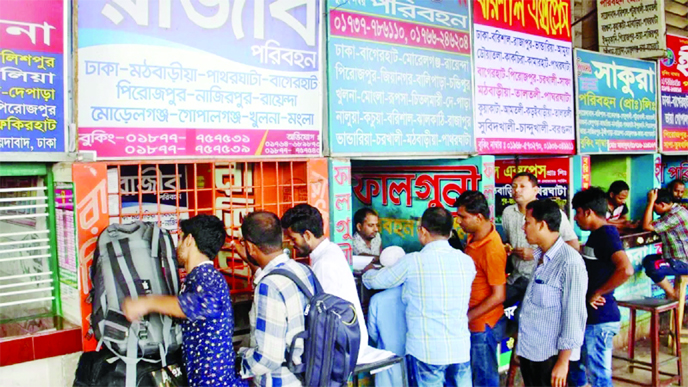
As thousands of people begin leaving the capital to celebrate Eid-ul-Fitr with their families, passengers in Dhaka are facing a familiar ordeal—inflated bus fares and difficulty securing tickets, with transport operators informally citing a possible fuel shortage.
At major terminals including Gabtoli Bus Terminal and Sayedabad Bus Terminal, many passengers complained that fares on several long-distance routes have increased beyond the government-approved rates.
On Wednesday afternoon, Popi Mondal, who was travelling to Meherpur, said she purchased a ticket for a JR Paribahan bus for Tk 750, although the usual fare for the route is around Tk 650.
“I had no option but to buy the ticket at a higher price because tickets are scarce and everyone is rushing home for Eid,” she said.
Hundreds of students, office workers and employees have already started their journeys to different districts to spend the holiday with their families. However, many say they are facing long queues, limited ticket availability and unusually high fares.
Passengers also alleged that ticket syndicates remain active, forcing travellers to pay higher prices for advance tickets.
During visits to several terminals, The New Nation correspondent observed that some bus supervisors and drivers were charging fares higher than the officially approved rates, despite government assurances that fares would remain unchanged.
Transport leaders, however, denied widespread irregularities.
Speaking to reporters, Shubhankar Ghosh Rakesh, general secretary of the Bangladesh Bus-Truck Owners’ Association, said the association is monitoring the situation closely.
“We are monitoring fares very strictly,” he said.
Meanwhile, Saiful Alam, general secretary of the Bangladesh Road Transport Owners’ Association, acknowledged that many petrol stations in Dhaka have become overcrowded.
“Even though the government has allocated fuel for public transport, some petrol stations are witnessing heavy crowds,” he said.
Government officials, however, rejected claims of a fuel shortage.
Sheikh Rabiul Alam, the Roads and Highways Minister, recently said there are no plans to increase transport fares or disrupt travel during Eid.
“The government has adequate fuel reserves. Buses will be supplied with sufficient fuel so that passengers can reach their destinations smoothly,” he said.
Similarly, Anindya Islam Amit, Adviser for Power, Energy and Mineral Resources, said the long queues at fuel stations were largely due to public anxiety rather than an actual shortage.
“There is no fuel crisis in the country, and there are currently no plans to raise fuel prices,” he said.
Despite these assurances, passengers say the situation on the ground tells a different story. Many allege that bus operators use the rumour of a fuel shortage as a pretext to charge extra fares, a practice that has been common during peak travel seasons for years.
A bus supervisor operating on the Dhaka–Khulna route, speaking on condition of anonymity, said owners often set revenue targets for supervisors.
“We have to meet the targets set by the owners. Without charging higher fares, it becomes difficult,” he admitted.
Passengers also said operators sometimes sell advance tickets at predetermined prices, but when passenger pressure rises closer to Eid, bus owners add extra trips and charge arbitrary fares.
Although authorities regularly warn transport operators against overcharging, travellers say effective enforcement is rarely visible.
To address the situation, the Dhaka South City Corporation (DSCC) has announced several measures to ensure smoother travel during Eid. These include removing illegal ticket counters, improving terminal management, clearing abandoned buses and strengthening passenger services at key terminals.
However, many commuters remain sceptical, saying that unless strict monitoring is enforced, passengers will continue to bear the burden of inflated fares every Eid season.