Govt seeks reforms as health system struggles
Staff Reporter :
Bangladesh’s new government is planning extensive reforms to overhaul a health-care system that experts say has been weakened by years of governance failures, underinvestment, and institutional stagnation.
In the early 2000s, Bangladesh was widely viewed as a global public health success story. Life expectancy increased, fertility rates fell sharply, childhood vaccination expanded, and maternal mortality declined at one of the fastest rates worldwide.
These gains were largely achieved through nationwide immunisation campaigns, family planning programmes, and community-based disease control initiatives supported by collaboration between the government, donors, and non-governmental organisations.
However, progress has slowed markedly over the past decade.
Ahmed Mushtaque Raza Chowdhury, a Dhaka-based public health expert who teaches at Columbia University’s Mailman School of Public Health, said the country initially benefited from relatively straightforward interventions.
“We harvested the low-hanging fruits through immunisation and preventive measures,” he said. “When more complex challenges arose, the system was never ready to respond.”
Health specialists say Bangladesh’s achievements have largely plateaued since 2010, leaving what they describe as a structurally weakened and dysfunctional system struggling to respond to rising demand and changing disease patterns.
Tahmeed Ahmed, executive director of the International Centre for Diarrhoeal Disease Research, Bangladesh, said the sector has deteriorated in recent years.
“The health of the health sector is not very good. Over the last several years it has declined, and that worries us,” he said.
Bangladesh’s population, currently around 180 million, is projected to reach approximately 250 million by 2050, further stretching public services.
At the same time, non-communicable diseases such as diabetes, hypertension, and cardiovascular disease now account for more than two-thirds of deaths nationwide.
Surveys suggest that about 25 per cent of Bangladeshis have hypertension, while between 6 per cent and 10 per cent are living with diabetes, many without knowing it.
Public health spending remains below 1 per cent of gross domestic product, among the lowest proportions in South Asia.
Around 70 per cent of health costs are paid directly by households, while out-of-pocket spending on diagnostic tests can reach as high as 80-90 per cent, placing heavy financial pressure on families.
Following its election victory, the Bangladesh Nationalist Party government has pledged to prioritise health-care reform.
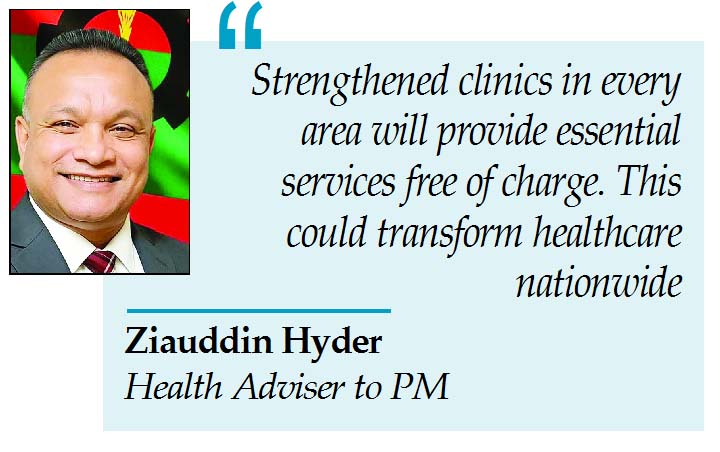
Ziauddin Hyder, a former World Bank health and nutrition specialist who is now advising Prime Minister Tarique Rahman, said strengthening primary health care will be central to the government’s strategy.
“Primary health care should be the backbone of any system in Bangladesh,” Hyder said, noting that historically it has remained weak. “We need functional primary health-care clinics, and these facilities must be strengthened.”
Bangladesh currently operates about 13,000 community clinics in rural areas, each intended to serve roughly 10,000 people.
However, experts say nearly 60 per cent of these facilities are poorly maintained. Health specialists estimate that at least 17,000 clinics will be required to provide adequate nationwide coverage.
Hyder said the government plans to establish primary health-care units in every rural union and urban ward, drawing inspiration from the United Kingdom’s National Health Service general practitioner model.
These units will provide maternal and child health services, mental health care, basic laboratory testing, and pharmacies supplying essential medicines free of charge.
“If they can really accomplish this, it will be a significant shift in the country’s approach to health,” Chowdhury said.
Workforce shortages remain another major challenge. According to the 2024 Bangladesh Health Workforce Strategy, of 77,877 sanctioned health-care posts nationwide, about 32 per cent remain vacant.
The shortages are most severe among nurses and midwives, where vacancies reach 62 per cent, followed by doctors and allied health professionals at around 40 per cent.
Hyder said the government intends to recruit about 100,000 additional health workers, roughly 80 per cent of them women, to strengthen community-level services.
He added that retention incentives and salary reforms would be needed, as many physicians prefer to work in cities where private practice offers higher income.
The government also plans to gradually increase public health spending from below 1 per cent to around 5 per cent of GDP as part of a broader push towards universal health coverage.
However, experts warn that financial investment alone will not solve the sector’s problems.
“If governance remains weak, no matter how many resources you invest, outcomes will not change,” Chowdhury said, stressing the need for stronger accountability and better management across the health system.