Fuel rationing imposed as energy stocks fall

Selim Reza with Muhammad Ayub Ali :
The missiles are landing in the Middle East, yet their ripple effects are visible in Dhaka as lights flicker under mounting energy shortages.

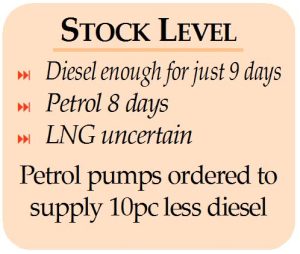
The ongoing Middle East conflicts are affecting Bangladesh’s oil and gas supplies. Delays in two shipments have led the government to impose nationwide diesel rationing, instructing fuel stations to sell 10 per cent less diesel amid tight stocks.
Qatar’s Energy Minister Saad al-Kaabi warned that Gulf energy producers could halt exports within weeks, potentially pushing global oil prices to $150 per barrel, according to an interview with the Financial Times published on Friday.
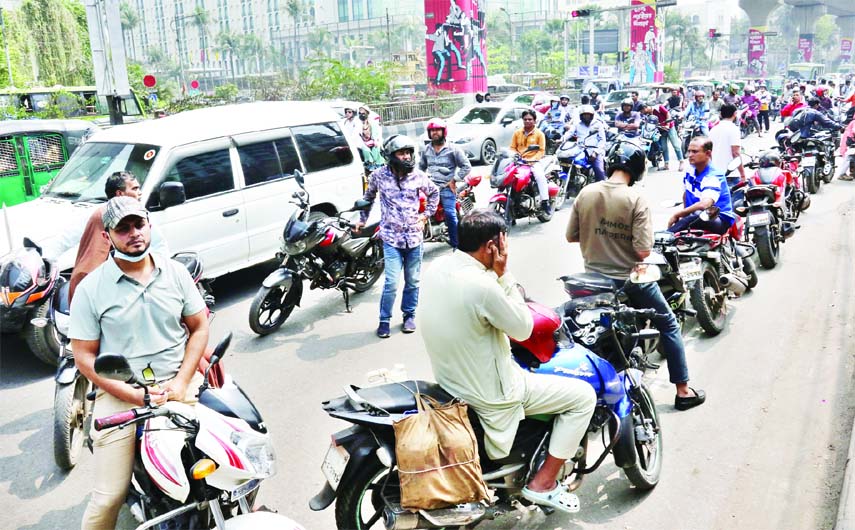
Long queues have already formed at fuel stations as consumers rush to fill up amid concern over shortages. Authorities are taking measures to prevent hoarding and over-purchase.
The situation is further complicated by Qatar Energy’s announcement that it cannot deliver two planned cargoes of liquefied natural gas (LNG) this month. The government is exploring spot-market purchases, but no sellers had been found as of last Wednesday.
Dr. M. Tamim, Professor of Petroleum and Mineral Resources Engineering at the Bangladesh University of Engineering and Technology (BUET), told The New Nation that Bangladesh should look for alternative sources of oil and LNG from countries such as China, Singapore and Malaysia, although securing LNG supplies from other nations may be challenging.
He warned that the situation could deteriorate gradually due to the Strait of Hormuz is shut down, which would intensify the energy crisis in the coming days.
On the other hand, Production at four state-owned urea fertilizer plants has remained suspended for the past 15 days due to a shortage of natural gas.
The affected factories include Palash Fertilizer in Ghorashal, Chittagong Urea Fertilizer Limited, Jamuna Fertilizer Company, and Ashuganj Fertilizer and Chemical Company.
BCIC Director (Production and Research) Moniruzzaman said on Friday that authorities had instructed the plants to halt operations for 15 days.
“We have been asked to shut down for this period, but it is still unclear what decision will be taken after that,” he added.
Energy officials warn that if these LNG shipments cannot be replaced soon, a gas shortage could emerge after 15 March.
In preparation, authorities may ration gas, prioritising households and industries while reducing supply to power plants.
The decision followed a meeting at the Secretariat on Wednesday chaired by Minister of Power and Energy Iqbal Hasan Mahmud Tuku.
Speaking after the meeting, the minister said the impact of the Middle East crisis had already reached Bangladesh and urged citizens to conserve fuel and electricity.
He also recommended avoiding decorative lighting in shops and exploring alternative energy sources.
The ongoing Middle East conflict intensified following recent US-Israel strikes on Iran. Bangladesh’s energy security has been affected, with the Bangladesh Petroleum Corporation (BPC) reporting critically low diesel stocks, sufficient for just nine days.
Over the past week, petrol stations and dealers have been selling diesel at higher-than-usual rates, with daily demand rising from around 11,000–12,000 tonnes to over 13,000 tonnes. Consequently, 2,307 pumps have been instructed to limit diesel sales by 10 per cent.
Global oil prices have also surged, with refined oil rising over $22 per barrel since Monday.
Diesel prices jumped from $80 to $109 per barrel, causing the government to lose over TK 40 per litre. Authorities are also concerned about potential diesel smuggling into neighbouring India.
As of 4 March, fuel stocks were: diesel 115,473 tonnes (9 days), octane 28,152 tonnes (15 days), petrol 17,364 tonnes (8 days), furnace oil 66,192 tonnes (60 days), Z fuel 41,084 tonnes (36 days), and kerosene 30,859 tonnes (170 days).
Bangladesh typically receives 15–16 oil shipments each month, with upcoming arrivals including MT Lucky (30,000 tonnes of diesel) on 7 March, MT Raffles Samural (30,000 tonnes) on 8 March, MT Shantelmo on 15 March, and MT Trom Delhi on 18 March, though some shipments remain unconfirmed.
The energy shortage is expected to affect electricity and fertiliser production. Citizens are urged to avoid decorative lighting, reduce the use of personal vehicles, and refrain from panic buying.
Bangladesh requires around 7 million tonnes of fuel annually, including more than 4 million tonnes of diesel.
Petrol stations have reported long queues, with cars waiting 40 minutes to an hour at night. At Tejgaon filling station, daily sales rose from TK 50 lakh to TK 80 lakh, mostly octane.
The LNG sector is also under strain. Following a terminal attack on Monday, Kuwait Energy announced it cannot deliver two cargoes on 15 and 18 March.
Alternative sourcing through Petrobangla, RPGCL, and international markets has so far been largely unsuccessful.
Indonesia has confirmed it cannot supply LNG to Bangladesh, prioritising domestic demand, while China and India dominate the international market.
In a meeting with US Assistant Secretary of State Paul Kapur, Energy Minister Tuku noted that Bangladesh’s daily gas demand of 400 million cubic feet currently exceeds supply, which stands at 260 million cubic feet, including 100 million cubic feet from LNG.
Any further disruptions could intensify the energy challenge.
With global supply uncertainties and rising prices, Bangladesh faces a challenging period as it navigates the ripple effects of Middle East tensions.