Iran vows unyielding resistance in ‘Hybrid War’
Diplomatic Correspondent :
An Iranian diplomatic official in Dhaka said Iran would never surrender in the ongoing war with the United States and Israel, describing the confrontation as a complex ‘hybrid war’.
Syed Reza Mirmohammadi, Cultural Counsellor, Embassy of the Islamic Republic of Iran also urged the government of Bangladesh to formally clear the stance against the United States and Israel.
Speaking to journalists during a meeting at Iran Cultural Centre in the capital on Thursday, he said the conflict cannot be understood solely as a military confrontation.
“This is not just a conventional war.
It is a hybrid war,” he said. “It includes political pressure, economic sanctions, media influence and geopolitical competition.”
According to him, several underlying factors explain why Iran has become a target. He pointed to the country’s long historical legacy, the ideological influence of the Iranian Revolution, and Iran’s growing technological capabilities.
“One reason is our 6,000-year-old civilization. Another is the revolution that changed the political structure of our country. And a third reason is our progress in science and technology,” he said.
“In satellite technology, atomic energy, nanotechnology and many other scientific areas, Iran has made remarkable progress. Some powers cannot accept this reality,” he added.
The Iranian official argued, “This did not begin overnight. For years Iran has faced sanctions, political pressure and different forms of confrontation. The current attacks are a continuation of that process.”
He said the conflict combines military strikes, diplomatic pressure and economic restrictions.
“That is why we call it a hybrid war. Military, political and economic elements are all involved at the same time,” he said.
The official also argued that Western powers see Iran as an increasingly influential regional power.
About the future leadership, he said despite loses the Iranian state structure remain intact.
“Iran’s system is strong and stable. It is built on three pillars – leadership, governance and the people,” he said.
He explained that under the Iranian constitution, if a senior leader is killed or unable to perform duties, a temporary council takes over state responsibilities.
“In such situations, a three-member council is formed involving the president, the judiciary and the Guardian Council. This council ensures that the state continues to function normally,” he said.
The official emphasised that the Iranian population strongly supports the government during the conflict.
“More than 99 percent of the Iranian people stand with the system,” he said. “After the attacks, people immediately took to the streets across the country.”
He added that demonstrations were held in multiple cities showing solidarity with the government.
“Even after the martyrdom of important figures, people became even more united. Their blood has made the nation stronger,” he said.
He insisted that surrender is not an option. “The people of Iran will never surrender. Iran will never submit,” he said.
Syed Reza Mirmohammadi also criticised what he described as weak international responses to the conflict.
“According to international law and the rules of the United Nations, such attacks should be condemned clearly,” he said. “But what we are seeing is a situation where power decides everything.”
“It looks like a jungle law where the stronger side imposes its will without respecting international law,” he said.
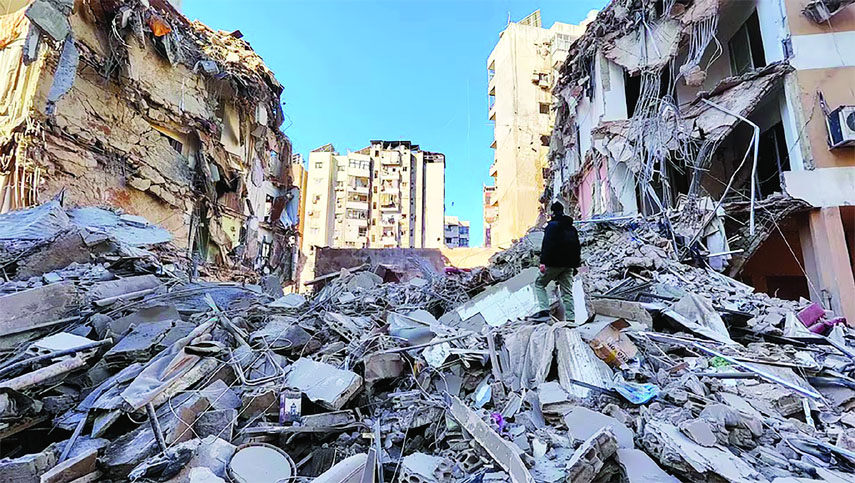
Responding to questions about Iranian strikes on American military installations in Gulf countries, the official defended the actions.
He said the attacks targeted military bases used by the United States in countries such as Bahrain, Qatar and the United Arab Emirates.
“These bases are used as platforms for launching attacks on Iranian cities,” he said. “Our response targeted those military installations.”
Mirmohammadi thanked the people of Bangladesh for showing solidarity through protests and public demonstrations.
“We are grateful to the people of Bangladesh,” he said. “From the beginning of the conflict many rallies and protests were organised expressing support for Iran.”
However, he said the embassy believes the official position of the Ministry of Foreign Affairs of Bangladesh lacks clarity.
“The statements issued by the government are not clear enough,” he said. “We hope the new government will reflect the feelings of the Bangladeshi people and take a clearer position.”
He urged Dhaka to explicitly condemn the attacks carried out by the United States and Israel.
The diplomat also appealed to the Bangladeshi media to report what he described as the “true picture” of the conflict.
“We request journalists to publish truthful news about what is happening,” he said. “The violations of international law must be presented clearly to the world.”
Looking beyond the current conflict, the official said the war could influence global geopolitical dynamics.
“The consequences of this war will not remain limited to Iran,” he said. “It could affect neighboring countries and the wider region.”
He suggested that ongoing global tensions – including competition between the United States and China, as well as emerging blocs like BRICS – indicate that the international system is changing.
“We are moving toward a new world order,” he said.
When asked how long the conflict could continue, the official said the outcome remains uncertain.
“It is difficult to predict how long the war will last,” he said. “But Iran will continue to resist.”
He added that the Iranian leadership believes perseverance and faith will ultimately determine the outcome.
“We believe that with the support of our people and our faith in Allah, Iran will overcome this challenge,” he said.