Fuel rush causes long queues in capital
Staff Reporter :
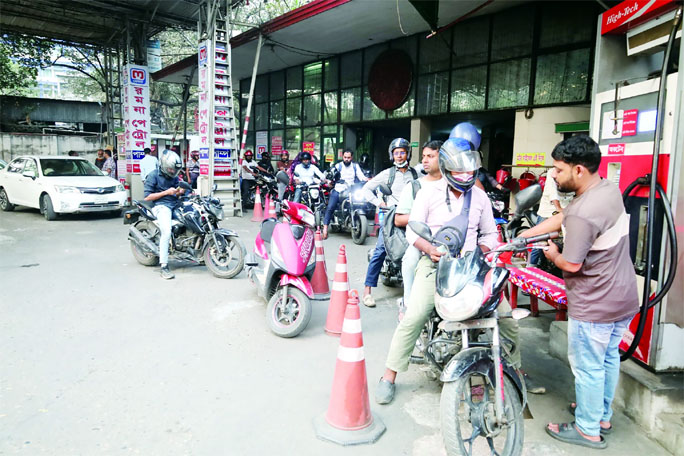
Panic buying has gripped fuel stations across Dhaka, with vehicle owners forming long queues to fill their tanks amid rising tensions in the Middle East.
Since Wednesday night, filling stations in the capital have experienced a sharp surge in demand, as cars and motorcycles lined up to purchase fuel.
In several areas, queues extended onto main roads, contributing to traffic congestion.
Fuel pump workers said they had received no official instructions and had not observed any indication that a price increase was imminent.
At the Eureka Enterprise fuel station in Mohakhali, staff reported that the usual flow of vehicles had multiplied significantly.
“Most customers are opting to fill their tanks completely,” said Rezaul Karim, a pump worker. “Many appear concerned that prices may rise or that fuel supplies could run short.”
Imran, a motorcyclist waiting in line, expressed a similar concern.
“Normally I buy only what I need, but fearing a possible crisis, I filled my tank for Tk 1,080,” he said.
Fuel station owners described the surge in demand as panic buying.
Mohammad Nazmul Haque, president of the Bangladesh Petroleum Dealers, Distributors, Agents and Petrol Pump Owners Association, warned that excessive purchases could quickly strain supplies.
“If consumers attempt to buy fuel far beyond their normal needs, reserves may be depleted prematurely,” he said.
According to him, fuel sales rose by around 60 per cent on Wednesday and reached nearly 80 per cent above normal levels by Thursday afternoon.
“If this trend continues, sales could double by the evening. Fuel stations can only sell what suppliers provide, and once stocks are exhausted, pumps will have no option but to close,” he added.
At the Gulshan Service Station, sales representatives reported that while prices remained unchanged, the volume of fuel sold had increased by about 1.5 times.
In response to the geopolitical uncertainty, the Ministry of Power, Energy and Mineral Resources issued a press release on Thursday urging consumers to adopt precautionary measures to conserve fuel.
The ministry cautioned that the evolving situation in the Middle East could disrupt global energy supply chains.
It advised the public to use public transport where possible, practise carpooling, limit unnecessary travel, enforce strict fuel-saving measures in government offices, and avoid excessive fuel consumption in commercial activities.
Officials from the ministry also held a meeting with petrol pump owners on Thursday to determine supply quotas based on previous average consumption, with the aim of preventing hoarding and managing the sudden increase in demand.