Trade deal with Washington ‘Not Irreversible’
Diplomatic Correspondent :
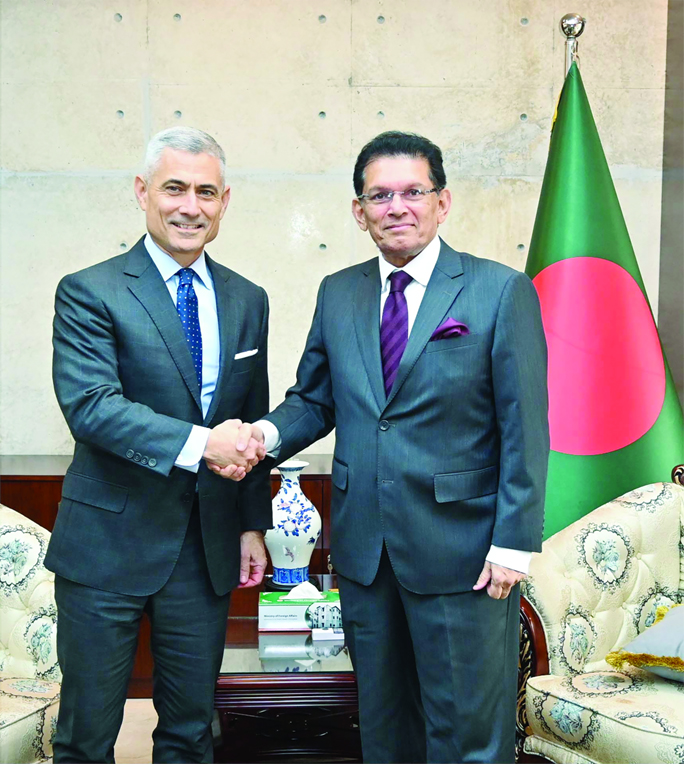
Foreign Minister Khalilur Rahman on Wednesday said the government would not enter into any agreement that undermines national interests, while confirming that Dhaka has sought tariff relief in the United States market.
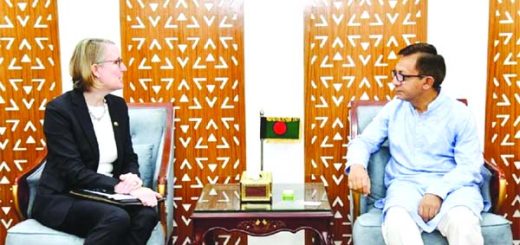
Speaking to journalists at the Foreign Ministry after a meeting with S. Paul Kapur, Assistant Secretary of State for South and Central Asian Affairs, the minister rejected suggestions that the recently concluded trade understanding with Washington had been rushed or compromised sovereignty.
“We have said that we will review the matter, and if any measures are required, we will take them strictly in accordance with the country’s laws,” he said. “It is not correct to suggest that we have compromised national interests or locked Bangladesh into something irreversible.”
Addressing criticism that the agreement was hurriedly signed shortly before the national election, Dr Rahman said negotiations had begun more than a year ago.
Bangladesh first raised concerns over its trade deficit with the United States in February last year. Talks intensified after Washington imposed reciprocal tariffs in April and continued through July, alongside discussions with other partner countries.
“At one stage we were facing a 20 per cent tariff,” he noted, adding that an understanding was largely reached by 31 July. He also said the Office of the US Trade Representative had consulted leaders of the country’s two main political parties prior to the election.
Framing the deal as a pragmatic response to external pressure, the minister said that without a negotiated framework Bangladesh could have faced tariffs as high as 37 per cent.
“Could we compete in that market with a 37 per cent tariff? We must consider the alternatives,” he said.
Under the current arrangement, Bangladesh faces a 19 per cent tariff—slightly above India’s reported 18 per cent rate.
However, Dr Rahman pointed to what he described as strategic gains, including zero reciprocal tariffs on garments made from American cotton and US-origin man-made fibres, a development of significance to the country’s ready-made garment sector.
He added that Bangladesh had also negotiated provisions on rules of origin, an area of particular sensitivity for exporters. Washington, he said, took additional time to finalise those clauses.
As part of the broader understanding, Bangladesh has committed to purchasing goods worth approximately $22 billion from the United States, including long-term energy imports over 15 years.
By comparison, the minister said India had committed to purchases valued at $500 billion over five years under its own arrangement.
“When one compares what Bangladesh has offered and what it has secured, the picture becomes clearer,” he said.
Dhaka has also formally requested a further reduction of tariffs under Section 301 of US trade law, seeking to bring the rate below 19 per cent.
The matter will be pursued with the Office of the United States Trade Representative. The minister said he remained “optimistic” about achieving additional relief.
Responding to questions about sovereignty and strategic alignment, Dr Rahman emphasised that the agreement contains both entry and exit provisions.
“The agreement will not become effective without notification,” he said, adding that it includes a 60-day exit clause, allowing the government to review, renegotiate or withdraw should it prove disadvantageous.
He also clarified that defence cooperation, including references to possible Acquisition and Cross-Servicing Agreement (ACSA) and General Security of Military Information Agreement (GSOMIA) arrangements, was not discussed in his meeting with Paul Kapur.
The minister acknowledged that the broader Indo-Pacific policy would require review by the newly installed BNP-led government, which has been in office for two weeks. “We will reassess our position carefully. Our highest priority is national security,” he said, reiterating that Bangladesh would not engage in bloc politics.
Echoing these remarks, Commerce Minister Khandaker Abdul Muktadir said the agreement is neither fixed nor irreversible. Following his separate meeting with Mr Kapur, he noted that bilateral trade currently stands at approximately $8.5 billion, with around $2.75 billion in imports from the United States.
“No agreement is final,” he said. “All agreements allow scope for amendment and renegotiation. If necessary, we can revisit the terms through further discussions.”
While debate continues among business groups and policy analysts, the government maintains that negotiated certainty — at 19 per cent — is preferable to the prospect of more severe and unpredictable tariff measures.