Bangladesh faces triple threat amid US-Iran conflict
Muhammad Ayub Ali :
Tensions in the Middle East are no longer distant headlines for Bangladesh they are fast becoming a direct economic threat.
As the conflict between the United States and Iran intensifies, economists warn that Bangladesh could face mounting financial strain across multiple fronts, including energy security, remittance inflows, trade stability, and the labor market.
A prolonged regional war risks sending shockwaves through the country’s fragile recovery, exposing structural vulnerabilities in its heavy reliance on Middle Eastern energy supplies.
Experts caution that the prolonged conflict in the Middle East could pose a serious threat to Bangladesh’s financial stability.
The country’s heavy dependence on imported energy leaves it particularly exposed to external shocks.
At present, Bangladesh meets nearly 65–70 percent of its total energy demand through imported LNG, crude oil and LPG most of which originate from Middle Eastern suppliers.
Around 55 percent of LNG imports come from Qatar and Oman, while close to 20 percent of crude oil is sourced from Saudi Arabia and the United Arab Emirates. Nearly all LPG imports also come from the region.
With domestic demand standing at roughly 1.2 lakh tonnes of LPG per month, any supply disruption could trigger sharp price increases and widespread shortages, intensifying inflationary pressure.
The situation has become more concerning following attacks on industrial facilities in Qatar’s Ras Laffan and Mesaieed areas, prompting state-owned QatarEnergy to temporarily suspend LNG production.
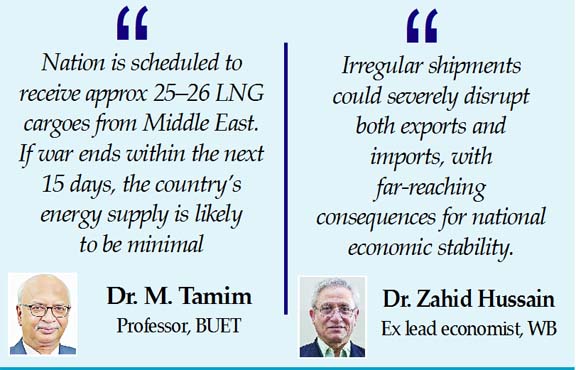
Speaking to the New Nation, Dr. M. Tamim, Professor of Petroleum and Mineral Resources Engineering at Bangladesh University of Engineering and Technology said that Bangladesh is scheduled to receive approximately 25–26 LNG cargoes from Middle Eastern countries.
“However, those shipments now face uncertainty due to the ongoing conflict.”
He said, “If hostilities subside within the next two weeks, the overall impact on energy supplies may remain limited.
A prolonged war, however, could create serious obstacles to securing LNG imports, placing significant strain on both the energy sector and the broader economy.”
What about the remittances Remittances another pillar of Bangladesh’s economy are also vulnerable.
The Middle East accounts for roughly 50–60 percent of the country’s total remittance inflows, with more than 70 percent of Bangladeshi migrant workers employed in Arab oil-exporting nations.
Economist Muinul Islam told The New Nation that while remittance flows remain stable for now, an extended conflict could disrupt employment and income streams, jeopardising a critical source of foreign exchange.
Trade ties with the region may also suffer.
According to Export Promotion Bureau data, Bangladesh exported goods worth $10.9 million to Iran in the last fiscal year, primarily jute yarn.
Meanwhile, the UAE and Saudi Arabia remain key export destinations, with shipments exceeding $350 million and $290 million respectively.
Dr. Zahid Hussain, former lead economist at the World Bank’s Dhaka office, warned that irregular shipping and logistical disruptions could affect both exports and imports, with far-reaching consequences for economic stability.
Speaking to the New Nation, former BGMEA director Mohiuddin Rubel said that such indirect impacts would likely place additional pressure on industries and households alike, compounding the challenges already facing the economy.
Although Bangladesh is not directly involved in the conflict, a sustained rise in global oil prices could drive up electricity and production costs, weaken export competitiveness, and accelerate domestic inflation.