Lobbying heats up for reserved women’s seats
Abu Jakir :
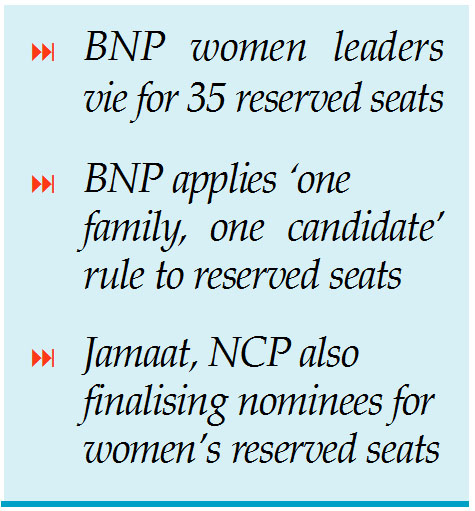
A high-stakes battle is quietly unfolding within the BNP as women leaders vie for the 35 reserved parliamentary seats following the party’s sweeping election victory.
Senior leaders of the party’s women’s wing, along with former activists of its student and associate bodies, have stepped up lobbying efforts in recent days.
Their presence has increased noticeably at the party’s central office in Naya Paltan and its political office in Gulshan, as hopefuls seek to draw the attention of top policymakers.
Party insiders say nearly a hundred women leaders are vying for nomination.
The allocation of reserved seats follows the publication of the official gazette of elected members by the Election Commission on 13 February.
Under constitutional provisions and the Representation of the People Order, the 50 reserved women’s seats in parliament are distributed among parties in proportion to the number of directly elected members they secure.
In the 13th parliamentary election, BNP won 209 seats outright, entitling it to 35 of the 50 reserved seats. Bangladesh Jamaat-e-Islami is set to receive 11 seats, while the National Citizens Party (NCP) will receive one.
The remaining three seats will be distributed among independents and smaller parties that won seats under their own symbols.
The Commission has indicated that it is considering holding the reserved-seat election during Ramadan, with the aim of completing the process before Eid.
Under the law governing reserved women’s seats, the election must be completed within 90 days of the publication of the final gazette of general election results.
The Commission will announce the schedule, including nomination submission, scrutiny, withdrawal, and voting dates.
Within BNP, the stakes are high. Having secured an absolute majority in the House, the party is treating the nomination process as politically significant.
Senior leaders say several criteria will guide the final decision: active participation in past movements, particularly anti-government campaigns; organisational competence; long-standing loyalty to the party; personal integrity; and contributions in professional and social spheres.
Party sources stress that nomination will not be determined solely by recommendations.
Grassroots acceptability and demonstrable political engagement—especially during the 16-year struggle against the previous government—are expected to weigh heavily in the leadership’s deliberations.
BNP also intends to uphold its “one family, one candidate” principle, a policy it adopted in the general election to encourage leadership development and avoid dynastic concentration.
If strictly applied to the reserved seats, the policy could sideline several familiar faces and open the door to younger or less-established figures.
According to party insiders, families that already have members serving as MPs or ministers are unlikely to be considered for reserved nominations.
A wide array of names has surfaced in discussions. They are: Afroz Abbas, president of Jatiyatabadi Mohila Dal; Hasina Ahmed, spouse of standing committee member and Home Minister Salahuddin Ahmed; Sultana Ahmed, general secretary of Jatiyatabadi Mohila Dal; Shammi Akter, member of the BNP media cell; Nazmun Nahar Baby, vice-president of Mohila Dal; former MPs Asifa Ashrafi Papia, Nilufar Chowdhury Moni, Rasheda Begum Hira, Rehena Akter Ranu and Yasmin Ara Haque; Nipun Roy Chowdhury, general secretary of Dhaka district BNP and member of the party’s central executive committee; Helen Jerin Khan, joint secretary of Mohila Dal; Arifa Sultana Ruma, member of Dhaka South BNP; Samira Tanzina Chowdhury, daughter of late leader Haris Chowdhury; Syeda Adiba Hossain, daughter of former MP Mokbul Hossain; Ferdousi Ahmed Misti, sister of late former Chhatra Dal president Nasir Uddin Pintu; Bithika Binte Hossain, spouse of late Swechchhasebak Dal president Shafiul Bari Babu; Sanzida Islam Tuli; Shahinur Nargis, central office secretary of Mohila Dal; former Chhatra Dal leader Shaukat Ara Urmi; Selina Sultana Nishita; Nadia Pathan Papon; Shahinur Sagar; Chemon Ara Begum; Jahan Panna; Bilkis Islam; Farida Yasmin; Mansura Alam, joint general secretary of Chhatra Dal; Jannatul Ferdous, former assistant student affairs secretary of the Private University Chhatra Dal.
A number of figures from the entertainment industry—among them singers Baby Naznin, Rizia Parvin and Kanak Chapa, as well as film actress Moushumi—are also being mentioned as potential nominees.
Speaking to the New Nation, former lawmaker Nilufar Chowdhury Moni said she had been reaching out to party high command.
“If the party considers me competent, it will nominate me. If it chooses someone else, I will have no objection,” she said, adding that she had been active on the streets during the movement to unseat the fascist government.
Nazrul Islam Khan, a member of the BNP standing committee, said the party would nominate those “who have been dedicated and committed to the party and its past movements, and who are competent.”
Sultana Jesmin, a former Chhatra Dal leader and Dhaka University graduate, argued that political labour should be matched by academic merit. “There should be a combination of sweat and scholarship in politics,” she said.
For its part, Bangladesh Jamaat-e-Islami confirmed that it is finalising its nominations, consulting its women’s division to identify suitable candidates capable of playing an effective parliamentary role.
The NCP, entitled to one seat, is reportedly considering joint convenor Monira Sharmin and southern regional joint chief organiser Mahmuda Alam (Mitu).
BNP Secretary General and Local Government Minister Mirza Fakhrul Islam Alamgir indicated that the finalisation of nominations for reserved seats is unlikely before Eid. Meanwhile, Baby Naznin said she was not actively lobbying but hoped that “those who truly deserve it” would be nominated.
In the direct election to 299 constituencies, 86 women contested, and seven were elected—six from BNP and one independent. Once the 50 reserved seats are filled, the total number of women in the 350-member parliament will stand at 57, roughly 16 percent of the House.
Under the current framework, one reserved seat is allocated for every six general members. In cases where fractional adjustments are required, the law allows for recalculation and, in some instances, even a lottery mechanism.
With the constitutional deadline still weeks away, parties have time to negotiate internally. But within BNP, at least, the contest for influence and recognition is already well underway.