‘Pilkhana tragedy exposed security lapses’
Staff Reporter :
Prime Minister Tarique Rahman on Wednesday described the 2009 Pilkhana massacre as a “sinister attempt” to undermine Bangladesh’s sovereignty, as families of the slain army officers renewed their demand for justice and accountability 17 years after the bloodshed.
Speaking at a views-exchange meeting with relatives of the 57 army officers killed during the mutiny at the then Bangladesh Rifles headquarters, the prime minister said the army symbolised the nation’s sovereignty and that the events of February 25–26, 2009 had exposed deep vulnerabilities in the country’s security architecture.
“The army is a symbol of our sovereignty. I believe the tragic incident at Pilkhana was an evil attempt to foil our sovereignty,” he said.
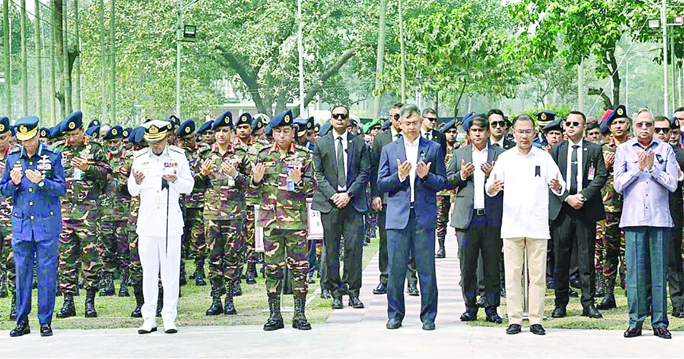
The programme was held at the Army Multipurpose Hall in Dhaka Cantonment to mark Jatiya Shaheed Sena Dibas (National Martyred Army Day). The day commemorates the killing of 74 people, including 57 top military officers, during the mutiny that began at Pilkhana and later spread to other parts of the country.
Referring to the security lapses revealed by the carnage, the prime minister said Bangladesh’s national security framework must be modernised in line with evolving global realities. “Our national security structure needs to be more modern, time-befitting and stronger. Our government will certainly work towards this goal,” he added.
Home Minister Salahuddin Ahmed, Chief of Army Staff General Waker-Uz-Zaman and Border Guard Bangladesh Director General Major General Mohammad Ashrafuzzaman Siddiqi also addressed the gathering. The prime minister’s wife, Dr Zubaida Rahman, and their daughter Zaima Rahman were present.
During the event, three representatives of the bereaved families spoke of their anguish and frustration over what they described as an incomplete quest for justice. Rakin Ahmed, son of slain BDR chief Major General Shakil Ahmed, said their foremost demand was to bring the “directing forces and conspirators” behind the killings to justice.
Nehrin Ferdousi, wife of Colonel Mujibul Haque, said the families had waited 17 years for justice and did not want further delay. “We want to know the names of the criminals and see them punished for their wrongdoing,” she said.
Outside the official ceremony, relatives reiterated that justice remained elusive despite mass trials and multiple inquiries. They urged the BNP-led government to act swiftly to ensure accountability.
The massacre occurred less than two months after the December 29, 2008 general election that brought the Awami League, led by Sheikh Hasina, to power.
The initial official investigation attributed the mutiny to years of pent-up grievances among rank-and-file soldiers over pay and treatment. In 2013, a mass trial sentenced hundreds of BDR members, though critics dismissed the process as flawed and politically influenced.
In 2024, the Ministry of Home Affairs formed a seven-member body to re-examine the findings of the original 2009 commission amid widespread criticism.
That panel evolved into the National Independent Investigation Commission, which submitted its final report in November 2025 to former chief adviser Prof Muhammad Yunus. The report has not been made public.
According to media accounts of the Commission’s findings, the new report contradicts earlier conclusions and alleges direct involvement by senior figures linked to the then-ruling Awami League.
Those named include lawmaker Sheikh Fazle Noor Taposh, former defence and security adviser Major General (retd) Tarique Ahmed Siddique, and former army chief General Moeen U Ahmed.
The most substantial evidence cited against Tarique Ahmed Siddique and General Moeen U Ahmed reportedly stems from testimonies by senior military officials, including current Army Chief General Waker-Uz-Zaman, who was present near the scene on the day of the mutiny.
According to the Commission’s account, then Major Waker-Uz-Zaman reached the vicinity of Pilkhana around 10:30am and positioned troops from the 46th Independent Infantry Brigade near Gate 4, prepared to intervene. Lt Gen (retd) Abdul Mubeen, then principal staff officer of the Armed Forces Division, testified that he had instructed Waker to take position on a rooftop in Dhanmondi and fire rocket shells at the gate to break the siege.
Mubeen told the Commission that Tarique Ahmed Siddique later ordered him not to intervene and questioned his authority to issue such instructions. The report says Tarique bypassed the chain of command and explicitly instructed Waker not to launch an attack, citing the government’s preference for a political resolution.
The Commission further states that Tarique was alerted to the unfolding massacre as early as 9:37am, when Major Md Zaedi Ahsan Habib, trapped inside the Darbar Hall, called him seeking assistance. Zaedi later survived and testified before the inquiry.
Testimony from Maj Gen Rezanur Rahman Khan, then a colonel and additional director general (operations) of RAB, indicated that he had ordered RAB units to proceed to Pilkhana and authorised them to open fire if necessary. However, he said Tarique called him en route and directed him instead to the state guest house Jamuna. Upon arrival, he was advised to cancel the order to fire and not to intervene without proper authorisation.
Rezanur told the Commission that he was instructed by the then director general of the Special Security Force and by Tarique not to enter Pilkhana. He relayed those instructions to forces on the ground and said repeated requests to intervene were denied.
The report also examines the role of General Moeen U Ahmed, who attended an emergency cabinet meeting at Jamuna and was tasked with overseeing the military response.
According to the Commission’s findings, the then army chief failed to issue specific operational orders to the 46th Brigade and spent crucial hours at Jamuna rather than directing field operations.
Despite reports of officer fatalities by noon, the Commission says he supported political negotiations and ordered troops to withdraw to a position two miles away, a decision that allegedly enabled further killings and allowed perpetrators to flee.
Additionally, the Commission questioned the actions of senior intelligence officials, including the monitoring of mobile networks at the National Monitoring Centre under instructions that allegedly bypassed formal command structures.
It noted that extended monitoring without clear authorisation raised concerns about whether officers’ locations were being identified and relayed during the crisis, though it stopped short of making definitive conclusions on that point.
On February 23, the BNP-led government announced it would form another commission to reinvestigate the massacre to “ensure justice,” signalling that further inquiries are anticipated.
Meanwhile, Maulana Mamunul Haque, ameer of Bangladesh Khelafat Majlis, demanded swift and full disclosure of the Pilkhana events. In a statement marking Martyred Army Day, he called for a neutral, transparent and credible process to uncover the truth and bring the real perpetrators to exemplary punishment. He urged political actors not to exploit the tragedy for partisan gain, saying justice — not division — should guide the nation’s response.
At 1pm on Wednesday, family members were scheduled to lay wreaths at the graves of the slain officers at Banani Military Cemetery in Dhaka, marking the 17th anniversary of a tragedy that continues to cast a long shadow over Bangladesh’s civil-military history.