Kitchen to Coffin: Deadly gas blasts shake Bangladesh
Muhid Hasan :
A residential gas cylinder explosion in Cumilla on Tuesday left four family members critically injured, including a toddler, just days after a separate blast in Chattogram’s Halishahar area killed two people and severely burned eight others.
These incidents are the latest in a troubling surge of gas explosions across Bangladesh, highlighting a growing national safety crisis.
The Halishahar blast on Monday destroyed parts of a residential building, with rescue teams rushing victims to nearby hospitals. Two of the critically injured later died, while others remain under intensive care.
The Cumilla explosion, occurring just a day later, underscores the widespread risk posed by faulty LPG cylinders and aging pipelines in homes across the country.
Gas cylinder explosions and leak-triggered blasts are rapidly emerging as one of Bangladesh’s most alarming public safety threats, with official data and reported cases showing a sharp rise in incidents and casualties between 2024 and 2025, and continued deadly explosions in early 2026.
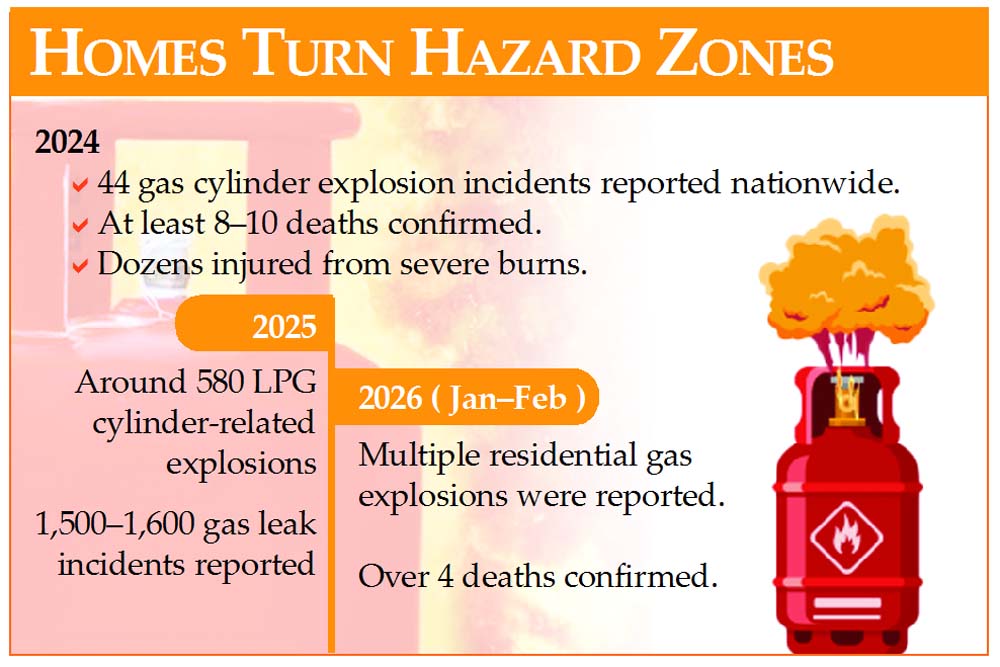
Government figures indicate that in 2024, at least 44 gas cylinder explosion incidents were officially recorded across the country.
Among the deadliest was a March 2024 blast in Gazipur’s Kaliakoir area, where 10 people died after multiple cylinders exploded inside a residence. Dozens more suffered severe burn injuries.
Nationwide, gas cylinder explosions that year resulted in at least eight confirmed direct deaths and numerous injuries, though burn specialists say actual injury figures may be higher due to underreporting in district-level incidents.
The crisis escalated dramatically in 2025. According to the Fire Service and Civil Defence, LPG cylinder accidents surged to approximately 580 incidents nationwide, marking a steep increase compared to 2024’s confirmed explosion count.
Officials further estimated that total gas-related explosions and serious leak-triggered incidents ranged between 1,500 and 1,600 during the year.
Several of those incidents turned fatal. In September 2025, a warehouse explosion in Chandanaish, Chattogram, left multiple workers critically burned, with at least five victims later dying in hospital.
Other district-level residential and vehicle-related gas cylinder explosions also resulted in deaths and injuries throughout the year, though consolidated nationwide fatality figures specific only to blast events remain fragmented.
The comparison between 2024 and 2025 reflects a striking pattern: from 44 confirmed cylinder explosions in 2024 to roughly 580 LPG-related blast incidents in 2025 — more than a tenfold increase in reported cases. Safety analysts describe this as a “clear upward trajectory” in gas blast frequency.
Early 2026 shows little sign of improvement. On 23 February 2026, a gas cylinder explosion at a residential building in Halishahar, Chattogram, left eight people severely burned, including children.
Two later died from their injuries. Within days, another household explosion in Cumilla injured four family members, three of them critically.
With multiple serious residential blasts recorded within the first two months of the year, experts warn that 2026 could match — or even surpass — 2025’s alarming totals if preventive measures are not strengthened.
Safety specialists attribute the surge to several overlapping factors: the rapid expansion of LPG use in households and commercial kitchens, weak monitoring of cylinder quality, illegal refilling operations, aging pipeline systems, and poor public awareness about leak detection and safe storage.
Brigadier General Muhammad Zahed Kamal, Director General of the Fire Service and Civil Defence, has repeatedly cautioned that LPG usage is increasing nationwide without a corresponding rise in safety compliance.
Medical professionals at burn treatment centers say gas blast victims often arrive with devastating injuries. Many suffer long-term disability, while treatment costs place heavy financial burdens on families.
Doctors note that a significant portion of these explosions are preventable with basic safety measures — such as checking regulators and hoses regularly, ensuring proper ventilation, and avoiding unauthorized cylinder modifications.
Without tighter regulation, routine inspection drives, and tougher penalties against illegal traders, the country risks normalizing preventable explosions as a recurring tragedy.
As Bangladesh moves further into 2026, the data tells a stark story: gas blasts are no longer isolated accidents but a growing national hazard.
The rise from dozens of confirmed explosion incidents in 2024 to hundreds in 2025 coupled with continued deadly blasts this year underscores an urgent need for coordinated national action.