
Ramadan Market: Fruits out of reach for mid-income people
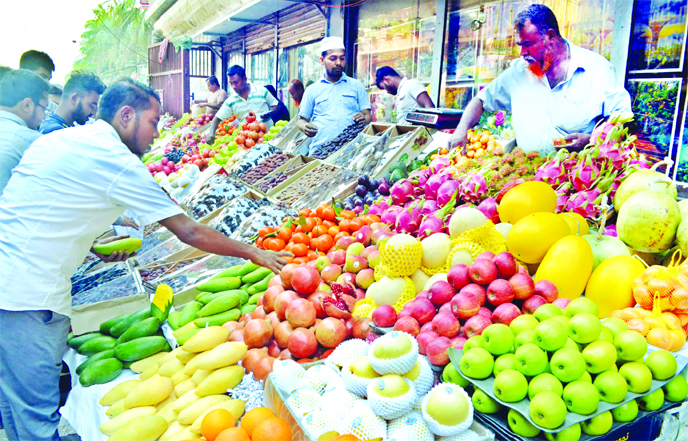
Muhammad Ayub Ali :
As Ramadan began, the rising cost of fruits delivered an early shock to many middle-income families in Dhaka.
On the first day of fasting, Alamin visited Shonirakhra market hoping to buy fruits for iftar.
What he found instead were prices far beyond his expectations. With nearly Tk800 in hand, he could afford only two maltas, four oranges, four apples and a small bunch of grapes—barely enough for a family meal.
Over the past two to three weeks, prices of imported fruits have surged sharply, increasing by Tk50 to Tk150 per kilogram.
Locally grown fruits have not been spared either, with papaya, banana, guava and plum becoming costlier by Tk30 to Tk60 per kilogram.
For families already grappling with higher living costs, the jump has made regular fruit consumption increasingly difficult.
“Earlier, I could easily buy a kilo or two of fruit for my children every month,” Alamin told The New Nation. “Now even picking a few pieces feels like a struggle. Even local fruits are beyond our reach.”
Market visits to Shahjadpur, Karwan Bazar, and Eskaton showed a clear Ramadan-driven spike in demand for dates, apples, grapes and maltas.
Malta and oranges are selling at Tk320–Tk360 per kilogram, red apples at Tk360–Tk400, green apples at Tk430–Tk450, green grapes at Tk430–Tk450, and red grapes at Tk520–Tk550. Pears are priced around Tk450 per kilogram, while pomegranates range between Tk500 and Tk600.
Prices climb even higher in supermarkets, where imported varieties dominate the shelves. Dates—a staple of iftar—have seen some of the steepest increases.
Even lower-grade Zahidi dates, usually preferred by low-income households, have jumped significantly within a week, while premium varieties such as Dabbas, Kalmi and Medjool continue to rise.
Traders attribute the surge mainly to Ramadan demand. Habib, a vendor in Palton, said higher consumption during the holy month naturally pushes prices up.
Others point to supply-chain bottlenecks, noting that consignments of imported fruits, particularly dates, are stuck at ports. “Demand is strong, but supply is choked,” said Arafat Hossain, a Karwan Bazar trader.
Experts argue that policy decisions are worsening the situation. Import duties on fruits currently stand at around 90 percent, significantly inflating retail prices.
Public health specialists warn that such high taxes make nutritious food inaccessible.
Nutritionists stress that fruits are essential sources of vitamins and minerals, and that reduced intake during Ramadan could lead to “hidden hunger,” weakening immunity and overall health.
While fruit prices continue to strain household budgets, some vegetables have shown slight relief.
Eggplant, green chilli and lemon prices dipped marginally due to improved supply, though shoppers say the relief is limited. For many families, Ramadan has begun with a tough choice between nutrition and affordability.