
Service chiefs call on PM at Secretariat

Staff Reporter :
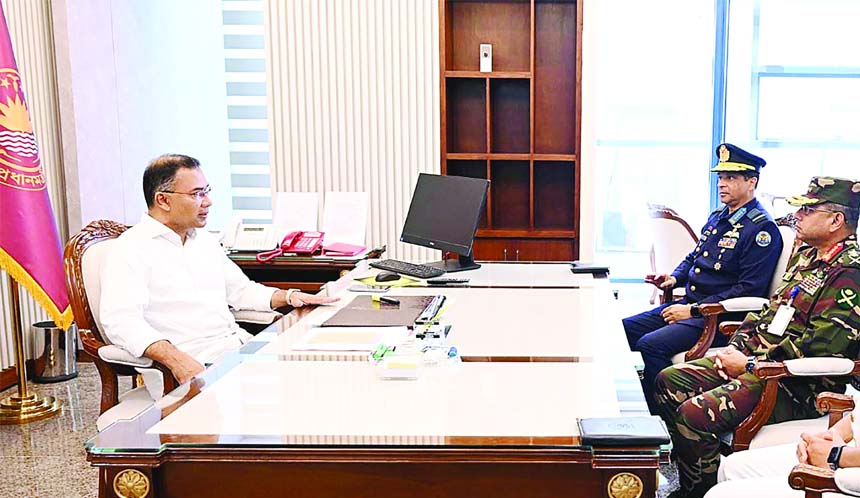
The chiefs of Bangladesh’s three armed services paid a courtesy call on Prime Minister Tarique Rahman at the Bangladesh Secretariat on Thursday, marking one of the first high-level institutional engagements of the new administration.
Chief of Army Staff General Waker-Uz-Zaman, Chief of Naval Staff Admiral M Nazmul Hassan, and Chief of Air Staff Air Chief Marshal Hasan Mahmood Khan met the prime minister at the Cabinet Division office during his second day at work.
The meeting was described as a courtesy call and was disclosed in a post on the verified Facebook page of the Bangladesh Nationalist Party (BNP), which formed the government after securing a landslide victory in the 13th National Parliamentary Election held on 12 February.
Tarique was sworn in as prime minister on Tuesday (17 February), alongside members of his new cabinet.
On Wednesday afternoon, he chaired the first meeting of cabinet members and advisers at the Secretariat, where the government outlined its initial governing priorities.
According to officials, the administration has set three immediate goals: bringing commodity prices under control, improving the law and order situation, and ensuring
a stable supply of electricity and fuel.
The early emphasis reflects mounting public concern over inflationary pressures, sporadic power disruptions, and security challenges in parts of the country.
Thursday’s meeting between the prime minister and the three service chiefs comes at a pivotal moment as the new government seeks to establish working relationships across key state institutions.
While the armed forces in Bangladesh traditionally operate under civilian authority, such early interactions are often viewed as significant in setting the tone for coordination on national security, disaster response, and strategic policy matters.
No detailed statement was issued regarding the substance of the discussions. However, observers note that the engagement signals continuity in civil-military communication during the transition to the new administration.
The BNP’s sweeping electoral mandate has ushered in a new phase in the country’s political landscape.
As the government moves to translate campaign pledges into policy, maintaining institutional stability and reinforcing coordination between civilian leadership and the security establishment is expected to remain central to its agenda.