
Oath dispute casts early shadow on referendum
Abu Jakir :
The 13th Parliament began its journey on Tuesday not with legislative momentum but with a constitutional controversy, as the ruling Bangladesh Nationalist Party (BNP) declined to take the oath as members of the Constitution Reform Council—despite provisions in the July Charter and a referendum mandate requiring it.
The decision has triggered sharp criticism from opposition parties and raised questions about the trajectory of the country’s promised reform process.
At the oath-taking ceremony inside the National Parliament complex on Tuesday (17 February), BNP lawmakers were sworn in as Members of Parliament by Chief Election Commissioner A.M.M. Nasir Uddin. However, they did not take the second oath as members of the Constitution Reform Council.
In contrast, lawmakers from Bangladesh Jamaat-e-Islami-led 11-party alliance and the youth-led National
Citizen Party (NCP) took both oaths, as stipulated in the July Charter.
The controversy centers on Article 8 of the July National Charter (Constitution Reform) Implementation Order, 2025, which clearly states that after taking the oath as Members of Parliament, elected representatives “shall, in the same oath-taking ceremony,” take the oath as members of the Council in the prescribed form.
The same authority administering the parliamentary oath is mandated to administer the Council oath.
According to Jamaat-e-Islami Ameer Shafiqur Rahman, the Parliament Secretariat’s official invitation letter mentioned two oaths: one as MPs and another based on the July Charter and the referendum proclamation.
“We came prepared to take both oaths,” he told journalists after the ceremony and a subsequent parliamentary party meeting. “If we had any concerns, we would have raised them earlier.
Despite differences in thought, we felt it was our sacred duty to respect the aspirations of July and the referendum verdict.”
Rahman argued that by abstaining from the Council oath, the government party had “ignored and undermined July,” placing itself in opposition to public aspirations. He framed the issue not as a partisan dispute but as one of democratic principle.
The July referendum had endorsed constitutional reform with a majority ‘Yes’ vote, and Article 7(1) of the Constitution recognizes that all power in the Republic belongs to the people. “The people have spoken in favor of reform,” he said. “To disregard that is to disregard sovereignty itself.”
The July uprising—during which at least 1,400 people were killed and thousands injured—was widely described as a mass mobilization against authoritarian governance and in favor of structural reform.
For many reformist parties, the Constitution Reform Council is not merely procedural but symbolic: a bridge between the uprising’s sacrifices and institutional transformation.
Criticism was swift and sharp. Sarjis Alam, northern chief organizer of the NCP and a defeated candidate from the 11-party alliance, wrote on Facebook that the BNP government had begun its journey by “betraying the July Charter and the aspirations of the uprising.”
His remarks reflected growing frustration among youth-led and reform-oriented groups who had seen the Charter as a binding political commitment.
Similarly, Maulana Gazi Ataur Rahman, joint secretary general of Islami Andolan Bangladesh, noted in a statement that Article 8 and Article 9 of the July Charter explicitly require the oath to be taken in the same ceremony before the same authority. “Regardless of past legal debates, all parties—including the BNP—signed the Charter,” he said.
“The referendum was held on that basis, and the people endorsed it.” He warned that ignoring the Council oath risks undermining the very democratic transition the election was meant to consolidate.
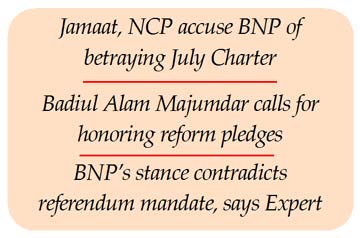
Political analyst Badiul Alam Majumdar, who previously led the Election System Reform Commission under the interim government and is now a member of the National Consensus Commission, has emphasized in past commentary that reform commitments must be implemented in both letter and spirit to sustain public trust. While he has not issued a formal statement on this specific episode, observers say the dispute underscores the fragility of consensus politics in a deeply polarized landscape.
Hasnat Kaiyum, President of the State Reform Movement and a Supreme Court lawyer, expressed concern over the current political trajectory in Bangladesh.
“At this stage, it is once again clear that the constitution lies at the heart of our national crisis.
The central question now is how the new political reality, forged after the mass uprising, can be stabilized within a sustainable constitutional framework,” he said.
He criticized political parties for interpreting the constitution through the lens of party interests and strategic advantage, which has intensified division rather than fostering fundamental consensus.
“From the beginning, BNP has viewed the current situation through the continuity of the 1972 Constitution. Their analysis emphasizes the need for a strong, centralized authority to run the state.
They believe executive power cannot be weakened if stability is to be maintained, reflecting a concern for bureaucratic continuity,” he explained.
Commenting on the differing oath positions on Parliament’s first day, Kaiyum described it as symbolic—a warning rather than an obstacle.
“After such a major political change, if parties fail to cultivate a culture of consensus, the people’s aspirations risk being thwarted,” he added.
From the BNP’s perspective, however, the move may reflect legal caution or strategic sequencing.
Salahuddin Ahmed, a member of Bangladesh Nationalist Party (BNP)’s standing committee and the party’s newly elected Member of Parliament (MP) from Cox’s Bazar-1, said, “We are committed and pledged to implement the July National Charter exactly as it was signed as a document of political consensus.”
He made the remarks to journalists on Tuesday, shortly after 12:30?pm, following the first meeting of BNP’s parliamentary party at the Jatiya Sangsad Bhaban. The meeting took place after BNP’s newly elected MPs had taken their oath as members of parliament.
The meeting was presided over by BNP Chairman Tarique Rahman. By unanimous decision, Tarique Rahman was elected as the parliamentary party leader and the prime minister.
Salahuddin Ahmed told reporters that during the meeting, Tarique Rahman issued two directives for the party’s MPs, no MP should accept duty-free car facilities, and no MP should take government plots.
The BNP leader added, “Change starts from today. Being an MP in this country no longer means they will be more equal than everyone else.”
BNP’s newly elected MPs did not take the oath as members of the constitutional reform council.
On the reason for not taking this oath, Salahuddin Ahmed said that to reflect the people’s will as expressed in the referendum, they must first go to the parliament. In parliament, necessary laws and constitutional amendments must be enacted.
Salahuddin Ahmed also remarked that under the existing constitution, the chief election commissioner (CEC) has no authority to administer the oath of the constitutional reform council members.
The CEC did not approach them to administer their oath as members of the constitutional reform council, and they did not take the oath,” he said.