US, Iran to hold 2nd round of nuclear talks in Geneva

AP :
The United States and Iran are set to convene a second round of negotiations over Tehran’s nuclear program on Tuesday in Geneva, amid heightened US military deployments in the Middle East and ongoing large-scale Iranian naval exercises.
US President Donald Trump has repeatedly warned that Washington could resort to military action if Iran refuses to curb its nuclear activities.
Tehran has responded that it would retaliate against any such move. Trump has also criticized Iran over its deadly suppression of recent nationwide protests.
The initial round of discussions took place on Feb. 6 in Oman and were conducted indirectly.
Vehicles bearing US flags entered the palace venue only after Iranian officials had apparently departed. Details about the format of Tuesday’s meeting have not been disclosed.
Trump’s envoys Steve Witkoff and Jared Kushner are traveling for the talks.
US Secretary of State Marco Rubio, speaking during a visit to Budapest, said Washington remains hopeful about reaching an agreement despite challenges.
“I’m not going to prejudge these talks,” Rubio said, adding that the president prefers diplomatic solutions.
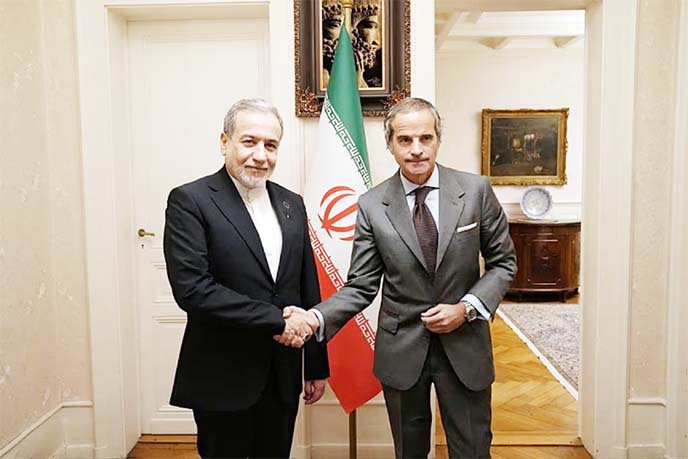
Iran’s Foreign Minister Abbas Araghchi, who is leading Tehran’s delegation, met Monday in Geneva with the head of the UN nuclear watchdog.
Writing on X, Araghchi said he had arrived “with real ideas to achieve a fair and equitable deal,” while emphasizing that Iran would not yield to threats.
Speaking to reporters aboard Air Force One en route to Washington, Trump said he would be involved in the negotiations indirectly and described them as crucial.
He characterized Iran as a tough negotiating partner and expressed hope that Tehran would take a more reasonable approach, adding that he believes Iran wants to avoid the consequences of failing to secure a deal.
Meanwhile, the US is also hosting discussions in Geneva between Russian and Ukrainian envoys ahead of the fourth anniversary of Russia’s full-scale invasion of Ukraine.
Iran is marking 40 days since one of the deadliest episodes in last month’s protest crackdown, in line with the traditional Muslim mourning period.
Activists say at least 7,015 people were killed, many during a violent overnight operation between Jan. 8 and 9.
The US-based Human Rights Activists News Agency reported the latest figures, though The Associated Press has been unable to independently verify the toll due to internet and communication restrictions in Iran.
State media said authorities would hold a memorial ceremony at the Grand Mosalla mosque in Tehran and blamed the unrest on armed groups allegedly backed by foreign intelligence services.
Iran said its paramilitary Revolutionary Guard launched exercises early Monday in the Strait of Hormuz, the Persian Gulf and the Gulf of Oman — key global shipping routes through which about 20% of the world’s oil supply passes.
Security firm EOS Risk Group reported that mariners received warnings about a potential live-fire drill in Iranian waters of the Strait of Hormuz on Tuesday.
Iranian state television did not confirm the live-fire element.
Last week, Trump announced that the USS Gerald R. Ford aircraft carrier would be redeployed to the Middle East, joining the USS Abraham Lincoln and accompanying destroyers already stationed there.
US forces recently shot down an Iranian drone that approached the Lincoln, on the same day Iran attempted to halt a US-flagged vessel in the Strait of Hormuz.
Gulf Arab states have cautioned that any escalation could trigger a broader regional conflict, as tensions remain high following the Israel-Hamas war in Gaza.
The Trump administration is seeking to limit Iran’s nuclear activities and ensure it does not develop nuclear weapons.
Tehran maintains its program is peaceful and has resisted calls to halt uranium enrichment or surrender its uranium stockpile.
Iran’s Deputy Foreign Minister Majid Takht-Ravanchi indicated Tehran may consider compromise but stressed that any agreement must include relief from US-led sanctions.
“The ball is in America’s court,” he told the BBC, saying progress would depend on Washington demonstrating sincerity.
Earlier negotiations were derailed in June after Israel launched a 12-day war against Iran.
During the conflict, the US targeted Iranian nuclear facilities, likely damaging centrifuges enriching uranium to near weapons-grade levels, while Israeli strikes weakened Iran’s air defenses and missile capabilities.
Before the June conflict, Iran had enriched uranium to 60% purity, a level close to weapons-grade, though it continues to insist its nuclear program is solely for civilian purposes.