
Post-poll Briefing: National interest first in foreign policy
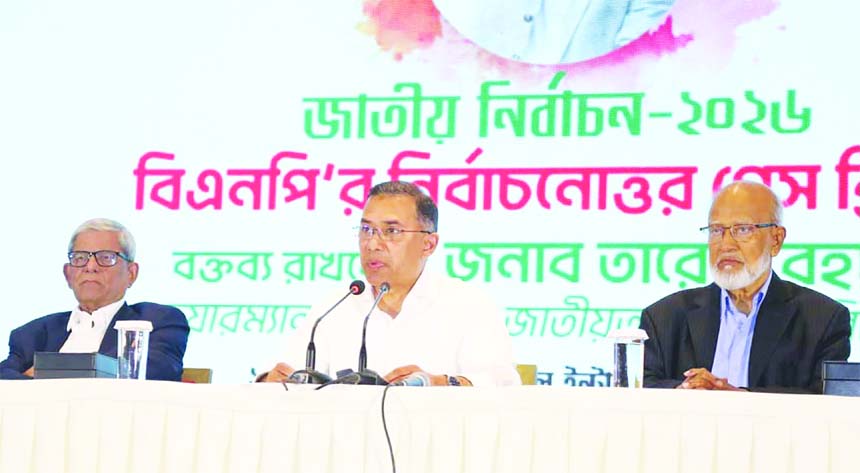
Staff Reporter :
BNP chairman Tarique Rahman has said Bangladesh’s foreign policy under a BNP-led government will be determined solely by the interests of the country and its people, signaling what he described as a balanced and non-aligned diplomatic approach following his party’s landslide victory in the 13th parliamentary election.
Speaking at a post-election press conference at Hotel InterContinental in the capital, the BNP chairman faced questions from domestic and international journalists on foreign policy, relations with India, the International Crimes Tribunal (ICT), economic reform and governance challenges.
“Regarding foreign policy, we have already made our position clear—Bangladesh and the people of Bangladesh come first,” Tarique Rahman said in response to a question from an Indian journalist about his plans for India-Bangladesh relations and whether ICT verdicts would be reviewed.
“By protecting the interests of Bangladesh and its people, we will determine our foreign policy,” he added.
Reinforcing that position, BNP Standing Committee member Amir Khosru Mahmud Chowdhury said the party does not believe in allegiance to any single country.
“Bangladesh’s foreign policy will be based on mutual respect, equality and trust. It will not be centered on any specific country,” he said.
On the ICT, Amir Khosru said the matter falls within the jurisdiction of the judiciary, indicating that the executive would not interfere in judicial decisions.
Tarique Rahman’s remarks came two days after the BNP secured more than a two-thirds majority in Thursday’s polls, clearing the way for government formation under his leadership.
He described the election as a restoration of democracy after what he termed years of authoritarian rule.
“The victory belongs to Bangladesh, the victory belongs to democracy,” he said, calling on all political parties to unite in rebuilding the country.
When asked by Khaled Mohiuddin of the New York-based Thikana about his earlier claim that the election would not be easy for the BNP—and whether any “engineering” had been required to secure more than 200 seats—Rahman rejected the suggestion of manipulation.
“Convincing the people is our engineering,” he said. “Bringing the people to our side was our engineering. Alhamdulillah, we have succeeded in that.”
He acknowledged that creating a fair and peaceful electoral environment was challenging. “To achieve any good goal, hard work is necessary. It is never easy,” he said.
Questions on foreign relations continued, including from a journalist of The Independent in the UK, who asked how a BNP government would balance ties with India, Pakistan and China, and whether corruption cases involving former Prime Minister Sheikh Hasina and her niece Tulip Siddiq would be pursued.
Amir Khosru reiterated that BNP’s foreign policy would apply equally to all countries, guided by mutual interest and non-interference.
On legal cases, BNP leaders indicated that judicial processes would proceed according to law.
Responding to a journalist from Al Jazeera about the main challenges facing the incoming government, Tarique Rahman identified the fragile economy, deteriorating law and order, and institutional politicization as key concerns.
“The previous government politicized almost all institutions,” he said. “We must ensure good governance and restore professionalism.”
On economic reform, Rahman referred to BNP’s manifesto and its 31-point reform program, highlighting the concept of a “democratic economy.”
He said the party aims to dismantle oligarchic structures and create equal opportunities for all.
“We want an economy where business and trade are conducted according to merit and qualification. We do not want to give long-term special advantages to any specific group,” he said.
Addressing concerns about post-election unrest, Rahman called on party leaders and activists to remain peaceful and vigilant.
He said he had instructed BNP members not to organize victory processions despite their decisive mandate, to prevent any untoward incidents.
“Peace and order must be maintained at any cost,” he said. “The law is equal for everyone. We will not tolerate injustice or illegal activities, regardless of party or opinion.”
He also paid tribute to those who sacrificed their lives in democratic movements from 1971 to recent years, and recalled the role of the late Khaleda Zia in opposing autocracy.
Thanking the interim government, Election Commission, law enforcement agencies and both local and foreign observers, Rahman described the election as peaceful, free and fair.