BADC strengthens efficient irrigation management across BD

National Desk ;
To build an efficient irrigation management system, the Bangladesh Agricultural Development Corporation (BADC) has been playing a vital role in Bangladesh. Bangladesh is primarily an agriculture-based country, and agriculture remains the main driving force of its economy.
Even today, nearly half of the population depends directly on agriculture for their livelihood, while every citizen is indirectly connected to the sector. Therefore, overall national development is not possible without agricultural advancement.
With the aim of bringing fundamental changes to agricultural management, BADC began its journey in 1961. Its objective was to ensure the supply of essential agricultural inputs-such as quality seeds of various crops, balanced fertilizers, and the optimum use of surface and groundwater irrigation-at farmers’ doorsteps. Under the supervision of the Ministry of Agriculture, BADC has been effectively carrying out these responsibilities and has become a leading public institution for the development of agriculture and farmers.
BADC’s role in developing efficient irrigation management is undeniable. In the 1960s, irrigation activities began with only 1,555 power-operated pumps using surface water. Later, 102 deep tube wells were installed in 1967-68 and 1,998 shallow tube wells in 1973-74, expanding the use of both groundwater and surface water.
Since then, various irrigation programs have continued uninterrupted according to farmers’ demands.
In the 2024-25 irrigation season, irrigation facilities were provided to 7.26 lakh hectares of land across the country through BADC initiatives.
Currently, two types of irrigation systems are in operation-minor irrigation (covering 95pc of irrigated land) and major irrigation (5pc). Of the total irrigated land, 27.99pc uses surface water and 72.01pc relies on groundwater (BADC Minor Irrigation Survey Report 2024-25).
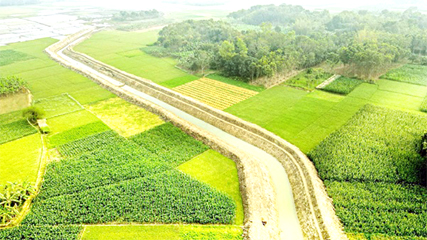
BADC’s irrigation management activities include canal re-excavation; construction of surface and underground irrigation channels (buried pipes); irrigation infrastructure development; crop protection embankments; installation and rehabilitation of deep and shallow tube wells; solar-powered irrigation pumps; dug wells; and rubber dams.
Over the past decade, BADC has re-excavated approximately 13,665 km of canals, constructed 14,637 km of underground irrigation channels and 3,610 km of surface channels, built 321 km of crop protection embankments, developed 14,260 irrigation infrastructures, installed or rehabilitated nearly 14,000 deep and shallow tube wells, and set up thousands of power-operated and solar irrigation pumps, along with rubber dams and other facilities.
To monitor groundwater levels, 400 groundwater monitoring data loggers have been installed in different upazilas, and a groundwater zoning map has been prepared to ensure sustainable water use and proper water resource management.
Through efficient irrigation management, BADC works to prevent water wastage, increase crop production, and reduce irrigation costs. To discourage excessive groundwater extraction and promote sustainable use, the “Groundwater Management Act 2018” was approved. In line with government plans such as the SDGs and the Delta Plan, BADC continues to adopt innovative initiatives. By 2030, it aims to increase irrigation efficiency from 38pc to 40pc, raise surface water use to 30pc, and reduce groundwater use to 70pc
As cultivable land continues to decrease and food demand rises with population growth, sustainable and profitable agriculture has become essential. Safe and efficient irrigation management is one of the key factors in achieving this goal. In this regard, BADC’s Irrigation Wing remains closely involved in delivering timely and effective irrigation services to farmers nationwide. Through efficient irrigation management, BADC’s contribution to supporting farmers and strengthening agricultural production remains unique and commendable.